

In today’s competitive engineering landscape, product reliability isn’t just a technical concern—it’s a business priority. Unplanned downtime, repair costs, and warranty claims can severely impact customer satisfaction and profitability. One of the most effective ways to assess and improve reliability is through MTBF analysis.
MTBF, or Mean Time Between Failures, is a standard metric used to estimate how long a product or system will operate before it experiences a failure. By performing MTBF analysis early in the design and development cycle, companies can proactively identify weak points, select better components, and improve the overall quality of their products.
In this guide, we’ll walk through the essentials of MTBF analysis, including:
- What MTBF means
- How MTBF is calculated
- The benefits of MTBF analysis
- Analytical methods and tools
- Industry standards used
- Practical use cases
- Limitations and best practices
Whether you’re a product designer, reliability engineer, or manufacturer, this post will help you understand how MTBF analysis contributes to long-term performance and customer satisfaction.
What is MTBF?
Mean Time Between Failures (MTBF) is a key metric used in reliability engineering to predict the average operational time between failures for repairable systems. It represents a statistical average—not a guaranteed time based on either historical data or predictive models.
Basic MTBF Formula
MTBF=Total Operating TimeNumber of Failures\text{MTBF} = \frac{\text{Total Operating Time}}{\text{Number of Failures}}MTBF=Number of FailuresTotal Operating TimeFor example, if a piece of equipment runs for 10,000 hours and experiences 4 failures, the MTBF is:
10,0004=2,500 hours\frac{10,000}{4} = 2,500 \text{ hours}410,000=2,500 hoursThis means, on average, a failure is expected every 2,500 hours under similar conditions.
Why is MTBF Analysis Important?
MTBF analysis goes beyond simple failure statistics it’s a forward-looking reliability tool that helps engineers and decision-makers:
- Identify weak components early
- Support risk-based design improvements
- Estimate maintenance intervals
- Justify quality or redundancy investments
- Ensure compliance with industry reliability standards
When used properly, MTBF analysis enables smarter engineering decisions that result in longer product lifespans and lower total cost of ownership.
How is MTBF Analysis Performed?
There are two primary methods used to perform MTBF analysis:
1. Empirical MTBF Analysis
This method uses real-world operational data from products already in the field. It’s most accurate when enough time and data have been collected to reflect actual usage conditions.
Example:
If a telecom company monitors 1,000 routers over 1 year and records 100 failures, they can calculate the empirical MTBF based on the accumulated uptime and number of failures.
Pros:
- Accurate and realistic
- Reflects environmental factors
Cons:
- Requires long-term data
- Not usable for new products
2. Analytical MTBF Prediction
Analytical methods estimate MTBF based on design details, component selection, and environmental stress factors. These calculations follow standardized models like:
- Telcordia SR-332
- MIL-HDBK-217F
- FIDES Guide
- IEC TR 62380 / 61709
Using these standards, engineers can predict MTBF before a product is even manufactured.
Pros:
- Useful during design phase
- No failure data required
Cons:
- Based on assumptions
- May not reflect actual usage
MTBF Analysis Tools and Software
To simplify MTBF analysis, engineers often rely on specialized tools and platforms. At Relteck, we specialize in providing custom MTBF calculations, PCB reliability assessments, and predictive modeling for clients across various industries.
Here are some commonly used MTBF analysis tools:
1. Online MTBF Calculators
Simple web-based platforms that use Telcordia or MIL-HDBK models to estimate MTBF based on parts list and environment.
2. Reliability Prediction Software
Advanced software like ReliaSoft Lambda Predict, BQR fiXtress, and Ptc Windchill allows detailed simulations, temperature modeling, and system-level reliability forecasts.
3. In-House Tools
Many engineering teams build their own tools using Excel or Python scripts, especially when they have custom requirements.
Relteck’s upcoming MTBF analysis solution will integrate standard calculations with PCB-level analysis and component-specific failure data watch our website for updates.
What Goes Into an MTBF Analysis?
MTBF analysis depends on accurate, detailed input. Key elements include:
- Component failure rates from recognized databases
- Operating environment (temperature, humidity, vibration)
- Electrical stress factors like over-voltage or under-load
- Duty cycle/load profile (continuous vs. intermittent operation)
- System configuration including redundancy and safety margins
- Quality level of components and suppliers
Inaccurate inputs can lead to misleading MTBF results, which is why expert oversight and data validation are crucial.
MTBF vs. MTTF vs. FIT
MTBF is often confused with similar metrics. Let’s break them down:
TermFull FormUse CaseMTBFMean Time Between FailuresRepairable systemsMTTFMean Time To FailureNon-repairable items (e.g., LEDs)FITFailures in Time (failures per billion hours)Semiconductor devices
Example:
A hard drive (repairable) might have an MTBF of 1,200,000 hours, while a resistor (non-repairable) might have an MTTF of 200,000 hours.
Industry Use Cases for MTBF Analysis
1. Telecommunications Equipment
Predicting MTBF ensures network uptime and helps in service-level agreements (SLAs). Telcordia SR-332 is the preferred standard in this domain.
2. Industrial Automation
Machinery and control boards must be reliable under extreme conditions. MTBF analysis supports predictive maintenance schedules and safety planning.
3. Aerospace & Defense
Military systems demand high reliability. MIL-HDBK-217F and FIDES are widely used here to forecast failures in mission-critical applications.
4. Consumer Electronics
Short product lifecycles make predictive reliability crucial. MTBF analysis helps balance performance with warranty cost control.
Limitations of MTBF Analysis
While MTBF is a powerful indicator, it’s not a perfect measure of product reliability. Some common limitations include:
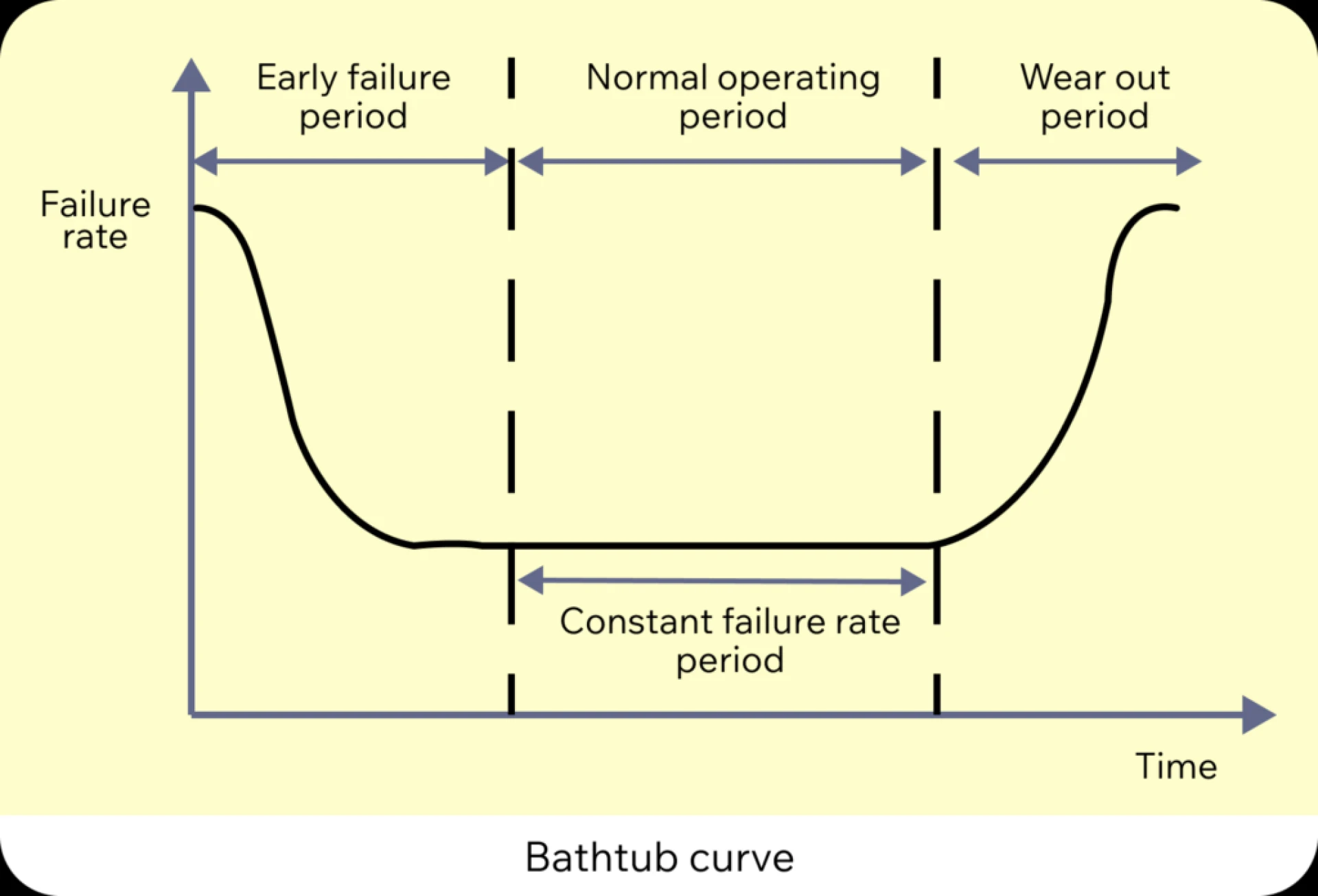
- Assumes constant failure rate (doesn’t model early-life or wear-out failures)
- Doesn’t predict individual failures
- Requires standardized input assumptions
- Ignores software failures or human error
- Can be misunderstood if used without proper context
Complementing MTBF analysis with tools like FMEA, Weibull analysis, and HALT testing creates a more complete reliability strategy.
Best Practices for Accurate MTBF Analysis
- Use Appropriate Standards
- Choose the right reliability standard (e.g., Telcordia for telecom, MIL-HDBK for defense) for your application.
- Validate Input Data
- Ensure accuracy of component specs, operating profiles, and failure rates.
- Update Regularly
- Revisit MTBF predictions when designs or operating conditions change.
- Cross-Check with Field Data
- Use empirical failure data to validate or refine your analytical MTBF results.
- Consult Experts
- Partner with reliability engineering professionals like Relteck to ensure valid and actionable results.
How Relteck Simplifies MTBF Analysis
At Relteck, we make MTBF analysis practical, accurate, and accessible. Our services include:
- Standards-based MTBF predictions (Telcordia, MIL-HDBK, FIDES)
- PCB-level reliability analysis for harsh environments
- Custom reporting for design validation and compliance
- Expert consulting for telecom, industrial, and defense applications
Whether you're developing a new product or improving an existing one, we help you make better, data-driven reliability decisions.
Conclusion
MTBF analysis is more than just a formula it’s a strategic tool that helps teams design better products, reduce failure rates, and enhance customer trust. Whether you use empirical data, analytical models, or hybrid approaches, a solid understanding of MTBF empowers you to build more reliable systems.
With trusted tools, validated standards, and expert support from Relteck you can transform reliability from a challenge into a competitive advantage.

























Sign in to leave a comment.