
Why the NBFC Software Decision Matters More Than Ever in 2026
India's Non-Banking Financial Companies are operating in the most tightly supervised environment the sector has seen in a decade. On November 28, 2025, the Reserve Bank of India consolidated its instructions into 238 Master Directions, including a dedicated NBFC-specific KYC Master Direction that replaced the 2016 framework NBFCs had relied on for years. Liquidity Coverage Ratio norms for deposit-taking and systemically important NBFCs have been phased in since April 2025, the 90-day NPA classification rule reached full effect for Base Layer entities in March 2026, and the Digital Personal Data Protection Act rules notified in 2025 now layer fresh data-governance obligations onto every digital lending workflow, including Video KYC.
None of this is optional reading for a lending business. It is the operating reality that your loan origination system, loan management system, collections engine and compliance stack must be built for on day one. An NBFC that is still running spreadsheets, disconnected point tools, or software that has not kept pace with the Scale-Based Regulation (SBR) framework is not just inefficient — it is exposed. Missed XBRL filings, an outdated KYC taxonomy, or a manual CRAR calculation are the kinds of gaps that trigger RBI show-cause notices, not just internal audit findings.
This guide is written for founders, CXOs, compliance heads and technology leaders inside NBFCs, digital lenders and Loan Service Providers who are evaluating software in 2026 — whether that means replacing a legacy system, building a first tech stack from scratch, or adding modules (collections, credit risk analytics, early warning systems) to what they already run. We will walk through what NBFC software actually consists of, the features that matter this year specifically, how to compare vendors, what it should cost, and the questions to ask before you sign a contract.
What Exactly Is 'NBFC Software'?
'NBFC software' is an umbrella term that, in practice, covers several distinct systems that together form a lender's technology backbone. Understanding these categories is the first step to buying correctly, because many vendors sell only one piece while marketing it as a complete solution.
Loan Origination System (LOS)
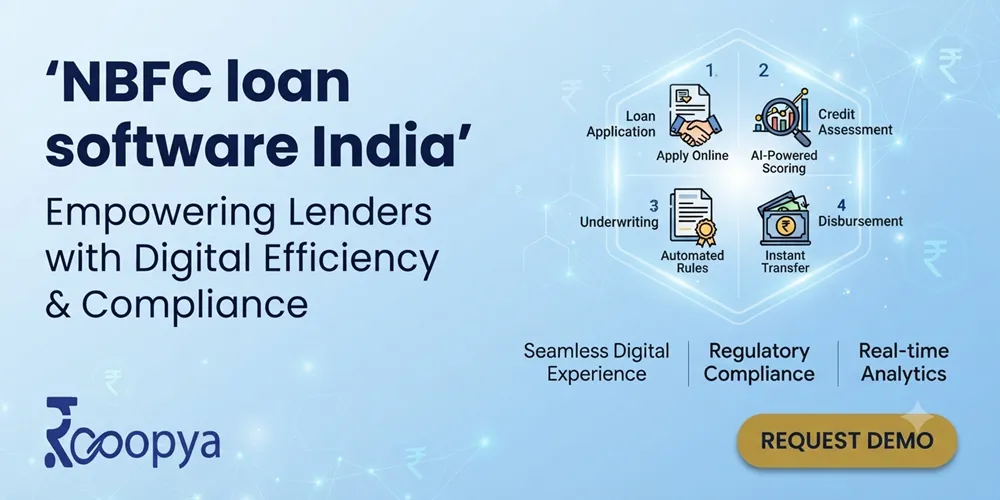
The LOS is the customer-facing and underwriting engine: digital application forms, document collection and verification, KYC and AML checks, credit bureau pulls, automated scoring, and the decisioning workflow that takes an applicant from lead to disbursed loan. A modern LOS should support configurable journeys for multiple loan products — personal, business, gold, payday, vehicle and home loans typically demand different data fields, document sets and approval logic.
Loan Management System (LMS)
Once a loan is disbursed, the LMS takes over: amortization schedules, repayment tracking, payment gateway reconciliation, restructuring, foreclosure, statement generation and the customer portal. This is the system of record for your entire live book, and it is the one place where errors compound fastest — a miscalculated schedule affects every subsequent payment.
Collections and Recovery
A dedicated collections module manages reminders, delinquency bucketing, field and tele-calling agent workflows, payment plans, and legal escalation. In 2026, RBI's continued scrutiny of Fair Practices Codes and third-party recovery agent conduct makes an auditable, policy-driven collections workflow a compliance requirement, not just an efficiency feature.
Credit Risk Analytics and Scorecards
This layer covers application and behavioural scorecard development, Probability of Default (PD), Exposure at Default (EAD) and Loss Given Default (LGD) modelling, Expected Credit Loss (ECL) calculation under Ind AS 109, pricing analytics, and model validation and stress testing. Larger and Upper Layer NBFCs are expected by RBI to demonstrate mature, back-tested risk models rather than static bureau-score cut-offs.
Early Warning Systems (EWS)
An EWS uses behavioural and transactional signals to flag accounts likely to default before they actually slip into arrears, feeding intervention workflows that can meaningfully reduce write-offs.
Compliance and Regulatory Reporting
This is the layer that connects your operational data to RBI's COSMOS portal and XBRL returns — NBS-6, NBS-7, NBS-9, DNBS periodic returns, CRAR and NOF reporting, CTR submission to FIU-IND, and CIC reporting. Middle and Upper Layer NBFCs are increasingly expected to run this through dedicated compliance management software rather than spreadsheets, particularly since the XBRL taxonomy changes at the start of most financial years and filing against an outdated taxonomy is a common — and entirely avoidable — cause of rejected returns.
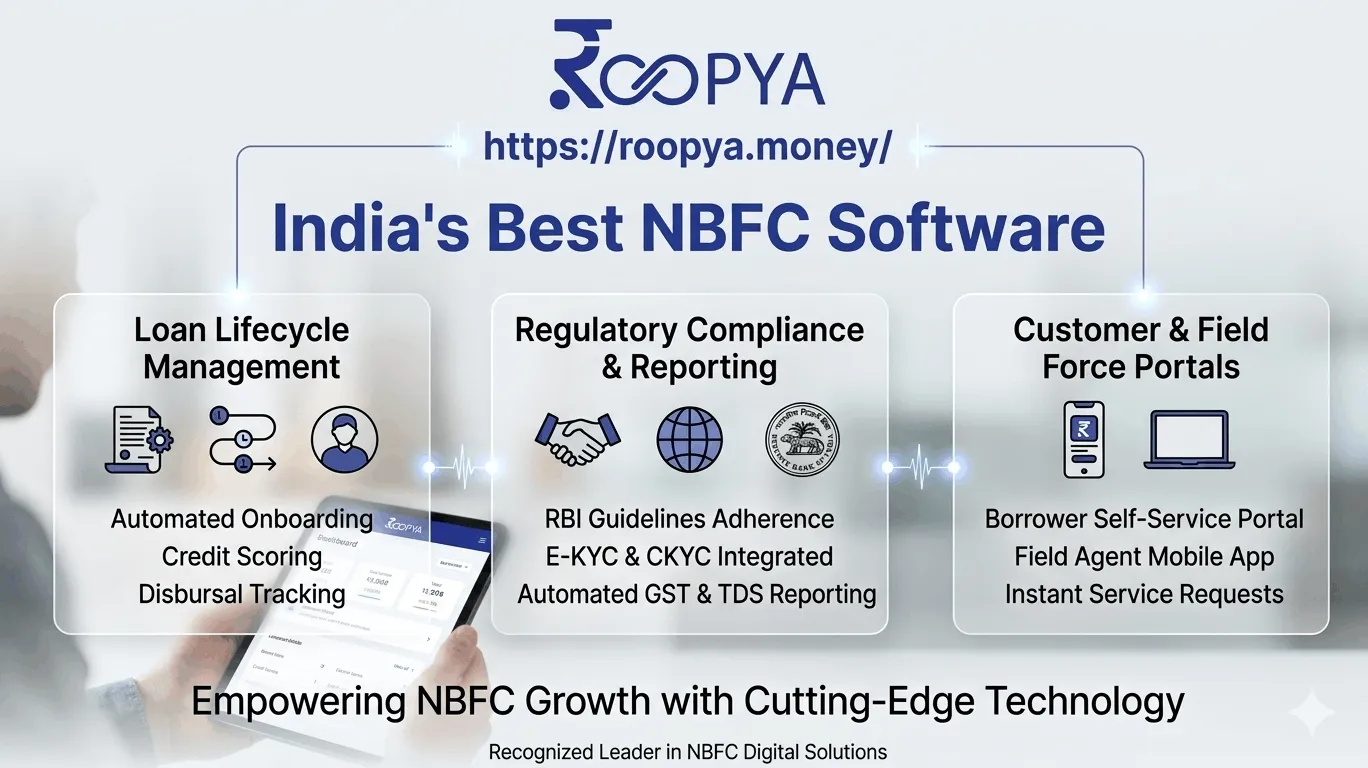
Some vendors, including Roopya, bring origination, servicing, collections, analytics and compliance-relevant reporting together as a unified, no-code lending infrastructure rather than as separate point products that need to be integrated after the fact. Whether you buy that as one platform or assemble it from specialists is one of the central decisions this guide will help you make.
The 2026 Regulatory Backdrop You Are Buying Against
Software decisions made without reference to the current regulatory environment age badly within a year. Four developments should directly shape your evaluation criteria in 2026:
- Scale-Based Regulation (SBR): Since October 2022, RBI classifies NBFCs into Base, Middle, Upper and Top Layers, with obligations that scale up sharply as you move layers. Your software must be able to grow with you into more demanding governance, capital and reporting requirements without a rebuild.
- Consolidated KYC Master Directions: The dedicated NBFC KYC Direction issued in November 2025 replaces the 2016 rulebook. Periodic KYC updation cycles (two years for high-risk, eight for medium-risk, ten for low-risk customers), event-triggered re-KYC, and Video Customer Identification Process (V-CIP) with active liveness detection are now baseline expectations, not advanced features.
- Digital Personal Data Protection Act (DPDP): Rules notified in 2025 add explicit data-governance obligations on top of RBI's requirements, particularly around consent, storage and V-CIP sessions. Software that stores customer data without clear consent trails and access controls is now a two-fold compliance risk.
- NPA glide path and LCR: The 90-day NPA classification rule took full effect for Base Layer entities in March 2026, and Liquidity Coverage Ratio norms have been phasing in for deposit-taking and systemically important NBFCs since April 2025. Your LMS and reporting layer need to classify and report against these thresholds automatically, not through manual reconciliation at quarter-end.
The practical implication: ask every vendor how quickly their platform was updated the last time RBI changed a Master Direction or the XBRL taxonomy. A vendor's release history on regulatory changes is a better predictor of future reliability than any feature demo.
Core Features to Evaluate in an NBFC Software Platform
Feature checklists are easy to pad and hard to use. The list below is organised by the outcome each capability is meant to protect — compliance, speed, risk quality, cost and continuity — because that is how you should be scoring vendors.
1. Regulatory and Compliance Readiness
- Board-approved Customer Acceptance Policy (CAP) configurability, including risk-tier classification and enhanced due diligence workflows for high-risk customers
- Support for the full Officially Valid Document (OVD) list — Aadhaar, passport, driving licence, voter ID, NREGA job card, and National Population Register letter
- Video KYC (V-CIP) with active liveness detection to prevent deepfake or pre-recorded submissions, with the customer's physical presence in India enforced
- Automated periodic and event-triggered re-KYC scheduling by risk tier
- COSMOS-ready XBRL generation for NBS returns, updated whenever RBI revises the taxonomy
- CRAR, NOF and NPA classification calculated automatically against current SBR thresholds
- Audit trails and consent logs aligned with DPDP Act requirements
2. Speed to Market and Configurability
- No-code or low-code journey and workflow builders so business teams can launch or modify loan products without engineering tickets
- Pre-configured templates for common products — personal, business/SME, gold, payday, vehicle and home loans — that can be customised rather than built from zero
- A visible, referenceable go-live timeline from similar-sized lenders, not just a marketing claim
3. Integration Depth
- Pre-built connections to credit bureaus (CIBIL, Experian, CRIF, Equifax), identity verification services, bank-statement analysis tools, and payment gateways
- Open REST APIs for connecting to your CRM, ERP, accounting system and any existing data warehouse
- An account aggregator (AA) framework integration for consented, real-time financial data access
4. Underwriting and Risk Intelligence
- A configurable Business Rule Engine (BRE) that credit and risk teams can adjust without vendor involvement
- Scorecard development and hosting for application and behavioural models, with support for PD, EAD, LGD and ECL calculation
- Alternative-data and AI-assisted scoring that supplements — not blindly replaces — bureau-based assessment, with explainability for audit and fair-lending review
- Model validation and stress-testing capability, which Upper Layer NBFCs will need to demonstrate to RBI
5. AI Capabilities Worth Scrutinising
AI is now standard vendor language, so evaluate specificity rather than the buzzword. Ask for a live demo, not a slide, of:
- Document OCR and fraud detection accuracy on real Indian documents (Aadhaar, PAN, bank statements, GST returns) — accuracy above 99% should be demonstrated, not just claimed
- How the BRE 'learns' from historical approvals and rejections, and what human oversight sits on top of it before any rule changes go live
- Whether natural-language reporting genuinely answers ad-hoc questions about the portfolio, or is limited to a fixed set of pre-built dashboards
6. Security, Data Residency and Continuity
- Data hosted within India, with encryption at rest and in transit
- Role-based access control and detailed audit logging on every customer record
- A documented disaster recovery plan and published uptime track record — ask for actual incident history, not just an SLA number
- Clear data portability terms: what happens to your data and configurations if you switch vendors later
7. Total Cost of Ownership
- Transparent pricing — flat licence, per-loan/per-transaction, or a hybrid — with no undisclosed implementation or integration fees
- Clarity on what happens to your monthly cost as loan volumes grow: does the platform reward scale, or does cost grow linearly with it
- The cost and lead time of adding a new loan product or a new API integration after go-live
Cloud SaaS, On-Premise, or Custom Build: Choosing Your Deployment Model
Most NBFCs in 2026 are choosing cloud-based SaaS lending platforms over custom-built or on-premise systems, and the reasons are structural rather than fashionable. Custom-built software puts the entire burden of tracking regulatory change onto your own engineering team — every KYC Master Direction update, every XBRL taxonomy revision, every LCR rule change becomes an internal project with its own timeline and risk of delay. On-premise deployments add infrastructure management and disaster-recovery responsibility on top of that.
A well-run SaaS platform, by contrast, ships regulatory updates to every customer simultaneously, usually well ahead of enforcement deadlines, and spreads the infrastructure and security cost across its customer base. The trade-off is dependence on the vendor's release discipline and support quality — which is precisely why the vendor evaluation questions later in this guide focus so heavily on regulatory responsiveness and support structure rather than only on feature lists.
| Factor | Cloud SaaS | On-Premise | Custom Build |
|---|---|---|---|
| Time to go live | Days to a few weeks | Several months | 6–18 months |
| Regulatory updates | Pushed by vendor | Manual, delayed | Fully your responsibility |
| Upfront cost | Low to none | High (infra + licence) | Very high (dev team) |
| Ongoing cost | Usage-based, predictable | Infra + maintenance | Engineering headcount |
| Customisation ceiling | High, via no-code config | High, via dev effort | Unlimited, but slow |
| Best fit | Most NBFCs, all layers | Large NBFCs with existing infra | Very large, highly differentiated lenders |
A Step-by-Step Framework for Choosing NBFC Software
- Map your loan products and volumes for the next 24 months, not just today. Software chosen for your current 500 loans a month should not need replacing at 5,000.
- Classify your current and expected SBR layer. A Base Layer NBFC planning to grow into the Middle Layer should buy software that already supports Middle Layer reporting, even if it is not required yet.
- List every existing system (CRM, accounting, bureau accounts, payment gateway) that the new platform must integrate with, and ask each shortlisted vendor to confirm integration status — pre-built, in progress, or not supported.
- Shortlist three to five vendors and request a live, hands-on demo using your own sample data and loan product, not the vendor's canned scenario.
- Ask for two to three reference customers of a similar size and loan type, and actually call them — ask specifically about regulatory update turnaround and support response times during an audit or filing deadline.
- Run a compliance stress-test question: 'Walk me through exactly what changed in your platform after the November 2025 KYC Master Directions, and how long it took.' A vendor's specific, dated answer here tells you more than any brochure.
- Negotiate a pilot or phased rollout — one loan product or one branch — before committing your entire book to a new LMS.
- Confirm data ownership, export formats and exit terms in writing before signing, regardless of how confident you are in the vendor today.
Red Flags to Watch For
- Vague answers on regulatory update cadence. If a vendor cannot tell you when and how they updated for the November 2025 KYC Directions or the March 2026 NPA glide path, assume they will be slow on the next one too.
- Point solutions marketed as 'complete platforms.' A strong LOS with no real LMS, or an LMS with bolt-on collections, often means costly integration work and data reconciliation gaps later.
- No transparent pricing. Pricing that only appears after multiple sales calls usually hides implementation costs that surface after you have committed internally.
- No live reference customers. Case studies are marketing; reference calls with existing customers of similar scale are due diligence.
- Locked-in data formats. If exporting your own loan book and customer data at the end of a contract requires the vendor's cooperation and custom scripting, you do not fully own your data.
Why NBFCs Are Evaluating Roopya
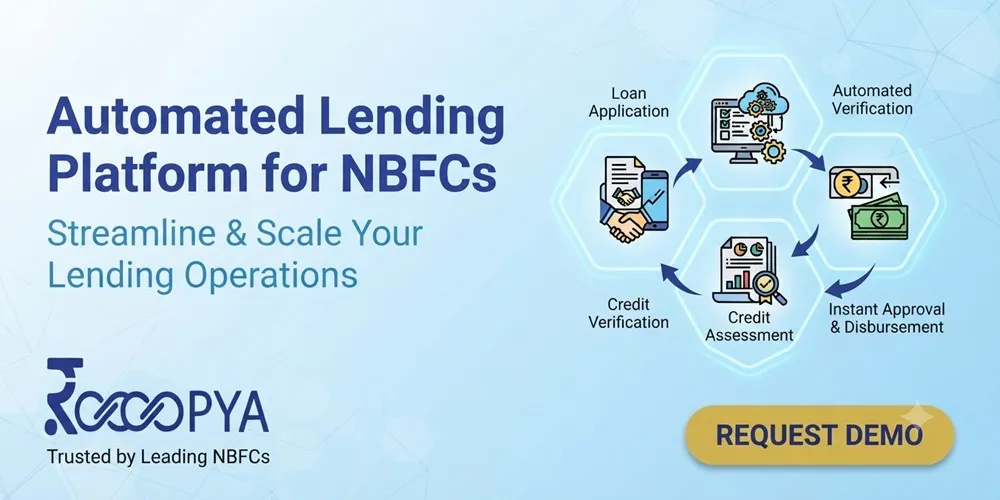
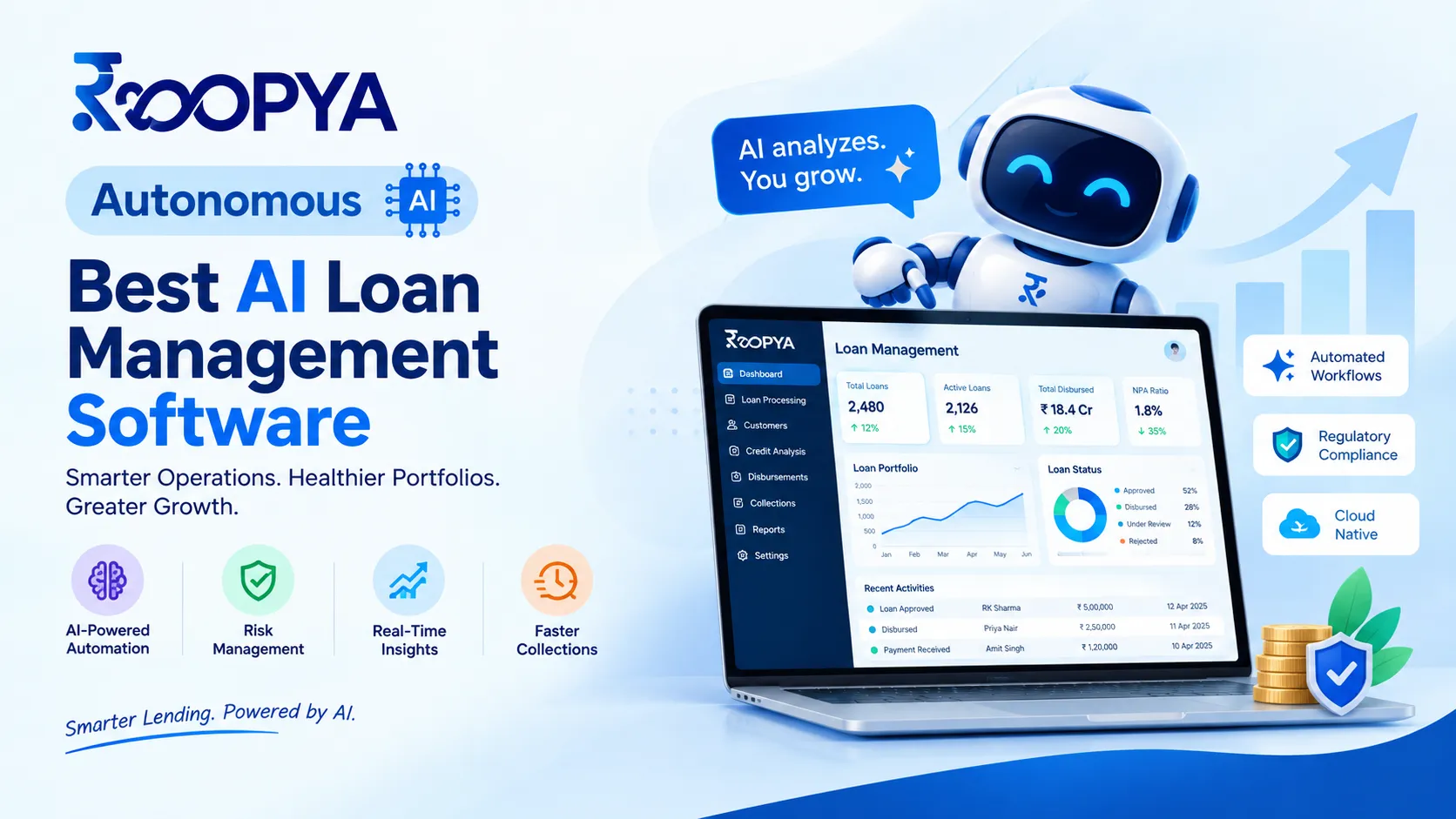
Roopya (by Geoalgo Technologies Private Limited) is built as a unified, no-code lending infrastructure that spans the full lifecycle a lender needs: loan origination, loan management, collections, early warning signals, and lending analytics, backed by over 300 pre-integrated APIs across credit bureaus, verification services and payment gateways, and 20+ pre-configured loan products spanning personal, business/SME, gold, payday, vehicle and home loans.
For NBFCs weighing the framework in this guide, three aspects of Roopya's approach are worth evaluating directly against your shortlist: go-live speed (the platform is designed for go-live within a day using plug-and-play configuration rather than months of custom development), a pay-as-you-use pricing model with no mandatory upfront cost, and a self-configurable Business Rule Engine that lets credit and risk teams adjust underwriting logic without engineering dependency. Roopya also positions its platform as continuously updated for regulatory change, which is precisely the criterion this guide recommends you verify directly with any vendor — ask for the specifics, and compare the answer against what you hear from other shortlisted platforms.
The right decision is always the one that fits your loan products, volumes, existing systems and compliance layer — not any single vendor's marketing. Use the framework above with Roopya and any other platform you shortlist, and request a demo built around your own data before you decide.
Buying NBFC software in 2026 is no longer a straightforward feature comparison — it is a decision about who is going to keep your lending business compliant, fast and financially sound as RBI's rulebook keeps evolving. The NBFCs that get this right treat their loan origination, management, collections and reporting stack as core infrastructure, evaluate vendors on regulatory responsiveness as rigorously as on features, and choose platforms that can grow with them across SBR layers rather than needing replacement every time the business scales or the rules change.
Start with the framework in this guide: map your products and volumes, shortlist on genuine capability rather than marketing claims, verify regulatory responsiveness with specific questions, and pilot before you commit. Whichever platform you choose, that discipline is what will make the decision hold up two and three years from now, not just at signing.
Frequently Asked Questions
1. What is NBFC software?
NBFC software refers to the technology stack a Non-Banking Financial Company uses to run its lending business end to end — typically a Loan Origination System (LOS) for onboarding and underwriting, a Loan Management System (LMS) for servicing live loans, a collections module, credit risk analytics, and compliance/regulatory reporting tools connected to RBI's COSMOS portal.
2. How much does NBFC software cost in 2026?
Pricing varies widely by deployment model. Cloud SaaS platforms typically charge on a pay-as-you-use or per-loan basis with little to no upfront cost, custom-built systems can run into the tens of lakhs to crores depending on scope, and on-premise licences add infrastructure and maintenance costs on top of the licence fee. Always ask for a full breakdown that includes implementation, integration and support costs, not just the headline licence price.
3. Is cloud-based NBFC software safe and RBI-compliant?
Yes, provided the vendor hosts data within India, encrypts data at rest and in transit, maintains role-based access controls and audit trails, and keeps pace with RBI's Master Directions and DPDP Act requirements. Ask vendors directly how quickly they updated for the November 2025 KYC Master Directions and other recent regulatory changes before assuming compliance.
4. What is the difference between a Loan Origination System and a Loan Management System?
A Loan Origination System (LOS) handles everything from the customer's application through underwriting and disbursal — application forms, KYC, credit checks, scoring and approval. A Loan Management System (LMS) takes over after disbursal, managing repayment schedules, collections, restructuring and the customer portal for the life of the loan.
5. Do small NBFCs (Base Layer) need the same software as larger NBFCs?
Base Layer NBFCs have lighter reporting and governance obligations than Middle, Upper or Top Layer entities, so they can often start with a leaner configuration. However, choosing a platform that already supports higher-layer requirements is worth considering if you expect to grow, since migrating core lending software while scaling adds risk and cost.
6. How long does it take to implement NBFC lending software?
Modern no-code cloud platforms can go live in as little as a day for a standard loan product, while custom integrations, data migration from a legacy system, or highly bespoke workflows can extend this to several weeks. Always ask a vendor for a realistic, product-specific timeline rather than a generic marketing figure.
7. What should I check before signing a contract with an NBFC software vendor?
Confirm data ownership and export terms, get pricing fully itemised in writing, speak to at least two reference customers of similar size, verify how quickly the vendor has historically updated for RBI regulatory changes, and where possible negotiate a pilot on one loan product or branch before a full rollout.
8. Can NBFC software handle multiple loan products on one platform?
Yes — most modern platforms, including no-code lending infrastructure like Roopya, support multiple pre-configured loan products (personal, business/SME, gold, payday, vehicle and home loans) on a single platform, each with its own journey, document requirements and underwriting rules, rather than requiring separate systems per product.

























Sign in to leave a comment.