

Facial Recognition is redefining how Qatar secures its airports, government buildings, corporate headquarters, and critical infrastructure. As the nation advances its National Vision 2030 and continues to invest in smart city technologies, organisations across Doha and the wider Gulf are turning to advanced facial recognition devices and AI biometric solutions to deliver frictionless access control, real-time threat detection, and verifiable identity assurance at scale.
Qatar occupies a unique position in the global biometric security landscape. Its combination of ultra-high-value energy infrastructure, one of the world's busiest air transit hubs, a large and diverse expatriate workforce, and ambitious smart-nation ambitions creates both the demand and the investment capacity for enterprise-grade Facial Recognition System deployments that set regional benchmarks for security excellence.
1. Understanding Facial Recognition: From Pixels to Identity
At its foundation, Face Detection is the first computational step in any biometric identification pipeline. The system locates and isolates human faces within a digital image or live video frame — accounting for variations in pose, distance, lighting, and partial occlusion. Once a face is detected, a cascade of deep-learning operations transforms the visual data into a mathematical representation unique to each individual.
Modern facial recognition pipelines operate across four distinct processing stages, each underpinned by a specialised neural network model:
Detection
The detection engine continuously scans incoming video frames to locate all human faces present. State-of-the-art detectors achieve sub-20-millisecond processing times even on dense crowds, making them suitable for high-throughput environments such as Qatar's Hamad International Airport, stadium access gates, and government border crossings.
Alignment and Feature Extraction
Detected faces are geometrically normalised — corrected for rotation, scale, and perspective — before being passed to a deep convolutional neural network (CNN) that extracts a compact Facial Identification vector. This vector, typically 128 to 512 floating-point values, encodes the geometric relationships between facial landmarks: the spacing of the eyes, the contour of the jaw, the proportions of the nose and mouth. It is this mathematical representation — not the raw image — that is stored and compared during identity verification.
Matching and Verification
The extracted feature vector is compared against a reference database using cosine similarity or Euclidean distance metrics. Facial Authentication systems apply a configurable confidence threshold: matches above the threshold are accepted; those below trigger an access denial or secondary verification prompt. Threshold calibration determines the balance between false acceptance rate (FAR) and false rejection rate (FRR) — a critical parameter that operators must tune to their specific security-versus-convenience requirements.
Decision and Audit
The system outputs an identity decision — verified, unverified, or unknown — accompanied by a confidence score and a time-stamped event record. This audit trail is preserved in an encrypted log that supports forensic investigation, regulatory compliance reporting, and continuous performance monitoring of the deployed system.
2. Facial Recognition Software: Platform Architecture for Enterprise Deployments
The intelligence layer of any biometric security deployment is the Facial Recognition Software platform — the application stack responsible for managing enrolled identities, processing live video streams, enforcing access policies, generating alerts, and producing compliance reports. Enterprise-grade platforms for Qatar's security market must satisfy a demanding set of functional and non-functional requirements:
Real-Time Multi-Stream Processing
Production environments in Qatar — whether a government ministry, a petrochemical complex, or a luxury hotel on The Pearl — typically require simultaneous processing of feeds from dozens to hundreds of cameras. Enterprise software platforms achieve this through GPU-accelerated inference engines and distributed processing architectures that maintain sub-second recognition latency regardless of camera count.
Identity Lifecycle Management
A comprehensive software platform manages the full lifecycle of enrolled identities: initial enrolment with multi-angle capture, quality assessment and liveness verification, periodic re-enrolment to account for ageing and appearance changes, and secure deprovisioning when an individual's access rights are revoked. In Qatar's large-project environments — with thousands of contractors cycling on and off sites — this lifecycle management capability is operationally essential.
Role-Based Access and Zone Control
The software enforces granular, zone-specific access policies: a contractor may be granted access to a construction zone between 06:00 and 18:00 on weekdays but denied entry to the server room or executive floors at any time. These rules are configured through a centralised dashboard and applied in real time at every access point, with policy changes propagating across the entire deployment within seconds.
Liveness Detection and Anti-Spoofing
A critical capability of any production-grade platform is active or passive liveness detection — technology that distinguishes a live human face from a photograph, video replay, or 3D mask. Compliant with ISO/IEC 30107-3 Presentation Attack Detection standards, enterprise liveness detection ensures that the system cannot be defeated by simple spoofing attempts — a non-negotiable requirement for high-security applications in Qatar's government and energy sectors.
API Integration and Ecosystem Connectivity
Modern facial recognition platforms expose RESTful APIs and SDK interfaces that enable seamless integration with existing security infrastructure: physical access control systems (PACS), video management systems (VMS), HR and identity management platforms, visitor management systems, and SIEM security operations tools. This integration capability allows organisations to layer biometric intelligence onto their current investment rather than replacing it wholesale.
3. Facial Recognition Device: Hardware Considerations for Qatar's Environment
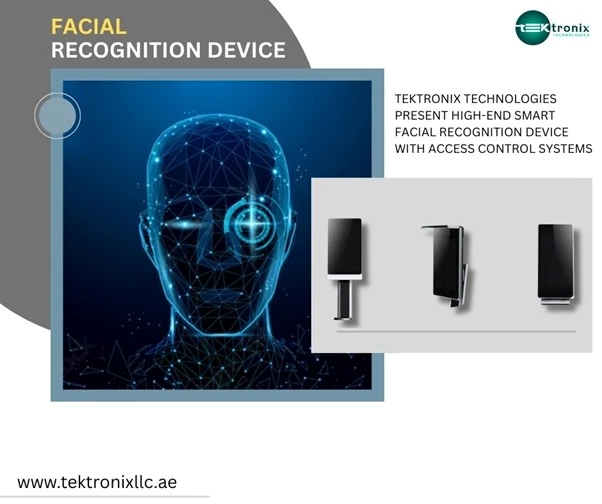
The performance of any biometric deployment is only as good as the hardware that captures the biometric data. A Facial Recognition Device deployed in Qatar must contend with environmental and operational conditions that differ substantially from temperate-climate markets — demanding careful hardware specification and vendor selection.
Camera Sensor Specifications
High-resolution CMOS sensors with wide dynamic range (WDR) are essential for Qatar's outdoor environments, where scenes can simultaneously contain deep shadows and intense direct sunlight — a dynamic range challenge that standard cameras fail. Minimum recommended specifications for outdoor Qatar deployments are 4MP resolution, 120dB WDR, and an integrated infrared illuminator for night-time operation.
Thermal Tolerance and Ingress Protection
Hardware deployed outdoors in Qatar must be rated for continuous operation at ambient temperatures of up to 60°C. Enclosures should carry IP66 or IP67 ratings to withstand the dust storms and occasional heavy rainfall characteristic of the Gulf climate. Internal thermal management systems — active cooling or thermally optimised passive designs — prevent sensor performance degradation during peak summer temperatures.
Edge AI Processing Capability
Next-generation facial recognition devices integrate on-board AI inference chips — NVIDIA Jetson, Hailo-8, or equivalent — that perform face detection, feature extraction, and local matching at the device level, without sending video to a central server. This edge architecture dramatically reduces bandwidth consumption, eliminates cloud latency, and enables continued operation during network outages — critical resilience properties for remote Qatar energy installations.
Access Control Integration Hardware
Purpose-built facial recognition terminals combine the camera, processor, and access control interface in a single ruggedized unit — capable of triggering electric strikes, magnetic locks, turnstiles, and boom barriers directly. Expedite IoT's facial recognition terminal and access control device portfolio is specifically engineered for the Gulf climate and pre-integrated with widely deployed PACS platforms used across Qatar's government and commercial sectors.
4. Facial Recognition Qatar: Industry Applications Driving Adoption
The deployment of Facial Recognition Qatar technology is accelerating across multiple sectors, driven by security requirements, regulatory mandates, and the availability of proven, regionally tested solutions:
Aviation and Border Security
Hamad International Airport — consistently ranked among the world's top airports — has invested heavily in biometric-enabled passenger processing. Facial recognition at departure gates enables fully automated boarding without manual document checks, reducing per-passenger processing time and freeing security staff to focus on anomaly investigation. At Qatar's border crossings, facial identification supports immigration control by matching live captures against watchlists and travel document databases in real time.
Government and Public Sector Facilities
Qatar's government ministries, royal court facilities, defence establishments, and judicial buildings operate under strict physical security mandates. Facial recognition provides a frictionless yet highly secure access control mechanism for registered personnel, while automatically flagging unrecognised individuals for security response. Integration with Qatar's national identity database — under appropriate legal authorisation — enables rapid verification of visitors against civil registry records.
Energy and Petrochemical Infrastructure
Qatar's LNG facilities, offshore platforms, and refinery complexes represent some of the most sensitive industrial sites in the world. Biometric access control using facial recognition ensures that only credentialed, safety-trained personnel access hazardous zones — eliminating the risk of contractor misrepresentation or credential sharing that badge-based systems are vulnerable to. Continuous monitoring cameras at plant perimeters and internal checkpoints maintain an unbroken record of personnel movements.
Hospitality and Luxury Real Estate
Qatar's world-class hotels, serviced residences, and private clubs on The Pearl and Lusail City are deploying facial recognition to deliver personalised, frictionless guest experiences — automatic room access, keyless lobby transit, personalised service triggers — while simultaneously maintaining the security required by their high-net-worth clientele.
Financial Services
Qatar's banks, exchange houses, and financial institutions are integrating facial recognition for customer identity verification at branch entry, ATM access, and secure transaction authorisation — addressing the dual requirements of reducing fraud and complying with Qatar Central Bank's Know Your Customer (KYC) mandates.
5. Facial Recognition Doha: Smart City Integration and Urban Security
As Doha evolves into one of the region's leading smart cities, Facial Recognition Doha deployments are increasingly integrated within broader urban security and city management ecosystems rather than operating as isolated point solutions.
Integrated Urban Surveillance Networks
Doha's smart city initiative connects thousands of CCTV cameras across the metropolitan area into a centralised Video Management System (VMS). Layering facial recognition analytics onto this existing infrastructure enables the city's security operations centre to maintain a real-time operational picture — tracking individuals of interest across multiple camera feeds, detecting known persons of concern as they enter monitored zones, and correlating identity events with other security data streams.
Event Security and Crowd Management
Qatar's portfolio of major international events — from the 2022 FIFA World Cup to the Formula 1 Grand Prix and the Qatar Open tennis tournament — demands security capabilities that can process tens of thousands of people rapidly and safely. Facial recognition at venue entry gates enables authorities to identify individuals on security watchlists without causing the bottlenecks associated with manual document checks, while crowd analytics modules monitor density, flow, and anomalous behaviour across the venue footprint.
Public Transport and Mobility Infrastructure
The Doha Metro, Qatar Rail, and major bus terminals represent high-footfall public environments where biometric identity management can simultaneously enhance security and improve passenger experience. Facial recognition-enabled fare gates enable registered users to transit without physical contactless cards, while security monitoring systems maintain continuous awareness of individuals moving through the transit network.
6. The Future of Biometric Security in Qatar: Emerging Capabilities
The facial recognition landscape is evolving rapidly. Qatar's security architects should be planning today for capabilities that will define the next generation of biometric deployments:
Multimodal Biometrics
Combining facial recognition with other biometric modalities — iris recognition, voice authentication, gait analysis, and palm vein scanning — creates layered identity assurance that is significantly more resistant to spoofing and false acceptance than any single modality alone. Multimodal platforms are particularly relevant for Qatar's highest-security applications, where the consequences of a single identity error are severe.
Emotion and Behavioural Analytics
Next-generation platforms extend beyond identity verification to behavioural analysis — detecting indicators of stress, agitation, deception, or distress in individuals passing through monitored checkpoints. While ethically complex and requiring careful governance, these capabilities are generating significant interest among Qatar's security operators in aviation and critical infrastructure contexts.
Federated Identity and Cross-Border Recognition
GCC-level initiatives to create federated biometric identity frameworks — allowing verified identities to be recognised across member states' border control systems — would transform the regional security landscape. Qatar's investment in high-quality national biometric infrastructure positions it well to participate in and benefit from these emerging regional identity federation protocols.
Quantum-Safe Biometric Data Protection
Biometric templates stored today may be vulnerable to future quantum computing decryption attacks if they are not protected using post-quantum cryptographic algorithms. Forward-thinking Qatar deployments — following guidance from NIST's Post-Quantum Cryptography (PQC) standards finalised in 2024 — should begin evaluating quantum-resistant encryption for their biometric databases.
Conclusion
Facial Recognition has moved from a niche biometric technology to a foundational pillar of physical and digital security in Qatar. From the precision of enterprise Facial Recognition Software processing thousands of identities per second, to the ruggedized performance of a purpose-built Facial Recognition Device operating through Doha's summer heat, to the regulatory rigour demanded by Qatar's PDPL framework — the technology has matured sufficiently to support mission-critical deployments across every sector of the economy.
As Qatar's smart city ambitions expand, as its critical infrastructure grows more complex, and as its regulatory environment for biometric data matures, organisations that invest now in well-architected, standards-compliant facial recognition infrastructure will be positioned to deliver security outcomes that manual and traditional electronic systems simply cannot match.
FAQs
1. What is a Facial Recognition System and how does it work in a security context?
A Facial Recognition System is an integrated technology platform that uses computer vision and deep learning to detect, analyse, and identify human faces from images or live video feeds. In a security context, the system captures a face at an access point or surveillance camera, extracts a unique mathematical feature vector from the facial geometry, and compares it against a database of enrolled identities to determine whether to grant access, raise an alert, or flag the individual for further investigation. Modern systems achieve this in under 300 milliseconds and maintain accuracy across varying lighting, distance, and demographic conditions — making them suitable for Qatar's high-throughput, high-security environments.
2. How accurate is Face Detection technology in Qatar's challenging outdoor environments?
Face Detection accuracy in real-world Qatar deployments is determined by a combination of hardware quality and software capability. Enterprise-grade systems using 4MP+ WDR cameras with infrared illumination and AI-powered detection algorithms achieve detection rates exceeding 99% in controlled indoor environments, and 90–95%+ in challenging outdoor conditions — including intense sunlight, dust, and partial occlusion from headwear. Operators should require vendors to provide accuracy benchmarks from comparable GCC climate deployments, not solely laboratory figures, before committing to a production deployment.
3. What is Facial Authentication and how does it differ from standard identification?
Facial Authentication is a one-to-one biometric verification process: the system compares a live capture against a single claimed identity to confirm or deny that the person is who they claim to be. It answers the question: 'Are you the person on file for this credential?' Standard facial identification, by contrast, is a one-to-many search: the system compares a live capture against an entire database to determine who the person is, without any prior identity claim. Authentication is used for access control (is this the registered employee?), while identification is used for surveillance and security watchlist applications (does this person appear in our database of persons of interest?). Both capabilities are available in enterprise platforms deployed across Qatar's security infrastructure.
4. How does Facial Recognition Software comply with Qatar's data protection regulations?
Enterprise Facial Recognition Software deployed in Qatar must comply with Law No. 13 of 2016 on Personal Data Protection (PDPL) and associated guidance from the National Cyber Security Agency (NCSA). Compliant platforms implement: encrypted storage of all biometric templates using AES-256 or equivalent; role-based access controls limiting who can query or export biometric data; documented data retention policies with automated deletion at schedule; complete audit logging of all data access and processing events; and data residency controls ensuring biometric data remains within Qatar's national borders. Vendors should provide documented evidence of their PDPL compliance framework as part of the procurement process, and operators should conduct a Data Protection Impact Assessment (DPIA) before deploying any biometric system that processes identifiable personal data.
5. What should Qatar organisations look for when procuring a Facial Recognition Device?
When selecting a Facial Recognition Device for Qatar deployment, organisations should evaluate: (1) Environmental ratings — IP66/IP67 ingress protection and operational temperature range up to 60°C for outdoor installations; (2) Sensor quality — minimum 4MP resolution with WDR and infrared capability; (3) Liveness detection — ISO/IEC 30107-3 compliant anti-spoofing to prevent photograph or video replay attacks; (4) Edge AI capability — on-board processing to eliminate cloud latency and ensure offline resilience; (5) Integration interfaces — ONVIF, Wiegand, OSDP, and API compatibility with existing PACS and VMS infrastructure; (6) Local support — a vendor with established UAE/GCC regional operations able to provide on-site commissioning, calibration, and maintenance.


























Sign in to leave a comment.