

Ask any experienced real estate sales professional what the hardest sale in the business is, and most of them will give you the same answer without thinking twice: an under-construction project to a first-time homebuyer.
Not because the product is bad. Not because the price is wrong. But because you are asking someone to commit crores of rupees to something that, at the moment of the decision, is essentially a hole in the ground, a set of architectural drawings, and a promise.
The trust required to make that leap is enormous. And the tools most developers give their sales teams — brochures, scale models, 2D floor plans, rendered images — were never designed to build that level of trust efficiently.
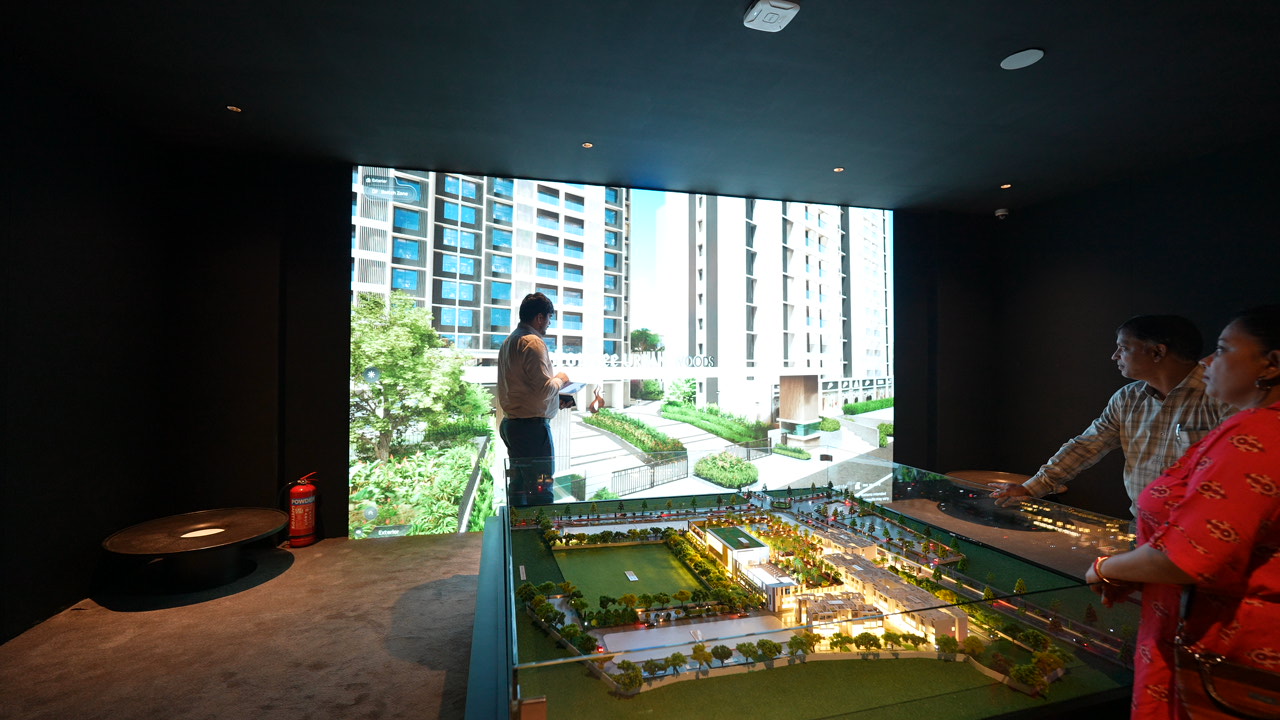
Interactive sales tools were. And L&T's Crestoria immersive experience center shows what is possible when you give buyers of an under-construction project the ability to see what they are buying before a single floor is finished.
Understanding Why Under-Construction Sales Are Different
Let us start with the specific psychology of the under-construction purchase, because it is genuinely different from buying a ready-possession home.
When you buy a ready home, the uncertainty is manageable. You can walk through the actual apartment. You can look out of the actual windows. You can stand in the actual kitchen and understand whether it suits you. The product is in front of you.
When you buy under construction, you are buying a future state. You are trusting that what you see in the render will match what gets built. You are trusting that the specifications listed in the agreement will translate into a finished home that meets your expectations. You are trusting that the developer will deliver — on time, to standard, as promised.
That is a significant amount of trust to ask for. And in a market where buyers have legitimate reasons to be cautious — delayed projects, construction quality concerns, developer credibility questions — the burden of building that trust falls heavily on the sales team at the experience centre.
The question is: what tools do you put in their hands?
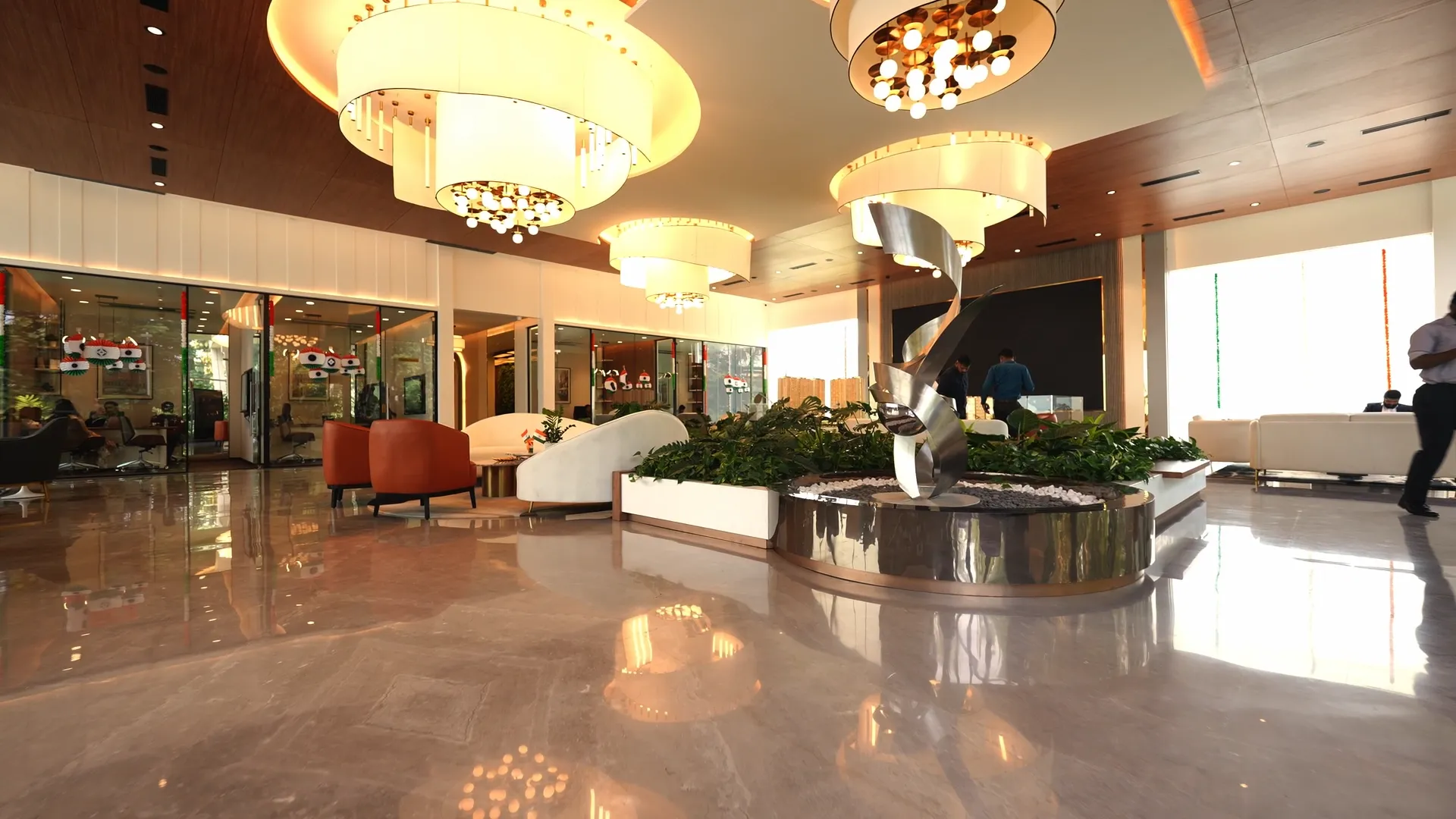
L&T Crestoria: Selling a Premium Vision Before the Towers Existed
L&T Crestoria is the kind of project that, on paper, should sell itself. A respected developer. A premium positioning. A considered design vision. A location with genuine future upside.
But "on paper" is the problem. The project was in its early stages, and the experience centre needed to do the work of making a future home feel real enough that buyers could commit to it today.
The Crestoria immersive experience center was built around V-Estate's platform — and it approached the under-construction challenge in a way that fundamentally changed the quality of buyer engagement.
Making the Vision Tangible
The core problem with selling under-construction is not actually trust — it is imagination. More precisely, it is the failure of imagination that happens when a buyer is asked to picture their finished home from a 2D floor plan and a glossy render.
The human brain does not work that way. We do not build complete, confident pictures from abstract representations. We build them from experience — from seeing, navigating, and feeling spaces.
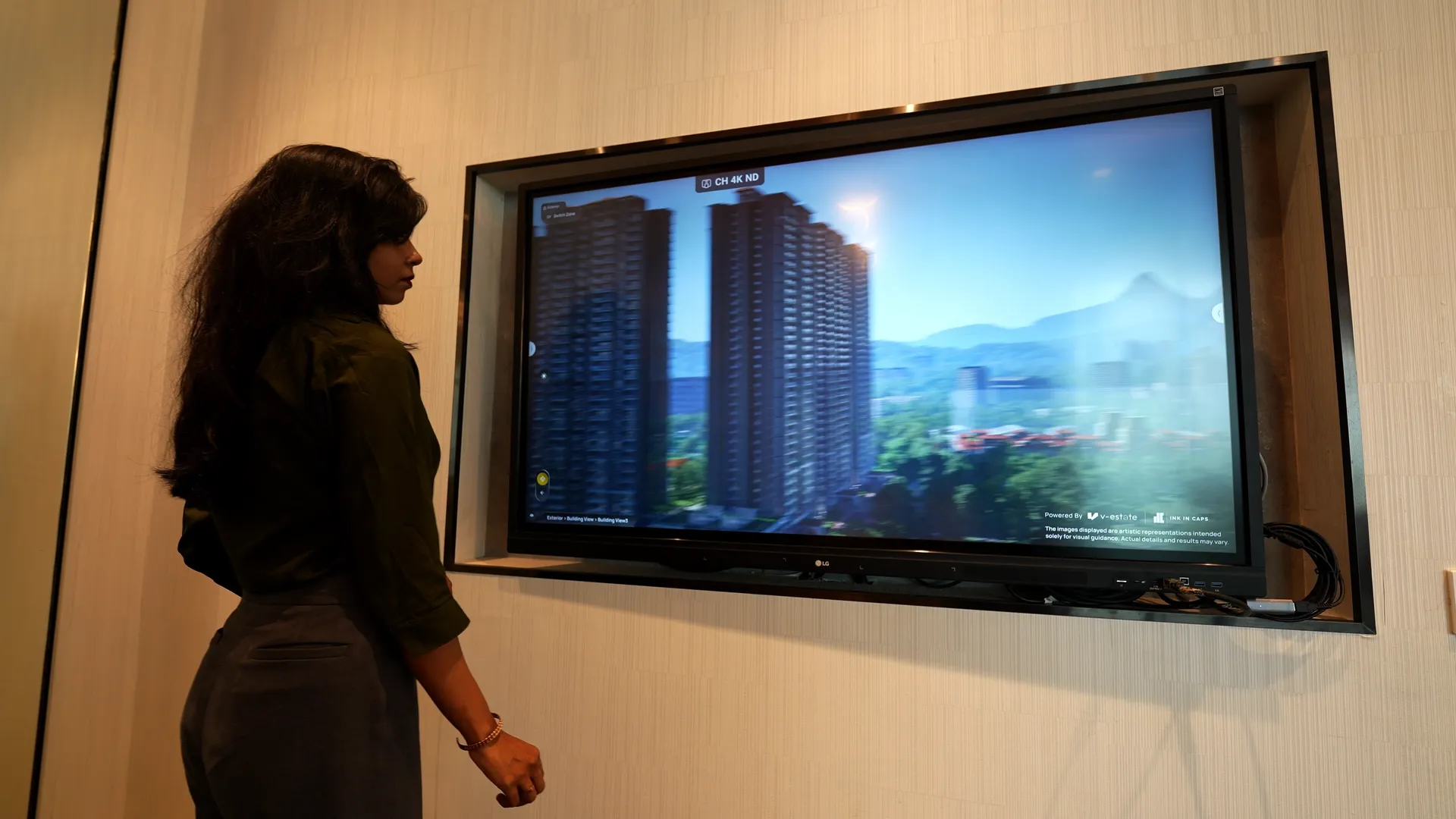
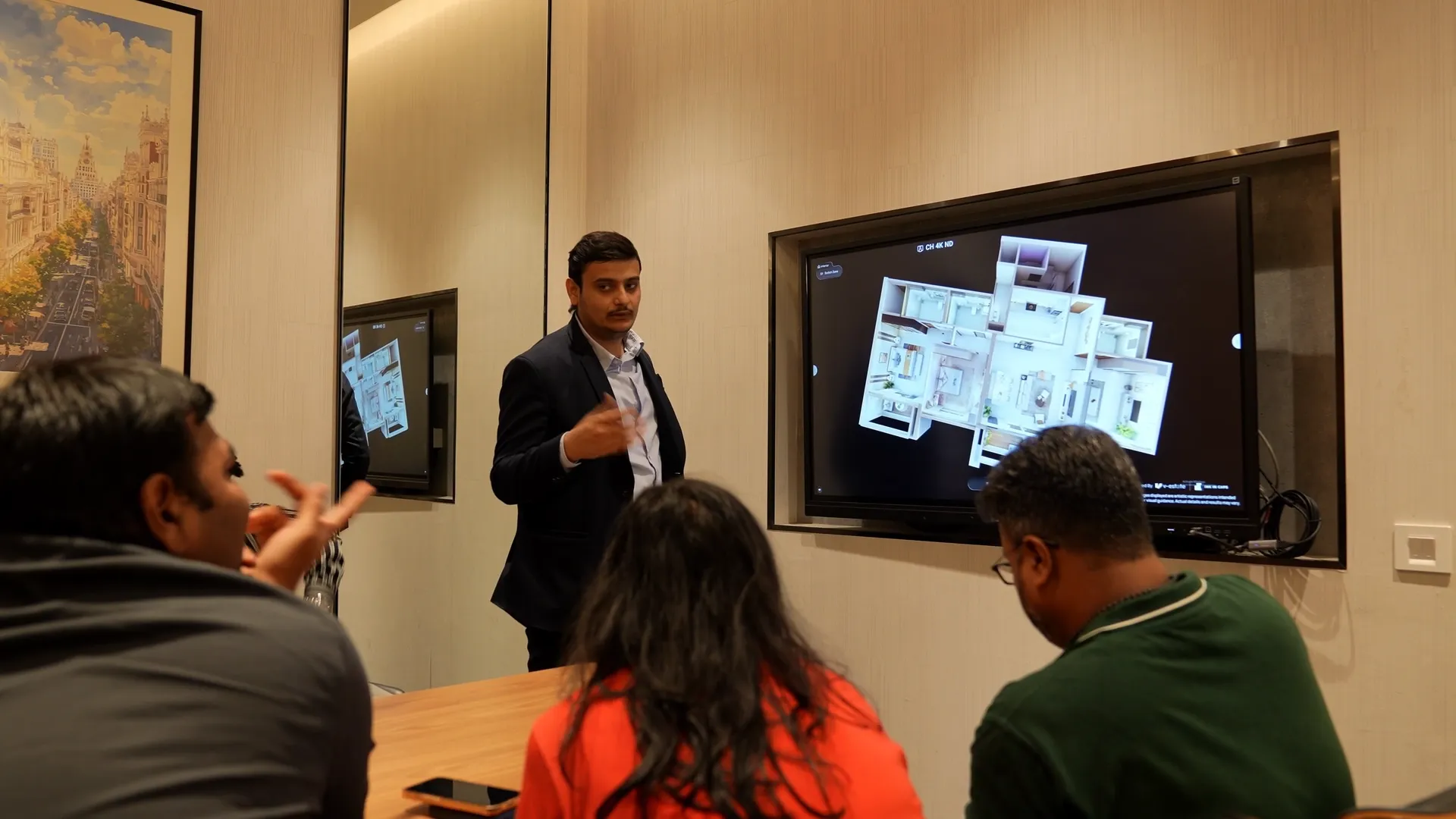
The Crestoria experience center gave buyers that experience before the building existed. Through V-Estate's 3D interactive walkthrough, buyers could navigate the finished project as it was designed to be — exploring the towers, the floor plates, the specific units they were considering, the amenities, and the overall environment.
The psychological effect of this is hard to overstate. A buyer who has walked through their future apartment — who has stood in the living room, looked out at the view, navigated from the bedroom to the bathroom, explored the balcony — experiences that home as real. Their emotional attachment to the space is not contingent on it being physically built. It has already been experienced.
The Specificity Advantage
One of the details that makes a meaningful difference in under-construction sales is the ability to show specific options to specific buyers.
When a buyer is considering a 3BHK on the 22nd floor, showing them a walkthrough of a 2BHK sample flat does not really answer their question. The dimensions are different. The views are different. The floor is different. The irrelevance is obvious.
With V-Estate's platform, a Crestoria buyer could navigate their specific unit — the actual configuration, the actual floor, the actual orientation. The particularity of the experience was what made it credible. When you can show a buyer the view from floor 22 facing north-west, not just "the kind of view this tower will have," the conversation becomes specific enough to close.

The Three Buyer Types Who Respond Best to Interactive Sales Tools
In under-construction project sales, buyers broadly fall into three categories — each with different fears, and each of whom responds differently to interactive experiences.
The First-Time Homebuyer
This buyer's primary fear is making a mistake they cannot undo. They are committing to something they cannot fully see, with money they have saved for years. What they need most is reassurance through clarity — the ability to see the finished product with enough detail that the uncertainty feels manageable.
Interactive property walkthroughs give this buyer a way to experience the project that feels genuine rather than promotional. When you can navigate a space yourself, it feels more honest than being shown a carefully produced video. This matters enormously to first-time buyers who are wary of being sold to.
The Upgrader
This buyer has bought property before. They know how these presentations work. They have seen the renders that looked better than reality. They are looking for signals of developer confidence — proof that the developer is not hiding anything.
An experience centre that shows everything — every unit type, every floor level, every amenity, the vicinity mapping with actual distances — is a signal of confidence. Developers who are proud of their product show all of it. The interactive setup communicates that confidence without anyone needing to say a word.
The Investor
This buyer is thinking about rental yield and resale value. They want to understand the project's appeal to future tenants or buyers. Interestingly, they are often highly responsive to vicinity mapping — proximity to metro corridors, commercial hubs, educational institutions — because these factors directly influence long-term asset value. Interactive tools that give this information clearly and spatially are speaking directly to what this buyer needs to know.
The Practical Impact on the Sales Cycle
Here is what developers who have implemented interactive sales tools report, consistently:
- Buyers spend longer at the experience centre — not because they are being held there, but because they are genuinely engaged with the content
- The quality of questions improves significantly — buyers are asking about specific units and configurations, not asking what the project will generally look like
- Follow-up conversion rates increase — buyers who leave with a clear picture of the project are far more likely to respond to follow-up outreach than buyers who left uncertain
- The number of repeat visits required to close decreases — many buyers who would previously have needed two or three experience centre visits can close within the first or second interaction
These are not marginal improvements. In a sales operation where each unit represents a significant revenue figure, compressing the sales cycle by even a week or two — multiplied across dozens of conversions — has a substantial effect on cash flow and sales efficiency.
The broader context of why this approach is gaining ground over traditional methods is worth understanding fully: why interactive sales tools are winning over traditional approaches in real estate marketing.
What the Experience Centre Setup Actually Involves
For developers considering this approach, it is worth being clear about what V-Estate's platform delivers in practice.
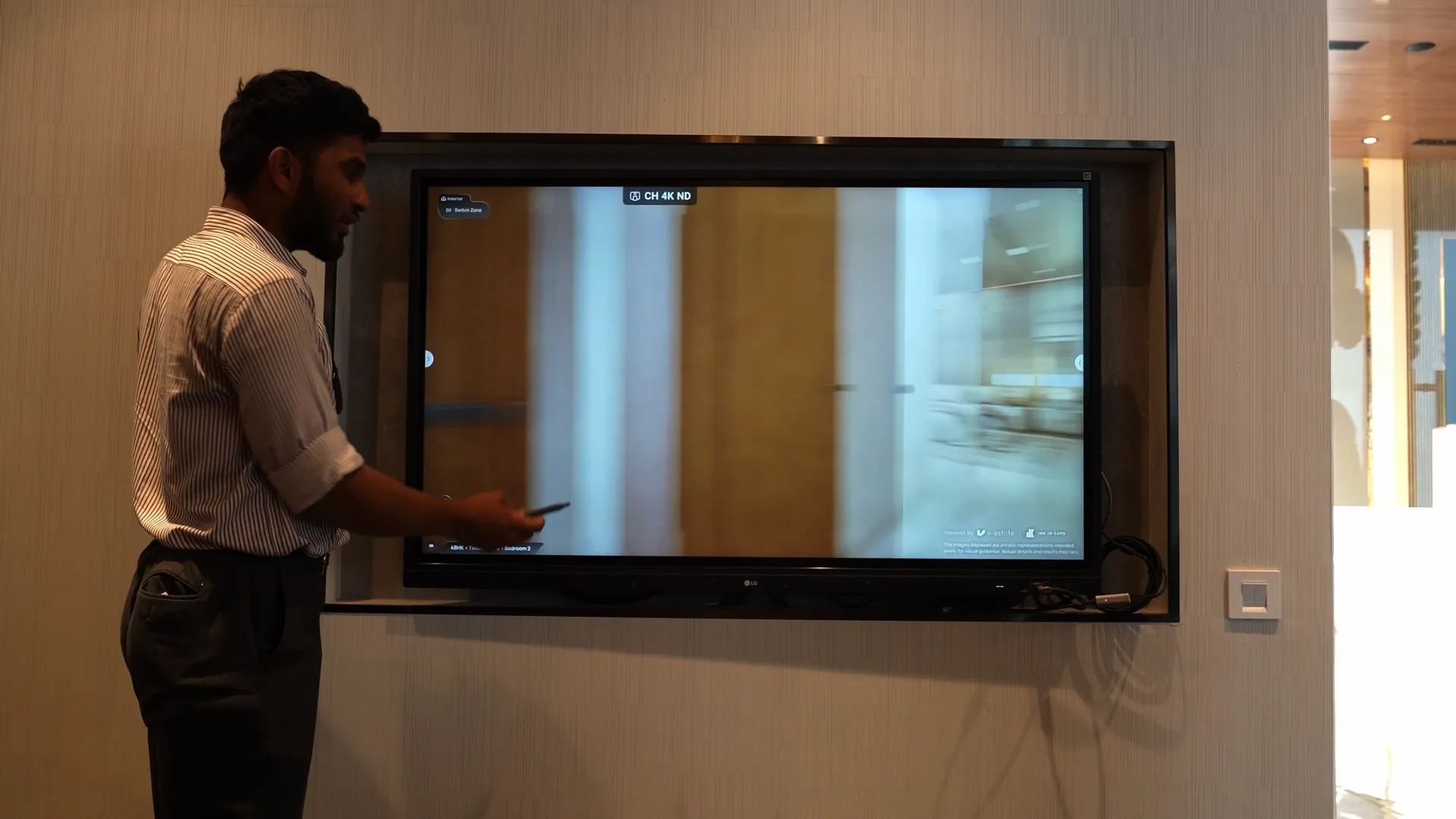
The system is designed as offline activation software — it runs in the experience centre without depending on internet connectivity. This is a practical necessity for any setup that needs to be reliable during buyer visits.
The content covers:
- Full project walkthrough at site and tower level, showing the development in its completed form
- Individual unit navigation across all configurations, allowing buyers to explore their specific choice
- Amenities visualisation in 360-degree detail, making the lifestyle offering tangible rather than theoretical
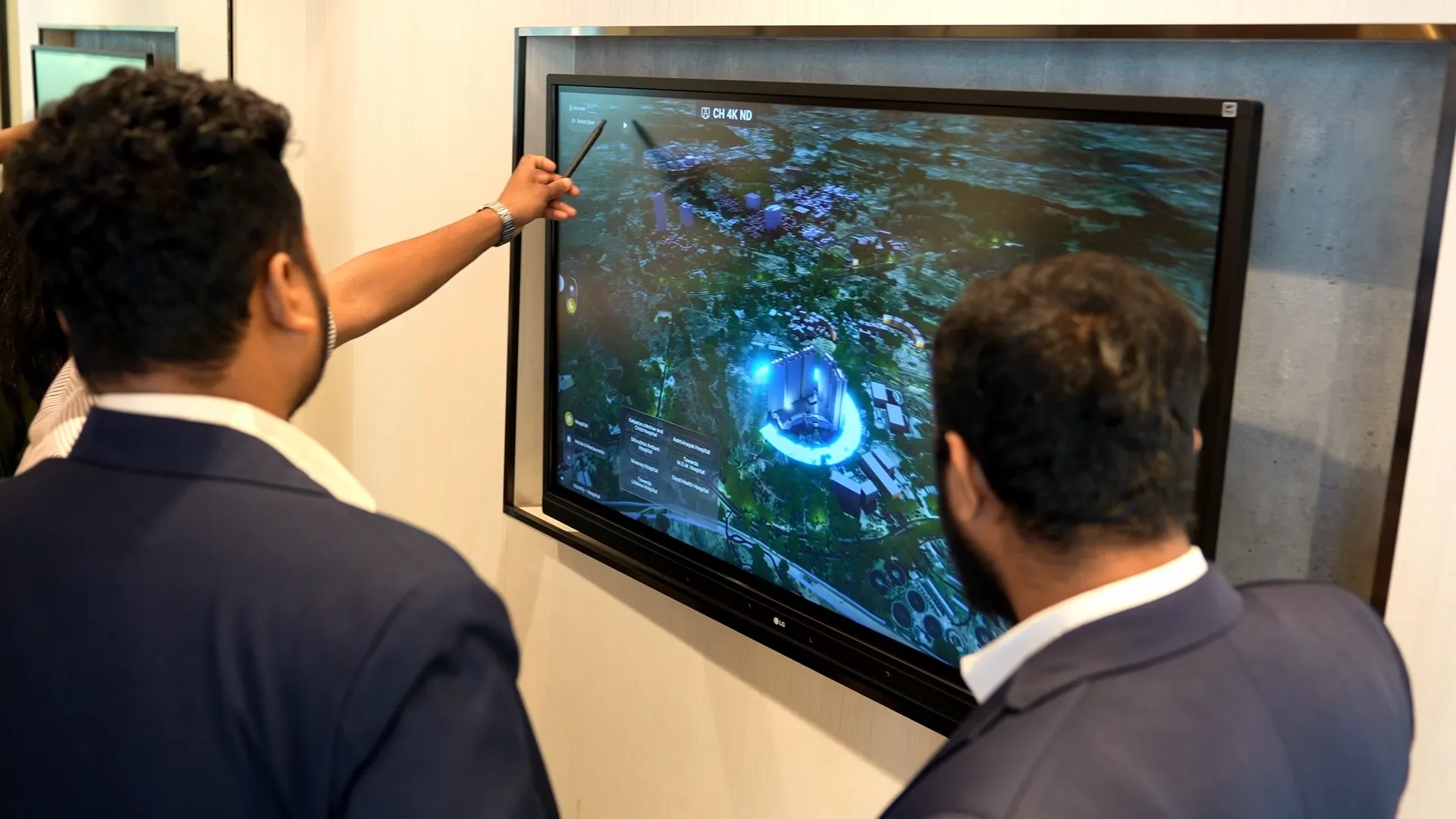
- Vicinity mapping covering key destinations within a 5 km radius, addressing location questions directly
- Daylight and view visualisation for specific floors and orientations, answering the questions that renders cannot
The platform integrates with the physical experience centre environment — the hardware, display systems, and interaction design work together to create a coherent experience rather than a technology demo.
The Developer's Competitive Advantage
There is a practical competitive dimension to this that is worth being direct about.
In any market where multiple projects are competing for the same buyer, the developer who makes the clearest, most honest, most experiential presentation will win a disproportionate share of decisions. Not because their project is necessarily better — but because their buyer understood their project better.
Buyers do not just choose the best project. They choose the project they feel most confident about. And confidence is built through clarity.
Developers who invest in interactive sales tools are not just improving their own presentation. They are making it measurably harder for competitors who are still relying on brochures and scale models to hold the buyer's attention in comparison.
The Under-Construction Sale Does Not Have to Be Your Hardest Sale
With the right tools, selling under construction can actually be an advantage — because you can show the project at its ideal completion, with every design decision made, without the buyer needing to mentally subtract the scaffolding.
A finished building can only look as good as it looks. A 3D walkthrough of a finished design, delivered through quality interactive software, can show it exactly as it was conceived to be.
If you are preparing for a project launch — or re-examining why your current sales cycle is longer than it should be — the conversation starts here.
Book a demo with V-Estate and see how your under-construction project could be presented in a way that turns hesitant prospects into confident buyers.
The promise you are selling is real. Let your buyers see it that way.

























Sign in to leave a comment.