
Take a quick look around your room right now. You are likely surrounded by dozens of electronic devices. Your phone, your laptop, your smart speaker, and even your microwave have something in common. They all rely on internal circuit boards to keep them running smoothly. If you open up almost any of these gadgets, you will find a rigid green board inside. That board is almost certainly made from a very specific material configuration. The tech world calls this standard foundation an FR4 PCB.
An FR4 PCB serves as the structural backbone for the vast majority of the world's electronics. It is the absolute baseline standard of the entire circuit board industry. The letters and numbers actually stand for Flame Retardant 4, which is a rating for safety. But just because it is the most popular kid on the block does not mean it is completely flawless. Like any engineering choice, using this specific material comes with a massive list of perks and a few serious limitations. Let us jump right into the honest truth about what makes this material awesome and where it completely falls flat.
What Exactly Is This Classic Board Material?
Before we look at the pros and cons, we need to understand what this material actually is. It is not just a random sheet of plastic.
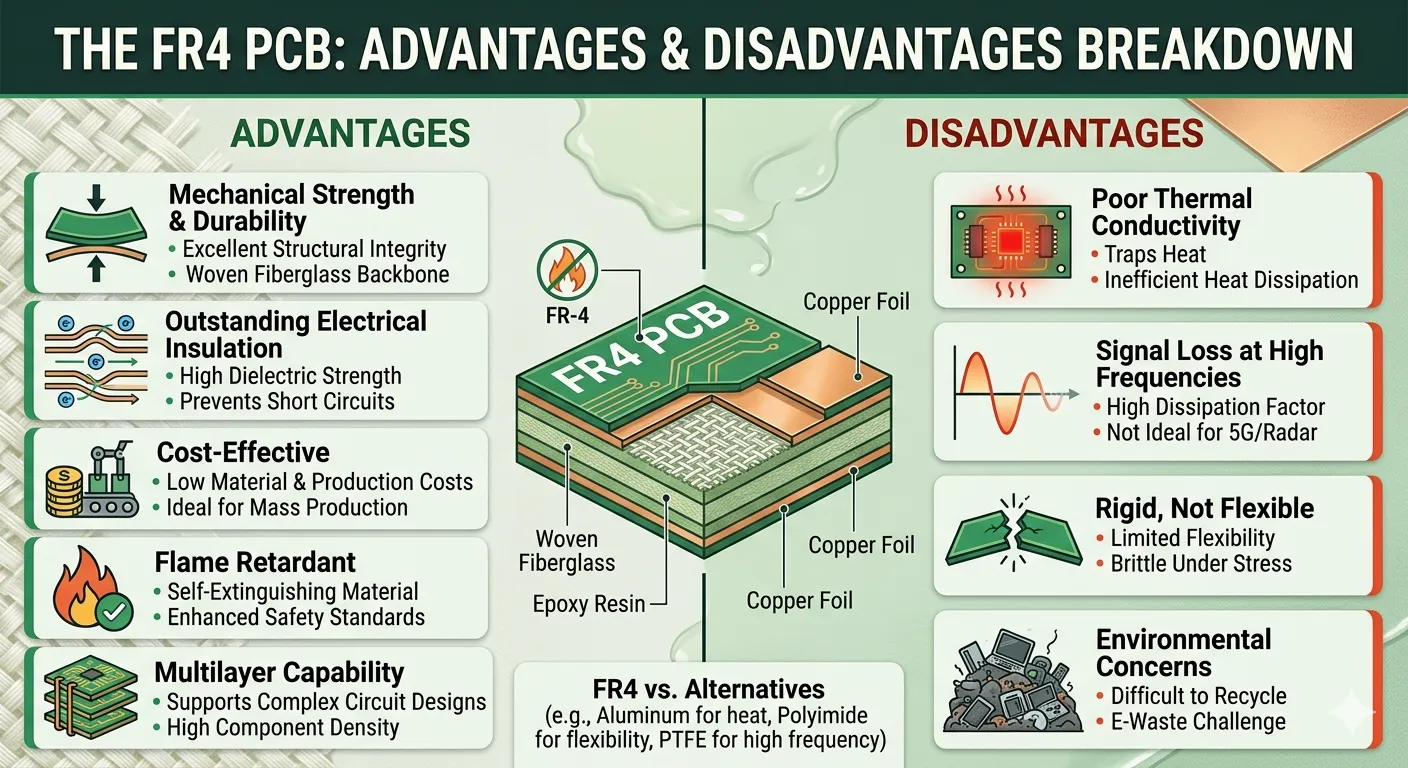
An FR4 PCB is a composite material made from woven fiberglass cloth. This fiberglass cloth is thoroughly soaked in an epoxy resin matrix. The resin acts like a super-strong glue that binds the glass fibers together. Manufacturers compress these layers together under immense heat and pressure to create a rigid sheet. Finally, thin layers of copper foil are laminated onto one or both sides of the board. This creates the canvas where engineers can etch their electrical circuits.
The Massive Advantages of Choosing FR4
There is a very good reason why this material dominates the electronics manufacturing industry globally. It delivers an incredible mix of mechanical strength, electrical insulation, and economic value that is hard to beat.
Incredible Structural Strength and Longevity
Electronic devices have to survive a lot of physical abuse in the real world. Users drop their phones, remote controls get kicked across the floor, and cars rattle violently on rough roads.
An FR4 PCB handles this mechanical stress like an absolute champ. The woven fiberglass layers inside the board provide immense structural integrity. This material does not bend, warp, or crack easily under physical pressure. It keeps all the tiny, delicate copper traces and soldered components completely stable. This high level of physical toughness directly translates into longer-lasting electronic products for consumers.
Outstanding Electrical Insulation Properties
The main job of a circuit board is to guide electricity along very specific pathways. You absolutely do not want electricity jumping across random parts of the board. That causes dangerous short circuits.
This is where the chemical composition of an FR4 PCB truly shines. The epoxy resin and fiberglass combination acts as a phenomenal electrical insulator. It has a high dielectric strength, which means it can withstand high voltages without breaking down. It keeps the electrical signals completely isolated within their designated copper tracks. This predictable electrical behavior ensures that complex circuits work exactly the way the engineer intended.
The Most Cost-Effective Choice on the Market
Money is always a massive factor when designing a consumer product for mass production. Engineers are always looking for ways to keep production costs as low as possible.
Choosing an FR4 PCB is one of the easiest ways to keep a budget under control. Because the industry has been using this material for decades, the manufacturing process is incredibly optimized. Raw materials like fiberglass and epoxy are cheap and widely available. Factories can churn out millions of these boards every single day at a very low cost per unit. This excellent affordability is the main reason why gadgets do not cost a fortune today.
Excellent Natural Flame Retardancy
Safety is a non-negotiable requirement when dealing with electrical devices. Circuits generate heat, and sometimes components fail catastrophically. If a component fails, you do not want the entire circuit board catching fire and burning down a house.
The name of the material tells you exactly why it excels at safety. The "FR" stands for flame retardant, and the material meets strict safety standards. The epoxy resin contains specific chemical compounds that actively resist ignition. If an electrical short causes a massive spike in heat, the board will self-extinguish rather than feed a fire. This built-in safety net gives peace of mind to both product developers and regular everyday users.
Perfect Compatibility with Multilayer Board Designs
Modern gadgets require insanely complex circuits packed into tiny physical packages. A simple single-sided board just does not provide enough surface area for all the necessary tracks.
An FR4 PCB handles complex multilayer designs with absolute ease. Manufacturers can stack multiple thin sheets of FR4 on top of each other like a multi-layered sandwich. They can place copper circuit patterns between every single layer. These layers are glued together using thin sheets of partially cured resin called prepreg. This stacking ability allows engineers to create incredibly dense, highly advanced circuits for powerful computers.
Very Low Moisture Absorption Rates
Moisture is the ultimate silent killer for electronic devices. Water can cause corrosion, alter electrical properties, and completely destroy a circuit board over time.
Fortunately, an FR4 PCB resists moisture like a duck resists water. The hardened epoxy resin forms a sealed, non-porous barrier over the fiberglass cloth. It absorbs almost zero water from the surrounding air, even in incredibly humid tropical environments. This high resistance to moisture ensures that the board remains stable and reliable in various climates. It prevents the internal layers from separating, which is a common failure mode known as delamination.
The Hidden Disadvantages of the Standard Material
While it sounds like the perfect material, it definitely has some major weaknesses. Certain advanced applications push this standard material far past its physical limits.
Poor Thermal Conductivity and Heat Dissipation
As electronic components get smaller and more powerful, they generate a massive amount of concentrated heat. High-power LEDs, fast processors, and power supplies get incredibly hot during normal operation.
An FR4 PCB is notoriously terrible at transferring and dissipating this heat. Fiberglass and epoxy resin are natural heat insulators, which means they trap heat instead of letting it escape. If a design generates too much heat, the board can suffer from localized hot spots. This trapped heat can degrade the copper traces and cause sensitive components to fail prematurely. Designers often have to add bulky metal heat sinks or loud cooling fans to fix this major issue.
High Signal Losses at Extreme Frequencies
We live in an era of ultra-fast communication, including 5G networks, high-frequency radar, and rapid satellite communication. These systems rely on electrical signals that cycle billions of times every single second.
At these ultra-high frequencies, an FR4 PCB starts to struggle significantly. The material has a relatively high dissipation factor, which means it absorbs a portion of the high-frequency energy. This absorption causes the electrical signals to degrade and lose clarity as they travel across the board. For high-speed applications, this signal loss is completely unacceptable. Engineers are forced to upgrade to specialized, expensive materials like Teflon-based substrates.
Limited Flexibility and Brittle Nature
The rigid nature of this material is great for standard desktop devices, but it limits design creativity. The world of tech is shifting toward flexible, wearable electronics that conform to the human body.
You cannot bend an FR4 PCB without permanently damaging it. If you apply too much bending force, the fiberglass layers will snap and break the internal copper connections. It is completely useless for smart clothing, curved medical devices, or tight folding mechanisms like flip phones. For those applications, manufacturers must use flexible materials like polyimide, which cost significantly more money.
Environmental Concerns and Recycling Challenges
Sustainability is a massive talking point in the modern manufacturing landscape. Consumers want to know that their tech choices are not destroying the planet.
The tough chemical nature of an FR4 PCB makes it an environmental nightmare at the end of its life cycle. The hardened epoxy resin cannot be melted down and remolded like simple plastics. The woven glass fibers are incredibly difficult to separate from the resin matrix. As a result, millions of these boards end up sitting in landfills forever as toxic electronic waste. Burning them is not a great option either, as the flame-retardant chemicals can release nasty vapors.
Variations in Dielectric Constant
For highly precise analog circuits, the electrical properties of the board must remain absolutely constant. Engineers need to know exactly how the material will react to electrical charges.
The dielectric constant of an FR4 PCB can vary slightly depending on how it was manufactured. The ratio of fiberglass cloth to epoxy resin can change across different sections of the same board. These tiny variations can alter the impedance of high-speed transmission lines. This unpredictability can cause unexpected bugs and performance issues in sensitive laboratory equipment or high-end audio gear.
Navigating the Challenges
The trick to successful product design is knowing how to minimize the disadvantages of your materials. Engineers have developed clever workarounds over the years to keep using this affordable material.
To fight poor thermal conductivity, designers use a technique called thermal vias. These are tiny holes drilled through the board that are lined with highly conductive copper. These copper tubes act as highways that pull heat away from hot components and send it to the other side of the board.
To deal with high-frequency limits, engineers use hybrid designs. They might use a premium, low-loss material only for the top layer where the fast signals travel. They then use standard, cheap FR4 for the remaining internal layers to keep the overall cost down. It is all about balance, compromise, and smart engineering choices.
Looking Ahead to the Future of Substrates
The electronics industry is constantly pushing the envelope of material science. Researchers are actively working to fix the core weaknesses of the traditional board.
Scientists are currently developing bio-based epoxy resins derived from natural plant oils. These new resins are much easier to break down, which could solve the massive e-waste crisis.
At the same time, manufacturers are creating ultra-thin fiberglass weaves. These advanced weaves offer a much more uniform dielectric constant, pushing the frequency limits of the material higher than ever before. The classic board is not going away anytime soon, but it is definitely getting a modern upgrade.
Summary
The FR4 PCB remains the undisputed heavyweight champion of the electronics world for very clear reasons. It offers an unbeatable combination of rugged strength, electrical insulation, safety, and affordability. It is the reason why modern technology can be mass-produced efficiently.
However, its limits in heat management, high-speed performance, and flexibility are becoming more apparent every day. As our devices get faster, hotter, and more flexible, designers must carefully weigh these pros and cons. Understanding these material characteristics is the key to building successful modern tech.
Are you preparing to develop your own custom hardware product? Take the time to analyze your project's specific speed and temperature requirements. If you are building a standard electronic device, stick with the classic choice to keep your costs manageable. Partner with an experienced manufacturer early in the process to optimize your layout for the best results. Let us build something amazing today.
























Sign in to leave a comment.