
When you design a circuit board, you are making a commitment to the materials that will hold your invention together for years to come. Most of the time, the default choice for the substrate is standard FR4, which is the industry's workhorse material. However, the world of hardware is evolving toward smaller, faster, and much hotter operating environments. If your design involves high-power components, intensive processing, or exposure to harsh industrial temperatures, you might find that a standard board starts to fail long before it should. This is where you need to start thinking about the glass transition temperature, or Tg, of your laminate. Choosing between a standard material and a High TG PCB is one of the most vital thermal management decisions you will make. This post explores the science of glass transition, why heat is the enemy of your board, and how upgrading your material can save your project from early retirement.
What is Glass Transition Temperature (Tg)?
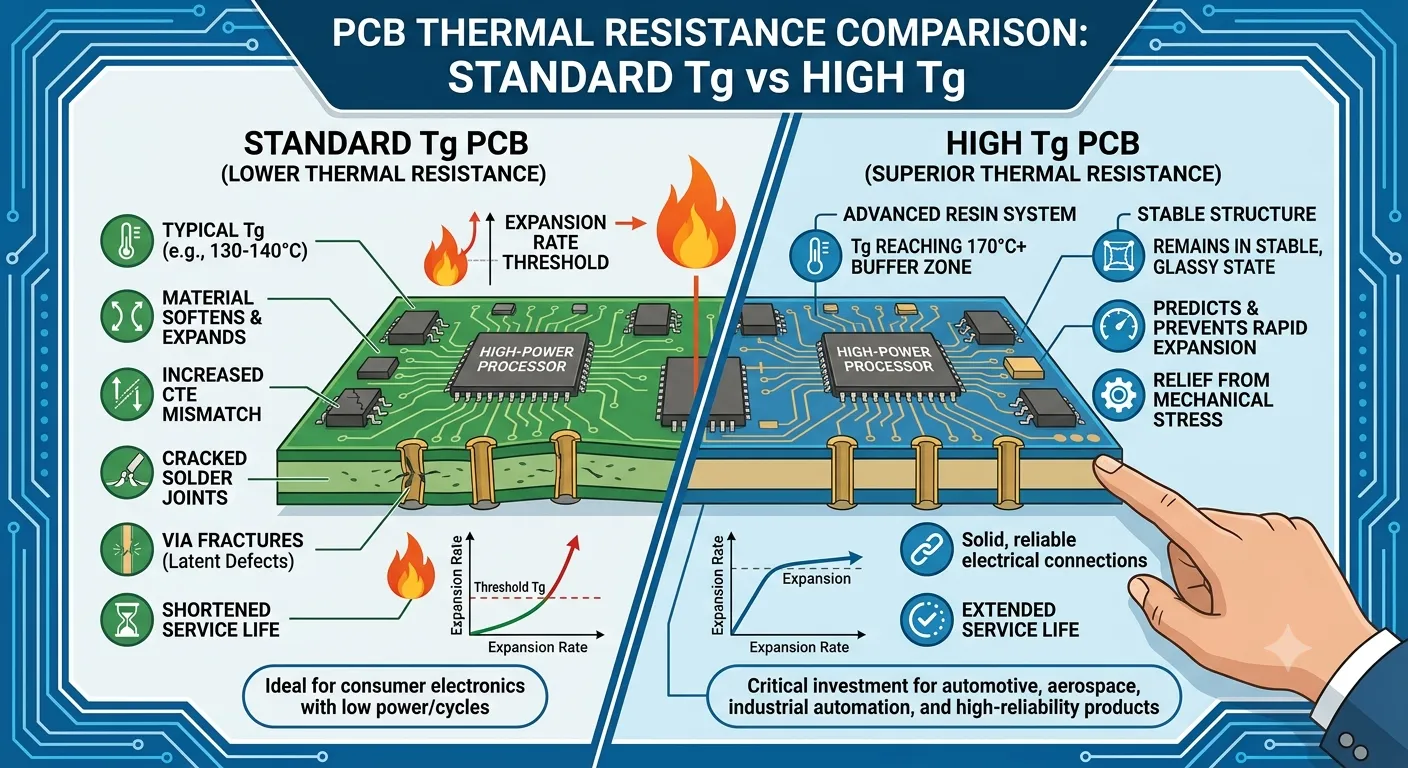
To understand why a High TG PCB is different, we first need to define the term "glass transition temperature." Every polymer-based material, like the epoxy resin used in standard circuit boards, exists in a solid, glassy state at room temperature. It is rigid, stable, and strong. As you apply heat, the polymer chains begin to vibrate and move, eventually reaching a point where the material softens and behaves more like a rubbery, viscous liquid. This specific point of transition is the Tg. Once the material crosses this temperature threshold, it starts to expand much faster, it loses its mechanical rigidity, and it becomes susceptible to damage. For a standard board, this temperature is typically around 130°C to 140°C. If your board operates near that temperature, you are essentially asking for a failure.
The Danger of Operating Near Tg
Imagine you are soldering components onto a board, or perhaps the board is running in a hot engine compartment. If your operating temperature is close to the Tg of your material, the board is sitting in a state of constant, microscopic change. When the epoxy resin softens, it expands at a different rate than the copper traces and the glass fibers inside the board. This mismatch in thermal expansion—known as the Coefficient of Thermal Expansion or CTE—causes massive mechanical stress. It leads to cracked solder joints, lifted pads, and internal fractures in the vias. These are often called "latent defects" because the board might work perfectly fine when it leaves the factory, only to fail months later in the hands of your customer. This is why you must treat the glass transition temperature as a hard limit for your design.
Why Choose a High TG PCB?
A High TG PCB is engineered specifically to push that limit higher. By using more advanced resin systems, these boards can push the glass transition temperature to 170°C, 180°C, or even higher. This provides a much larger safety margin for your design. When you have a higher Tg, the board remains in its stable, glassy state even when your components are running hot. It does not soften, and it does not experience the rapid, erratic thermal expansion that destroys standard materials. If you are building high-reliability products, such as those used in automotive, aerospace, or industrial automation, the extra cost of a High TG PCB is not just an expense; it is a critical investment in the longevity and safety of your product. It essentially moves the "danger zone" far away from your operating conditions.
Thermal Cycling and Mechanical Stress
Electronic components are rarely turned on once and left in a steady state. They cycle. They turn on, they get hot, they turn off, and they cool down. Every single cycle puts stress on your board materials. This process of thermal cycling is where a High TG PCB really shines. Because the material remains rigid and stable throughout a wider range of temperatures, the copper traces and the via barrels are not subjected to the same level of stretching and compressing that occurs on a standard material. Over thousands of cycles, a standard board can develop micro-cracks in its vias, which leads to intermittent connections and total system failure. A high-Tg material maintains its structural integrity through these cycles, keeping your electrical connections solid and your system reliable over its entire service life.
Lead-Free Soldering Requirements
One of the biggest drivers for the move toward high-Tg materials has been the shift to lead-free soldering. Lead-free solder has a higher melting point than the traditional lead-tin alloys we used for decades. This means the board must be subjected to much higher temperatures during the assembly process to ensure all the joints are properly formed. If you use a standard board with a low Tg, you risk the board softening or even warping during the reflow soldering process. This can lead to "popcorning" where the internal layers delaminate, or it can cause the via barrels to snap. Because High TG PCB materials can withstand these high assembly temperatures without losing their rigidity, they have become the de facto standard for modern, lead-free, high-density surface-mount assemblies.
When Standard Tg Is Perfectly Fine
It is important to remember that you do not need a high-Tg material for everything. If you are building a simple product that is intended for indoor, temperature-controlled use, and your components run cool, a standard material is more than enough. It is cheaper, more widely available, and easier for manufacturers to source. Over-engineering your board with a high-Tg material that you do not need is just throwing money away. You should only pay for the premium performance of a High TG PCB when your design constraints—such as power density, ambient operating temperature, or the number of thermal cycles—actually require it. Always base your decision on a thermal model of your product rather than on a guess.
Analyzing Your Thermal Constraints
Before you finalize your board material, you need to do a little bit of homework. First, calculate the maximum operating temperature of your product. Consider the environment where it will live—will it be in an enclosure? Will it be exposed to direct sunlight? Second, look at the power dissipation of your hottest components. Do you have a processor, a power transistor, or a high-intensity LED array that is running hot? Third, determine if you are using lead-free soldering processes. If you are, the assembly temperature alone might be a reason to opt for a higher-Tg material. If you find that your expected operating temperature is within 20 or 30 degrees of the material's Tg, it is time to upgrade. A good rule of thumb is to maintain a buffer to ensure you never push the material to its limits.
Manufacturing and Fabrication Considerations
Working with a High TG PCB does not usually require a completely different set of manufacturing tools, but it does require some care. Because these materials are more rigid and harder to process, the fabricator might need to adjust their drilling speeds or their etching chemistry. You should always discuss your material choice with your manufacturing partner early in the design cycle. They will know if their current process is optimized for a specific high-Tg laminate. Some high-Tg materials also have different dielectric constants, which can affect the impedance of your high-speed signals. If you are doing RF design or high-speed data transmission, check the data sheet of the specific high-Tg laminate you are considering to ensure that your impedance calculations are still accurate.
The Cost of Reliability
It is easy to look at the quote for a High TG PCB and see a higher number than for a standard board. It is harder, but more important, to see the cost of a product failure. If your device is installed in a hard-to-reach location, like a remote weather station or an industrial machine inside a sealed enclosure, the cost to send a technician to repair or replace a failed board is enormous. When you factor in the potential for warranty claims, loss of customer trust, and the reputation damage of a product that breaks down, the "extra" cost of a high-Tg material looks like a bargain. You are buying insurance against the physical reality of heat-induced degradation. In the world of professional hardware, this kind of foresight is what separates a good design from a great one.
Design for Longevity
When you design with a High TG PCB, you are thinking about the future. You are thinking about the environment the board will face in two, three, or five years. This shift in mindset is crucial for any hardware designer. We often focus on the functionality of the device—does it turn on? Does it talk to the cloud? Does it have a good UI?—but the physical integrity of the board is what makes the product a success. By choosing materials that are resilient to heat and thermal stress, you are giving your device the best possible chance to survive in the real world. A design that lasts is a design that creates value.
Future Trends in Laminate Technology
The industry is not standing still. We are constantly seeing new, more advanced resin systems that offer even higher Tg values, better dielectric performance, and lower costs. Researchers are also working on materials that have better thermal conductivity, allowing heat to move away from components faster. As our electronics become more packed with functionality, the demand for high-performance laminates will only increase. Keeping up with these trends is part of the job. It allows you to build products that are thinner, faster, and more reliable than what was possible even a few years ago.
Common Mistakes to Avoid
The biggest mistake is ignoring the thermal data sheet. Every laminate manufacturer provides detailed data sheets that show the Tg, the CTE, and the dielectric properties of their materials. Don't just pick "the high Tg option" and hope for the best; compare the data sheets and choose the material that fits your specific needs. Another mistake is assuming that all high-Tg materials are the same. They are not. Some are optimized for thermal stability, while others are optimized for high-frequency performance. Make sure you are picking the right one for your application. Finally, don't forget that your board is only part of the thermal puzzle. Make sure you are also thinking about your external heat sinking and ventilation. The board can only do so much to manage the heat generated by your components.
Building a Culture of Quality
Choosing a High TG PCB is about more than just a single design choice. It is about a commitment to quality. When you decide to use better materials, you are signaling to your team and your customers that you care about the product's performance and longevity. This culture of quality filters down into every other part of the design process, from how you route your traces to how you choose your components. It creates a discipline that leads to better products. Don't be afraid to specify higher-performance materials if you know they will help your design.
Conclusion
The decision to move from a standard material to a High TG PCB is a fundamental step in the development of any high-performance, high-reliability electronic product. While it might seem like a small change in the bill of materials, the impact on your product's thermal stability, mechanical robustness, and long-term reliability is profound. By understanding the glass transition temperature, evaluating your operating environment, and choosing the right material for the job, you can build products that stand the test of time. Don't let heat be the reason your project fails. Invest in the right materials from the start, and give your electronics the solid, stable foundation they need to succeed in the real world.


























Sign in to leave a comment.