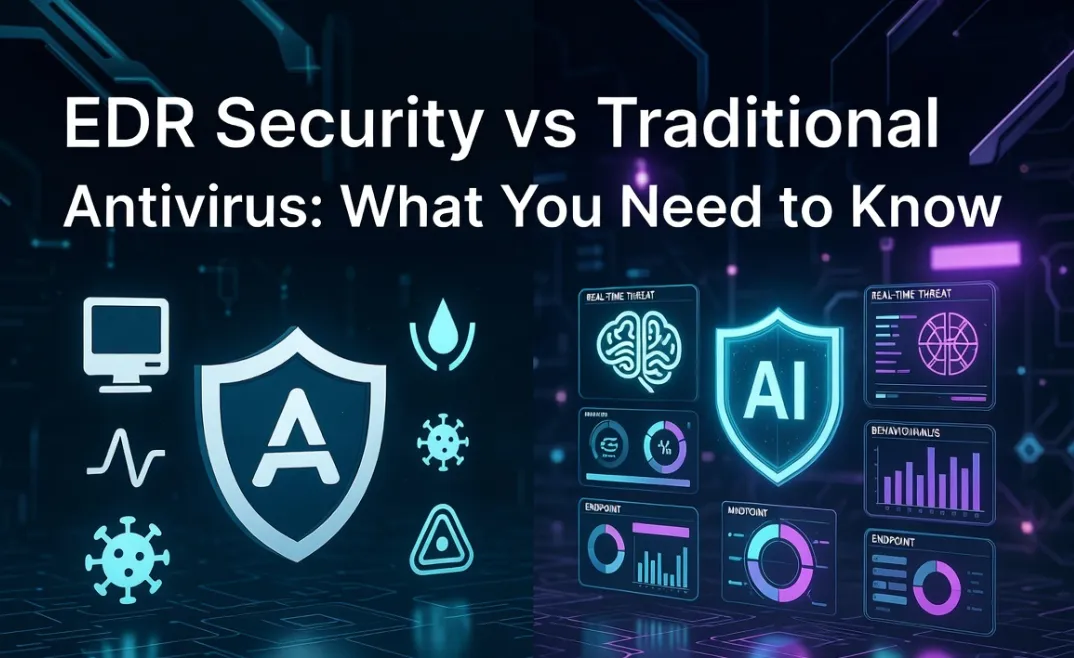

As cyberattacks grow more advanced and persistent, traditional antivirus software cannot protect modern enterprises. Signature-based tools detect only known threats, leaving organisations exposed to fileless attacks, zero-day exploits, lateral movement, and insider threats.
To stay ahead of adversaries, enterprises increasingly adopt EDR security a comprehensive, intelligence-driven approach that detects, analyses, and responds to threats in real time.
Why Traditional Antivirus Falls Short Today
Antivirus software typically relies on signature files for its function, which imposes significant restrictions on its detection capabilities as follows:
- Inability to detect new and unknown malware or polymorphic malware
- Limited visibility of endpoint behaviour
- No correlation between threats across their various attack stages
- No automated response, effectively slowing containment
Antivirus as the sole source of protection for an enterprise when dealing with advanced adversaries leaves it vulnerable.
Why EDR Security Offers a Meaningful Upgrade
Modern EDR cybersecurity platforms continuously monitor endpoints and use AI/ML to analyse suspicious behaviour. Key advantages include:
- Real-time threat detection based on behaviour, not signatures
- Deep visibility across devices, applications, and processes
- Automated containment and remediation to reduce dwell time
- Threat hunting powered by advanced analytics and threat intelligence
- Incident investigation with granular timeline reconstruction
This proactive model strengthens your defence posture and accelerates incident response.
EDR Security vs Traditional Antivirus: Key Differences
| Capability | Traditional Antivirus | EDR Security |
| Detection Method | Signatures | Behaviour + AI/ML |
| Visibility | Limited | Comprehensive endpoint telemetry |
| Response | Manual | Automated + guided remediation |
| Threat Hunting | None | Built-in |
| Zero-day Protection | Weak | Strong |
Enterprise Use Cases for EDR
- Protecting distributed and hybrid workforce environments
- Securing sensitive workloads across endpoints and servers
- Detecting insider threats and lateral movement early
- Ensuring rapid response during targeted attacks or ransomware attempts
Conclusion: EDR Is No Longer Optional
Modern enterprises need continuous visibility, proactive defence, and intelligent response capabilities. EDR security delivers these capabilities reliably—far beyond what traditional antivirus can offer.


























Sign in to leave a comment.