Businesses nowadays deal with a huge amount of sensitive data across multiple platforms, including the cloud and mobile, as well as multiple sites. Businesses now understand that cyber-attacks are becoming increasingly targeted, and therefore, it is essential that they not only protect their infrastructure but also the data itself. Data masking and anonymisation are two techniques that play a very important role in securing sensitive information; however, many IT Leaders confuse the two, as they are almost identical in nature. However, each has a distinct purpose.
Understanding the Concepts
What is Data Masking?
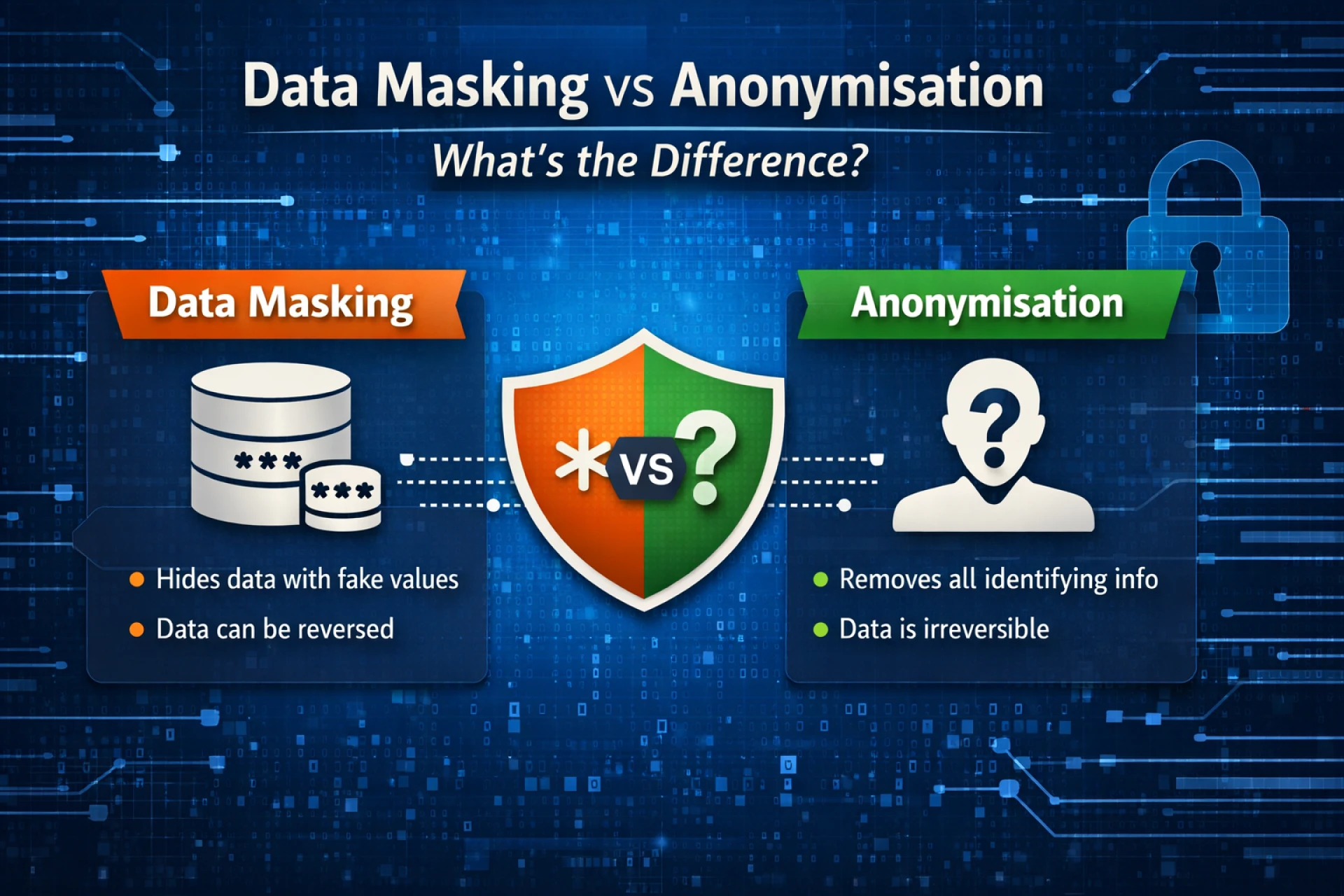
Data masking makes sensitive data appear different while preserving its format, structure, and usability. It is most often used in a team environment for non-production scenarios, e.g., development, testing, or analytics, where data must not be real.
When properly applied, masked data will maintain its appearance and structure but cannot be traced back to the original.
What is Anonymisation?
Anonymisation removes all identifying information from a data set, making the data no longer identifiable and preventing it from being reversed.
Anonymisation is thus an excellent choice for long-term analytics, data sharing, and regulatory compliance.
Where Each Technique is Appropriate
Use Cases for Data-Masking
- Safeguarding Data in Development or QA Environments.
- Safe Access for Third-Party Vendors.
- Securing Sensitive Fields during Internal Analytics.
- Keeping Realistic Data Sets to Test Software/App.
Use Cases for Anonymisation
- Wide-Scale Behavioural Analysis.
- AI/ML Model Training that Doesn’t Identify Individual Users.
- Cross-Departmental/Regulator Data Exchanges.
- Reduction of Long-Term Personal Data Storage Liability.
Compliance, Regulation & their Meaning
Globally and in India, laws (GDPR, DPDP Act, 2023, HIPAA, and PCI-DSS) require strict controls over the handling of personal data (PD) and financial information.
- The use of Data Masking helps organisations achieve compliance with operational processes by limiting access to personal and financial data.
- Anonymisation supports privacy-by-design programs and ensures that data cannot be associated with an identity.
Cyber Security Mesh Architecture-Based Solutions (such as Seqrite’s Data Privacy and Zero Trust Solutions) enable enterprises to operationalise both techniques through AI-based policy enforcement and centralised management of all Data, including data masking and anonymisation.
Closing Thoughts
Daily operations are protected by Data Masking, which masks sensitive numbers, while anonymisation provides long-term, non-recoverable privacy protection. Data Masking and Anonymization are fundamental cornerstones of today's data protection.
To enhance your data privacy approach, take advantage of Seqrite Enterprise-Grade Data Privacy Products and use Seqrite Labs' data-driven, strategic insights to make intelligent decisions.

























Sign in to leave a comment.