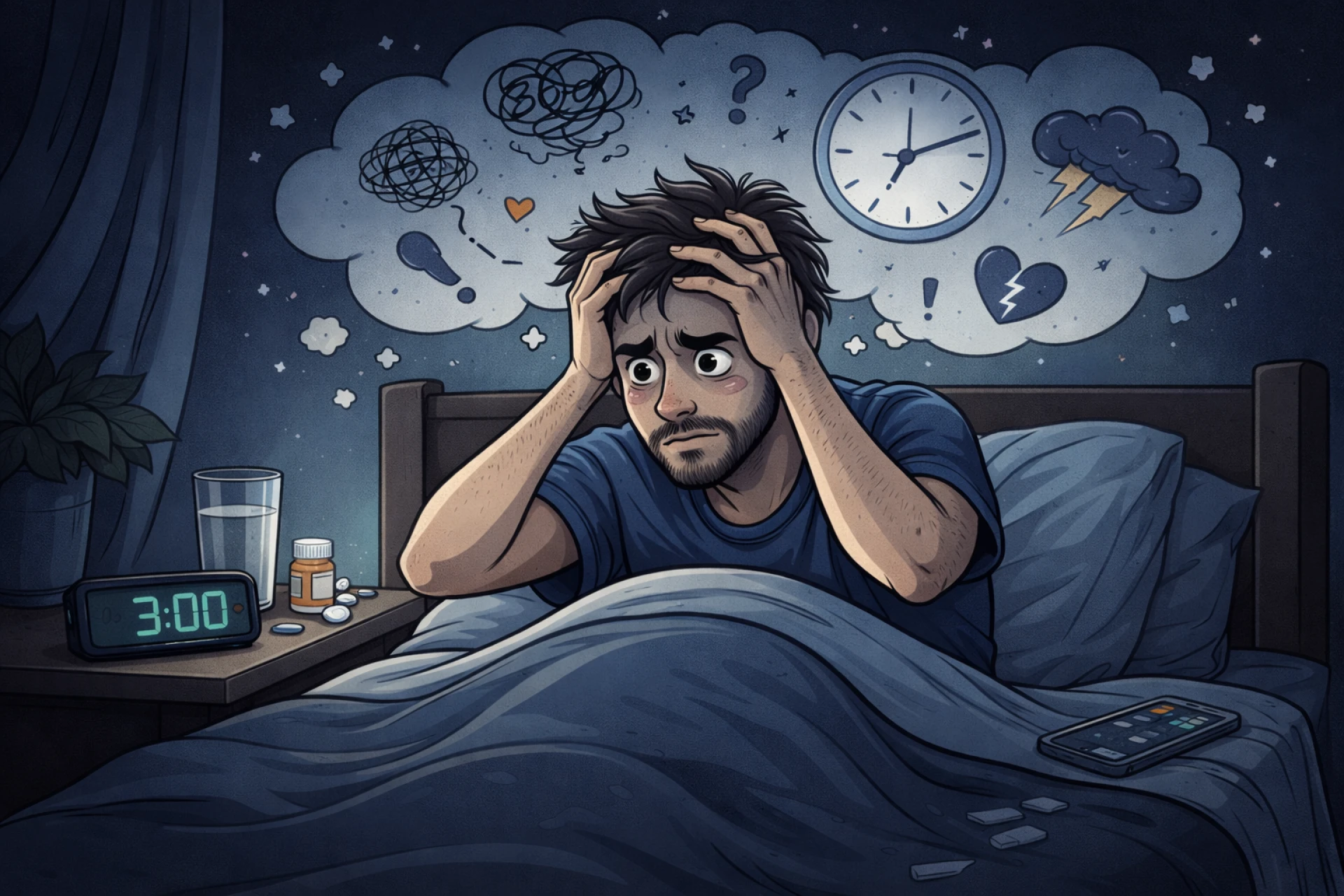

During the daytime, we are usually distracted with our day-to-day activities, which may involve going to work, looking after the family, and spending time with friends. We are busy. The anxiety, however, comes back at night.
Anxiety affects everyone differently and at different times. You may notice your anxiety gets more serious at night when you try to sleep.
Night time anxiety is not a lot different from generalized anxiety disorder (GAD). You find yourself replaying the conversations that occurred during the day, thinking about what could go wrong or what you have to do tomorrow.
You can't sleep when you feel anxious, and you may experience certain symptoms like:
- Feeling overwhelmed
- Nervousness and fear
- Digestion issues
- Rapid breathing
- Palpitations
- Sweating
Once you understand what night time anxiety is and what causes it, you can manage it effectively.
What causes night time anxiety?
Cortisol
It is a stress hormone that keeps you awake and alert. It peaks in the morning and gradually decreases as the day proceeds. The hormone remains low throughout the night.
Studies show that people who have anxiety disorders have a disrupted cortisol curve, also known as flattened cortisol, meaning their cortisol levels don't have highs or lows. When you are stressed, your cortisol levels are generally high, and you face difficulty falling asleep at night.
Amygdala and Frontal Lobe
The amygdala is the stress and survival center of the brain. When you are afraid or anxious, the amygdala lights up. The amygdala gives you fear, but the fear is essential. Imagine you find a snake while walking in a park, and you run away out of fear. At times, your fear keeps you alive.
The influence of the amygdala can become more active when you go to bed. The reasons are:
- We dream when we sleep. Dreaming or nightmares are a way to process our emotions, and the negative emotions come from the amygdala. When the amygdala becomes active, anxiety will naturally increase.
- The frontal lobe controls other parts of the brain, but it is also the source of restraint and willpower. So even if you feel anxious during the daytime, your frontal lobe prevents you from focusing on your anxiety much because you have other important tasks that need to be done, like your job or studying.
The frontal lobe also suppresses the amygdala, and in doing so, it can experience fatigue by the end of the day. We need it when we are awake. Hence, when we go to bed, the frontal lobe becomes less active. This is another reason why our night time anxiety becomes worse.
Bottom line, the part of the brain that is responsible for anxiety becomes active, whereas the part that is responsible for suppressing it reduces its activity at night.
Distraction
What we usually do is distract ourselves from what makes us anxious during the daytime using sensory distractions. Once you go to sleep and there is sensory deprivation, you notice your anxiety coming back to you in higher quantity because you have been suppressing it the entire day.
Default mode network
When you go to bed, have you ever found yourself thinking about how your day was, what you could have done better, what could go wrong, or what you will be doing the next day? This can be because the activity of the default mode network increases at night.
The default mode network is the network in our brain that is responsible for self-reflection and emotional processing. This may sound good, but in the case of people with anxiety disorders who also experience insomnia, this is a bad thing because the hyperactivity of the default mode network further triggers both insomnia and anxiety.
Melatonin
The hormone increases GABA and hence suppresses the amygdala so that we don't get anxious at night. When you have anxiety, your melatonin production may be disrupted, and it cannot suppress the amygdala. As a result, your anxiety gets worse at night, and you have trouble falling asleep.
How to calm anxiety at night?
If you suffer from night time anxiety, you can take a few steps to regulate your anxiety and improve the quality of your sleep.
Try establishing a bedtime routine where you go to bed every day around the same time and avoid using any screen before that. Reading a book before going to sleep or practicing yoga can also prove beneficial in case of insomnia.
Look around and see what you can physically touch or feel with your five senses, like your pillow, and smell your blanket. Once you can focus on your present, you stop your thoughts from spiraling, and you can feel your breathing getting normal.
Treating your daytime anxiety can certainly help with your night time anxiety. Cognitive behavioral therapy (CBT), under the guidance of an anxiety specialist, can help you stop thinking of your bed as a place to worry or overthink and make it seem like a place where you feel safe and can relax.
When to seek help?
Although lifestyle changes can provide relief to many people, if they don't help you, it may be time to consider seeking professional help. You should consider reaching out to a mental health professional if:
- Anxiety begins disrupting your daily life, and you're unable to do your usual tasks.
- You are unable to sleep or remain asleep.
- You feel like you can't breathe and experience frequent panic attacks.
- Your anxiety symptoms have been occurring for over two weeks or longer.
Night time anxiety affects more than your sleep; it doesn't end with the night. You carry it to the next day, and the cycle continues. Once you understand why your anxiety increases at night, you can move toward breaking the cycle.
If you are unable to calm your anxiety using natural methods, you can consider approaching an online psychiatrist who will help you understand the root cause of your anxiety and guide you toward better health and sleep.
Remember that reaching out for help is not a sign of weakness. It shows you are willing to take care of yourself to improve your quality of life.
Seeking help also requires courage.



























Sign in to leave a comment.