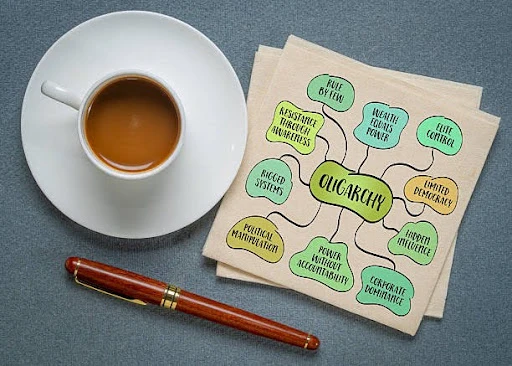

Though the word oligarchy may conjure up memories of old political theory, it is actually still very pertinent now. Although many countries profess to be democracies, power usually rests in a few people or groups wealthy elites, corporate magnates, or political families echoing the very structure of an oligarchy.
Oligarchies are what?
Meaning rule by the few, oligarchy comes from the Greek words oligos (few) and arkhein (to rule). In an oligarchic system, a small and privileged group controls a more numerous populace often without fair or open public participation.
Based on: oligarchies
- Wealth (Plutocracy)
- Noble or Family Lineage (Aristocracy)
- Military Might (Stratocracy)
- Religious Authority (Theocratic Oligarchy)
- Corporate Oligarchy: Corporate Influence
Oligarchy is distinguished not so much by how power is obtained but by how it is held and practiced, frequently behind closed doors, with little public input or opposition.
Historical Examples of Oligarchy
Ancient Greece
Though Athens is acknowledged as the birthplace of democracy, many Greek city states, including Sparta, were oligarchies where a small number of affluent inhabitants held control over government. Political rights were first limited to a small group of free landowner males even in Athens.
Roman Republic
Though partly elected, the patricians, wealthy families with actual influence, dominated the Roman Senate, hence influencing law and policy.
Florence and Venice
Wealthy merchant families ruled city states like Venice during the Renaissance. The Medici family dominated politics, religion, and art in Florence using their financial resources derived from banking.
imperial Russia
Russian czars and nobles ran an oligarchical system under the guise of monarchy prior to the 1917 revolution, with little political participation for farmers and workers.
Contemporary Examples of Oligarchy
Few nations formally identify as oligarchies nowadays, yet several modern states show oligarchic traits:
Russian
During privatization following the collapse of the Soviet Union, a tiny group of businesspeople, known as oligarchs, acquired major state assets. Many of them built strong alliances with political leaders, especially under President Vladimir Putin, therefore concentrating authority in few.
China
Though under the control of the Communist Party, China is run as a political oligarchy. The state, military, and economy are under the direction of a small faction of party elite. Decision Making is very centralized with little public participation.
Debated United States
Although the United States is a constitutional republic, opponents contend that its political system displays oligarchic tendencies. Frequent influence on policy results from large campaign contributions, corporate lobbying, and ultra wealthy people's lobbying. Public opinion frequently counts less. According to a Princeton study conducted in 2014, the preferences of the elite in the United States have significantly greater influence on policy than the interests of average voters.
Saudi Arabia
Though it is a hereditary monarchy, Saudi Arabia also operates as an oligarchy in that top clerics and the royal family hold the bulk of power. Governance and law are much influenced by religious and tribal elites.
Main Characteristics of Oligarchy
Although oligarchies can vary depending on time period and culture, they usually have the following characteristics:
1. Control of power
Usually unelected and unaccountable to the public, a tiny elite hold decision-making power in their hands.
2. Domination in the economy
Usually governing significant sectors, media, banks, or natural resources, oligarchs have power over both the political system and the economy.
3. Relatively low political contest
Money, media power, or limited candidacy may all affect elections (if any). Therefore, genuine opposition is hard.
4. Policies that are favorably biased
Often molded to serve the interests of the elite, rules and policies are shaped using tax loopholes, subsidies, or advantageous legislation.
5. Condensation of Dissent
In many oligarchies, opposition is stifled or penalised by censorship, intimidation, or control over judicial systems.
Advantages of oligarchy (according to supporters)
Although usually seen negatively, some claim that oligarchies have advantages:
Small groups can make quick policy decisions without the gridlock often found in big countries.
Economic Stability:
Oligarchs can advocate business-friendly measures that steady markets and draw in money.
Long-term Planning:
Without frequent elections, elites may concentrate on long-run policies instead of immediate popularity.
These benefits are frequently used to support power retention rather than increase the general good.
Oligarchy's drawbacks
The drawbacks of oligarchic government are far more commonly known:
1. Money Disparity
Because oligarchies often distribute wealth and income among the wealthy, the difference between rich and poor grows and social mobility drops.
2. Political Bribery
Oligarchs often engage in corruption using coercion, nepotism, or bribery in order to retain their authority.
To keep their power, oligarchs frequently participate in corruption employing coercion, nepotism, or bribery.
3. Erosion of Democracies
Public engagement, elections, and responsibility decrease, therefore destabilizing democracy processes.
4. Civil Unrest
Protests, strikes, and political instability follow the rise in exclusion and inequality.
Maintaining Power by Oligarchies
Oligarchies have several ways of keeping their power:
Owning or controlling media shapes public opinion and inhibits dissent.
Legal Systems:
Often used to safeguard elite interests and penalise dissent, courts and legislation also serve this purpose.
Education Control:
Curricula could be geared to support elite narratives or to prevent critical thought.
Force is used to stifle demonstrations or attempts at reform as well as safeguard property.
Oligarchy: Can a country avoid it?
It's hard but possible to move away from oligarchies. It usually entails:
Ensuring equitable voting systems and lowering the power of money in politics are electoral reform.
Transparency:
- Improving institutions so that leaders are responsible.
- Helping activist, journalistic, and watchdog organizations.
Education:
- Encouraging civil education so that people are empowered to challenge authority and advocate equality.
- Through public pressure and reforms, nations like South Korea and some postSoviet states have made remarkable progress in decreasing oligarchic influence.
Conclusion
Oligarchy, the few rules, is not only an idea from ancient philosophy. Often inside systems purporting to be democratic. It still exists today in both obvious and subtle forms.When a small group controls politics, riches, and the media, the ideals of liberty, justice, and equality are compromised.
Anyone who backs participative governance, economic justice, and the power of the people first needs to recognize and challenge oligarchical systems. Creating a more inclusive and responsible society calls knowing how power truly operates and who wields it whether via reform, activism, or education





























Sign in to leave a comment.