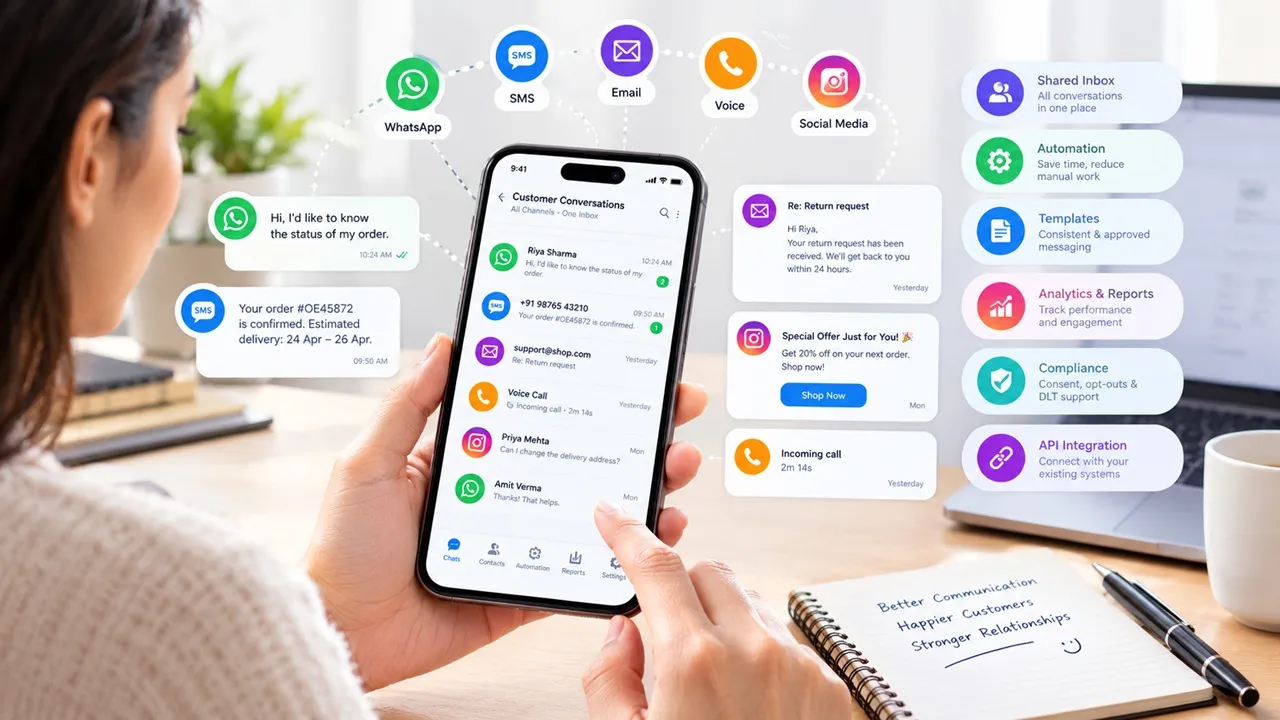

The repeated questions, lost context and slow replies that customers notice first
Omnichannel communication fixes one big problem: customers having to repeat themselves. When SMS, WhatsApp, email and calls share one record, your team sees the full story. The customer gets one continuous conversation, not five separate ones.
Here is what that looks like, and what it cannot fix.
Omnichannel vs Multi-Channel Communication
These two terms sound alike but they work differently.
- Multi-channel communication means you are present on many channels. Each one may run by a different team with its own records.
- Omnichannel Communication means those channels are connected. A message on WhatsApp, a call and an email all land in the same customer record.
Being on five channels is not the same as being joined up across five channels.
A Familiar Story
A customer messages on WhatsApp about a delayed order. Nobody replies for a day. She calls the helpline. A new agent asks for her order number again. She emails. Another agent asks the same question.
Three channels. Three agents. Zero shared context. She is not angry about the delay anymore. She is angry about the process.
What Omnichannel Communication Fixes
1. Repeating the same details
When all messages sit in one thread, any agent can read the history. The customer says it once.
2. Slow or missed replies
A single inbox shows who is waiting and for how long. Messages are less likely to fall between teams.
3. Mixed messages from different teams
Sales promises one thing on email. Support says another on SMS. With shared records, both see the same facts.
4. Poor timing
If a customer already replied on WhatsApp, you can skip the reminder SMS. That avoids annoying people with duplicate nudges.
5. Guesswork in customer engagement
You can see which channel each person actually responds to. Then you send there first.
What It Does Not Fix
- Slow internal processes. If refunds take two weeks, connected chat will not speed that up.
- Untrained staff. A good tool still needs people who know what to say.
- Bad data. If customer records are wrong, they will be wrong in every channel.
- Too many messages. More channels can mean more noise if you are not careful.
Practical Examples
- A clinic sends an SMS reminder. The patient replies on WhatsApp to reschedule. The front desk sees both in one thread.
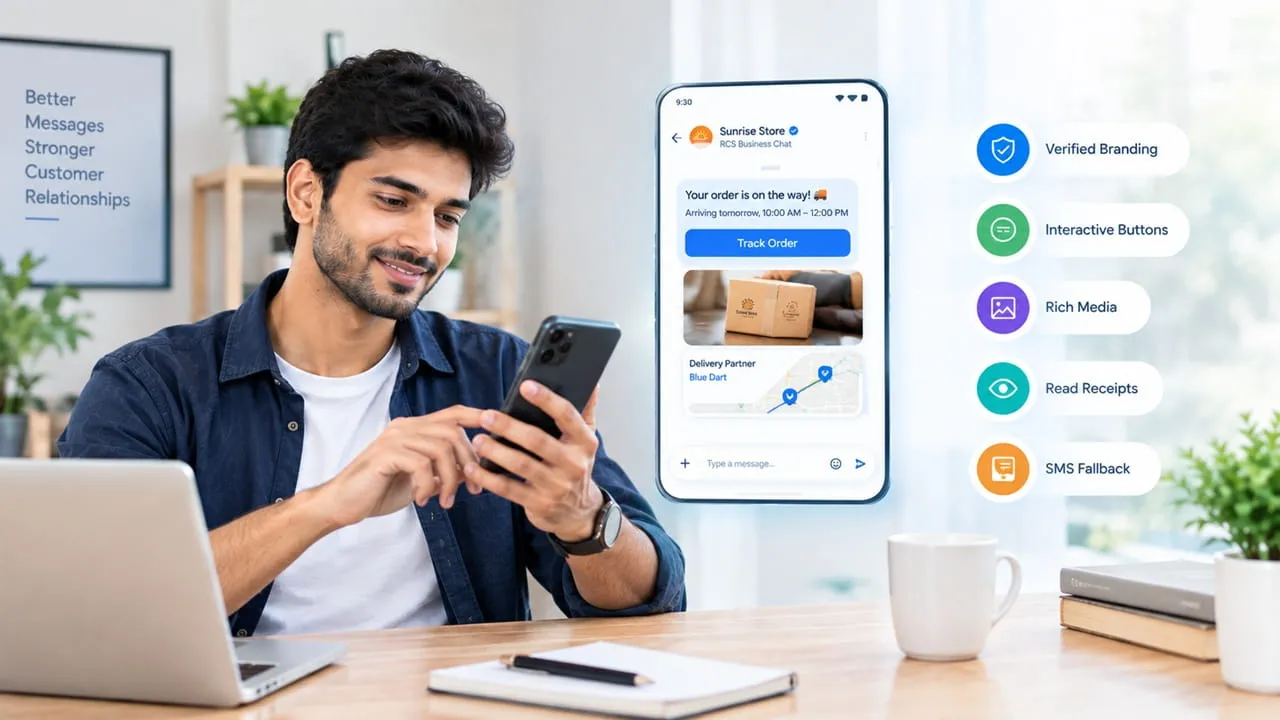
- An online store sends an order update by RCS. The buyer asks about a return by email. Support sees the earlier update and replies in context.
- A bank sends an OTP by SMS and a statement alert by email. A call centre agent sees both when the customer phones.
Common Mistakes When Setting Up Omnichannel Messaging
- Adding every channel at once. Start with two or three.
- Not agreeing on who owns the conversation. Someone must be responsible.
- Skipping consent rules. Follow TRAI, DLT and the DPDP Act for Indian customers.
- Ignoring handover. When a bot passes a chat to a person, the history must travel with it.
How to Start
- List the channels customers already use to reach you.
- Pick the two with the most traffic.
- Join them in one inbox with a shared customer record.
- Set simple rules for who replies and how fast.
- Review after a month. Add another channel only if the first two work.
What Customers Notice First
Customers rarely say 'we need omnichannel.' They say things like 'Why do I keep explaining this?' or 'Nobody answers on chat.' Those complaints point straight at broken handovers between channels.
When handovers improve, small things change. Agents greet customers with context. Follow-ups reference earlier chats. Customers stop saying 'as I told your colleague.' These are small shifts, but they add up to trust.
What It Means for Your Team
Agents also gain from a joined-up view. They spend less time searching through tools and more time solving problems. New joiners learn faster because they can read past conversations. Managers can see where chats stall and fix the cause.
That said, the team needs clear rules. Decide who picks up a chat, how long it can wait and when to escalate. Without rules, a shared inbox can become a shared mess.
A Quick Self-Check
Ask your team three questions.
- Can any agent see a customer's past chats on every channel?
- Does a reply on one channel stop duplicate reminders on another?
- Can a customer switch channels without starting over, even midway through a complaint?
If the answer to any of these is no, you have a gap worth closing first.
Key Takeaways
- Omnichannel messaging links every channel to one customer history.
- It is different from multi-channel communication, where channels run separately.
- The biggest wins are fewer repeated questions and faster replies.
- A better omnichannel customer experience also helps teams, not just customers.
- It will not fix poor service, thin training or unclear processes.
- Start by connecting two channels your customers already use.
Conclusion
Omnichannel communication will not fix everything. It does fix the most common irritation customers have: telling their story again and again. Join up two channels first and see what changes.
A note on setup: Arihant Global Services, a Jaipur-based digital marketing and CPaaS company, works with businesses on messaging setups like these. Teams often start by fixing one channel before adding the next.
Frequently Asked Questions
Q1. What is omnichannel communication in simple words?
It means your channels talk to each other. The customer can switch from chat to call to email without starting over.
Q2. Is omnichannel only for large companies?
No. Small teams benefit too, since they often have fewer people to handle repeated questions.
Q3. Which channels should I connect first?
Begin with the ones your customers already use most, such as WhatsApp, SMS and email.
Q4. Does omnichannel replace human agents?
No. It gives agents the information they need. Bots can handle simple tasks and hand over the rest.
Q5. How do I know if it is working?
Watch first response time, repeat questions per customer and customer satisfaction scores.























Sign in to leave a comment.