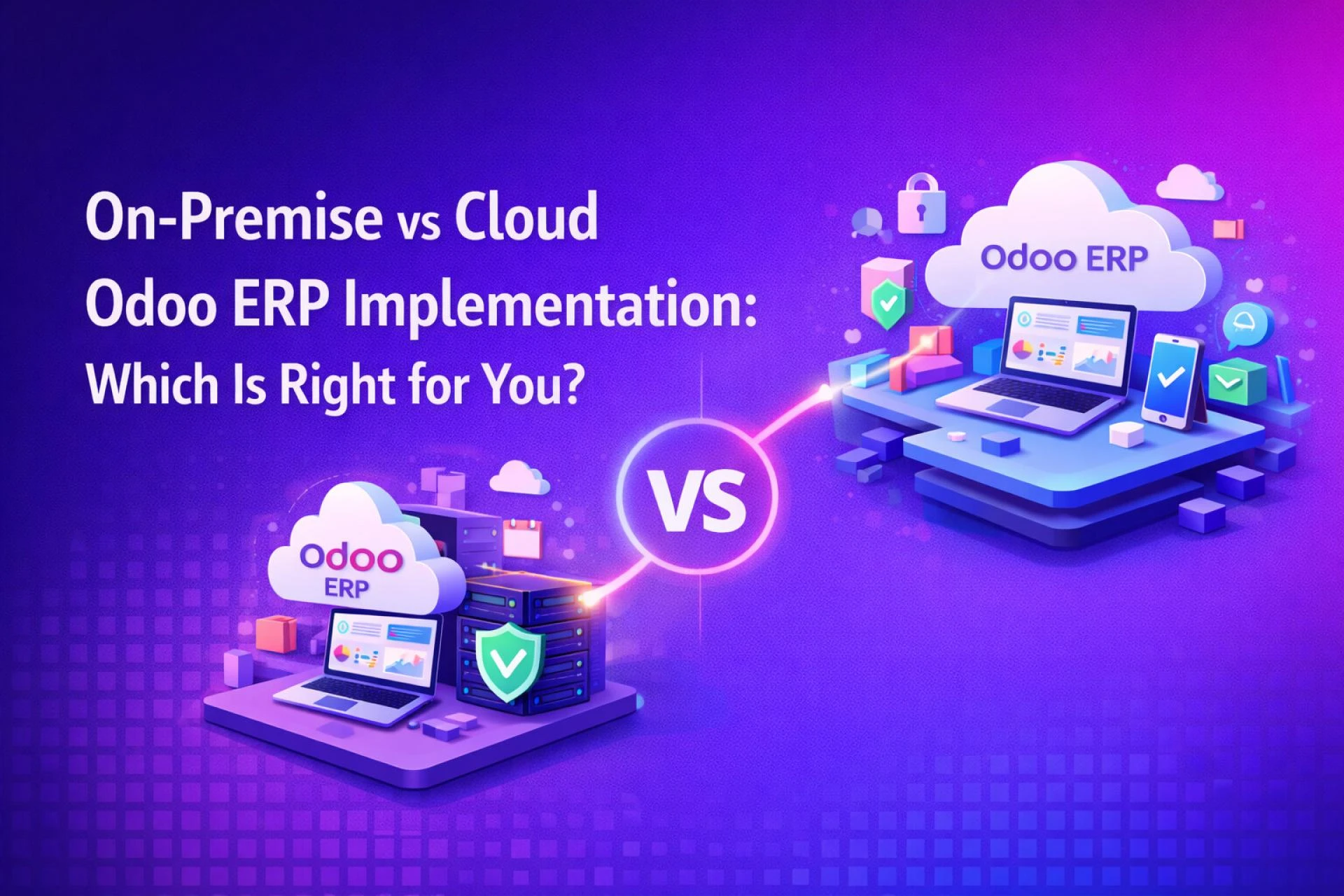

Choosing the right ERP deployment model can make or break your digital transformation. When it comes to Odoo ERP implementation, businesses often face a critical decision: On-Premise vs Cloud Odoo ERP. The stakes are high impacting costs, performance, security, flexibility, and long-term growth. Before diving in, it’s worth noting that the right strategy involves not only the technical choice but also trusted Odoo Development services to guide the implementation journey from planning to optimization.
Why Deployment Choice Matters in Odoo ERP Implementation
Odoo’s modular suite can adapt to diverse industries manufacturing, distribution, retail, services, and beyond. However, the technical foundation whether on-premise or cloud influences everything from ROI to user experience.
What Does “On-Premise vs Cloud Odoo ERP” Really Mean?
At a high level:
- On-Premise: You host Odoo on your own servers; your IT team manages infrastructure, security, and updates. You have full control.
- Cloud: Odoo runs on remote servers managed by the provider or a partner, delivered as a subscription-based service, with maintenance, updates, and backups handled externally by the vendor.
1. Deployment & Implementation Timeline
One of the biggest practical considerations in choosing between On-Premise vs Cloud Odoo ERP implementation is speed to go-live:
On-Premise Deployment
Setting up on-site servers, configuring networking, and ensuring security compliance can stretch implementation to several months or longer. This is especially true when significant customization, integrations, or hardware upgrades are involved.
Best suited for: Businesses with established IT teams and complex customization needs.
Cloud ERP Implementation
Cloud deployments are typically faster because you skip hardware procurement and infrastructure setup. Vendors can provision environments, populate initial data, and configure modules rapidly often within weeks.
Best suited for: Organisations that need quick deployment, agility, and predictable budgets.
2. Cost Considerations: CAPEX vs OPEX
Budget modeling is where the contrasts become very real.
On-Premise Costs
- High upfront capital expenditure (servers, storage, licenses)
- Ongoing costs for IT staff, infrastructure maintenance, and support
- Customization budgets tend to be higher due to bespoke development and infrastructure tuning
Example: A mid-size enterprise might spend significantly on hardware and dedicated resources before seeing productivity gains.
Cloud ERP Costs
- Lower upfront investment
- Predictable operating expenses (subscription model) covering hosting, maintenance, and support
- No hardware to deploy or maintain — your monthly cost adjusts with business growth
Pro tip: While on-premise may seem cheaper long-term for very large enterprises with existing infrastructure, cloud often wins for small to mid-size businesses due to minimal barriers to entry.
3. Scalability & Flexibility
Cloud Odoo ERP Scalability
Cloud platforms shine when it comes to scaling. Adding users, modules, or business units can often be done without downtime or infrastructure redesign.
For example, a growing distributor can easily onboard additional warehouses or remote sites without incurring hardware costs.
On-Premise Scalability
Scaling on-premise requires hardware expansion or network upgrades, which can be slow and expensive. Yet, for organizations that must customize deeply or operate in highly controlled environments (e.g., defense, certain financial sectors), this trade-off may be acceptable.
4. Customization & Control
On-Premise ERP Customization
This model offers full control you can modify workflows, tailor modules extensively, and even tweak underlying code. For businesses with unique processes, this depth of customization can be invaluable.
Case Insight: A manufacturing firm with intricate production planning might choose on-premise to embed industry-specific logic that wouldn’t easily fit into a SaaS template.
Cloud ERP Configuration
Cloud solutions usually provide configuration and extension capabilities without full source-level access. Custom modules can still be deployed, but changes must align with governance rules to ensure compatibility and maintainability.
Cloud is ideal when agility and ease of updates outweigh extensive bespoke development needs.
5. Security & Compliance
On-Premise Data Control
Advantages include total control over security policies, data residency, and compliance enforcement. This can be crucial for sectors with strict data sovereignty rules.
Cloud Security Paradigm
Vendor-managed security means encryption, automated patching, redundant backups, and enterprise-grade protocols often surpassing what many mid-size companies can build in-house.
Important: Cloud ERP’s security is shared between the vendor and your IT/operations teams — but with strong SLAs and continuous monitoring.
6. Accessibility & Remote Work
Cloud ERP wins here users can securely access their Odoo environment from anywhere with an internet connection, enabling collaboration across teams and locations.
On-premise setups require VPNs or remote access tools, adding complexity and potential latency.
Real World Comparison Example
| Deployment Factor | On-Premise Odoo ERP | Cloud Odoo ERP |
| Upfront Cost | High | Low |
| Deployment Time | Weeks to Months | Weeks |
| Maintenance | In-house | Vendor managed |
| Scalability | Hardware dependent | Flexible subscription |
| Security Control | Full | Shared (vendor + business) |
| Remote Access | Complex | Built-in |
Which Odoo ERP Deployment Is Right for Your Business?
Here’s how to think about it:
- Best for Enterprises with Unique Requirements & IT Strength: On-Premise ERP reigns when control, customisation, and compliance are paramount.
- Best for Growth-Oriented, Agile Businesses: Cloud Odoo ERP is ideal for scalability, rapid deployment, and reduced overhead.
- Hybrid Approach: Some companies adopt a hybrid — core operations on-premise with select modules or analytics in the cloud — combining control with agility.
Internal & External Link Suggestions
Internal
- Link to a guide on Odoo ERP modules or implementation steps.
- Link to case studies showing Odoo deployment success in similar industries.
External
- Link to Odoo’s official deployment documentation.
- Link to reputable ERP industry reports for credibility and trust signals.
Conclusion: Choose With Clarity & Expert Support
Whether you're leaning toward On-Premise or Cloud Odoo ERP, the goal is to match deployment strategy with business priorities budget, size, security, and growth trajectory. Cloud offers agility and predictable costs; on-premise offers control and deep customisation. Often, the best choice aligns with where your business is headed, not just where it is now.
For a smooth transition and optimal results, partnering with Trusted Odoo ERP Implementation services ensures that your deployment regardless of the model is done right. With the right expertise, you minimize risk, accelerate ROI, and empower your teams with a system that truly supports your vision.



























Sign in to leave a comment.