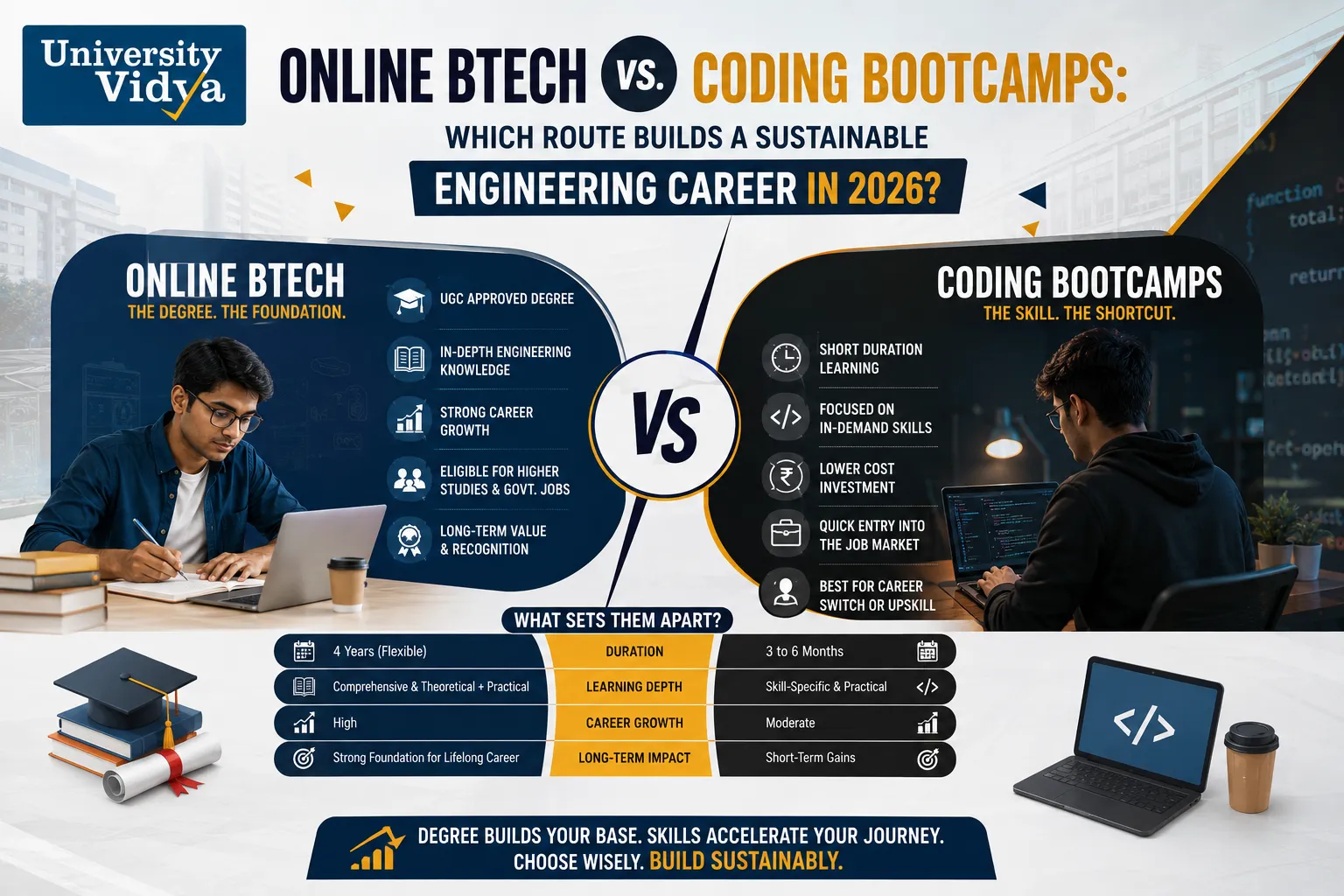

The tech industry in 2026 looks vastly different than it did just a half-decade ago. With advanced artificial intelligence automating basic programming scripts and boilerplate code, the corporate demand for simple "code monkeys" has plummeted. Today's top-tier recruiters are aggressively hunting for systems architects, deep problem solvers, and visionary technical leaders.
If you are trying to break into the tech sector or upgrade your current career, you are likely facing a massive educational dilemma. Should you enroll in a quick, specialized coding bootcamp, or should you invest your time in a comprehensive Online B.tech? Both options promise lucrative tech salaries, but their long-term career trajectories are entirely different.
In this comprehensive guide, we will break down the current hiring realities of 2026. You will discover exactly which educational route offers real job security and builds a sustainable, future-proof engineering career.
The 2026 Tech Landscape: Why Fundamentals Matter Again?
During the massive tech boom of the early 2020s, companies were desperate for anyone who could build a basic web application. Coding bootcamps thrived in this environment, churning out thousands of developers trained in a single, specific software framework. However, the paradigm has completely shifted as AI tools now easily handle those exact repetitive tasks.
Modern employers no longer pay premium salaries for someone who merely knows how to type out React or Node.js syntax. They require engineers who understand what happens deep inside the computer's memory when that code is executed. They need professionals who can design scalable cloud architectures, optimize algorithms, and secure massive data pipelines.
This requires a deep, fundamental understanding of computer science that a rapid, six-month bootcamp simply cannot provide.
The Allure (and Limitations) of Coding Bootcamps
Coding bootcamps are incredibly tempting because they promise high-speed results with a lower upfront cost. They focus purely on the exact coding languages that are currently trending in the job market. For someone looking to grab an entry-level junior web developer role as quickly as possible, they can be highly effective.
However, the major limitation of a bootcamp is its extremely shallow theoretical depth. Students are taught how to use a specific software tool, but they are rarely taught why that tool works mathematically. When a new technology eventually replaces the framework they learned, bootcamp graduates often struggle to adapt.
Furthermore, bootcamps completely skip critical engineering subjects like discrete mathematics, operating systems, and hardware-software integration. Without this foundational knowledge, tackling advanced fields like machine learning, cybersecurity, or embedded systems becomes nearly impossible.
Why Does a Formal Degree Offer Unmatched Longevity?
A university engineering curriculum is meticulously designed to create adaptable, lifelong problem solvers. When you enroll in an accredited Online Engineering Course, you are not just memorizing today's popular coding syntax. You are studying the timeless, mathematical laws of computing that will remain relevant for the next fifty years.
This deep theoretical foundation makes formal degree holders incredibly resilient to industry shifts. When a new programming language emerges, an engineer does not need to start from scratch. They can master it in a weekend because they already understand the core logic governing all software development.
3 Reasons Degrees Outperform Bootcamps Long-Term
To understand the long-term career impact, consider these three distinct advantages of a formal degree:
- Algorithmic Efficiency: Degree programs rigorously test your ability to write code that scales without crashing servers. This mathematical optimization is crucial for enterprise-level applications.
- Hardware Understanding: Knowing how software interacts with physical processors and memory allocation separates a true engineer from a basic programmer.
- Global Recognition: A formal university degree is universally respected by international employers, visa processing agencies, and government sectors, whereas bootcamp certificates are frequently rejected.
The Hidden Glass Ceiling: Advancing to Tech Leadership
Getting your foot in the door is only the first step of a sustainable tech career. Eventually, you will want to transition from writing code to leading teams and managing multi-million-dollar tech budgets. This is where bootcamp graduates inevitably hit a frustrating, impenetrable glass ceiling.
Corporate HR departments still heavily utilize degree requirements as strict filtering mechanisms for senior management tracks. Without a recognized bachelor’s degree, moving into a lucrative Lead Engineer or Chief Technology Officer (CTO) role is highly unlikely. Your practical skills might be excellent, but corporate bureaucracy will stall your promotion.
Additionally, a bachelor's degree serves as the mandatory academic gateway for higher specialization. If you ever wish to pursue an Online M.tech to dominate niche fields like Artificial Intelligence or Quantum Computing, you must have a formal undergraduate degree first. A bootcamp certificate simply will not qualify you for graduate-level university admissions.
Ensuring Your Degree Holds Corporate Weight
It is important to note that not all digital university programs are created equal in the eyes of tech recruiters. Enrolling in an outdated, unaccredited program is just as dangerous as having no degree at all. You must ensure your chosen university is strictly approved by bodies like the UGC and AICTE.
Navigating these accreditations and choosing the right technical specialization can be incredibly overwhelming for a working adult. This is exactly why utilizing a trusted educational advisory platform like University Vidya is the smartest first step. They expertly guide you toward fully accredited, industry-aligned programs that modern tech companies deeply respect.
Make the Smart Investment in Your Future
In 2026, the tech industry does not need more fast-tracked coders; it desperately needs highly trained, adaptable engineers. While a bootcamp might offer a quick sprint into an entry-level job, a formal degree builds a robust marathon-ready career. It provides the deep theoretical roots required to survive AI automation and climb the corporate ladder.
Do not sacrifice your long-term career sustainability for a short-term educational shortcut. Take control of your professional trajectory by investing in recognized, comprehensive engineering fundamentals. Reach out to academic experts today to explore your accredited digital degree options and build a tech career that lasts a lifetime.


























Sign in to leave a comment.