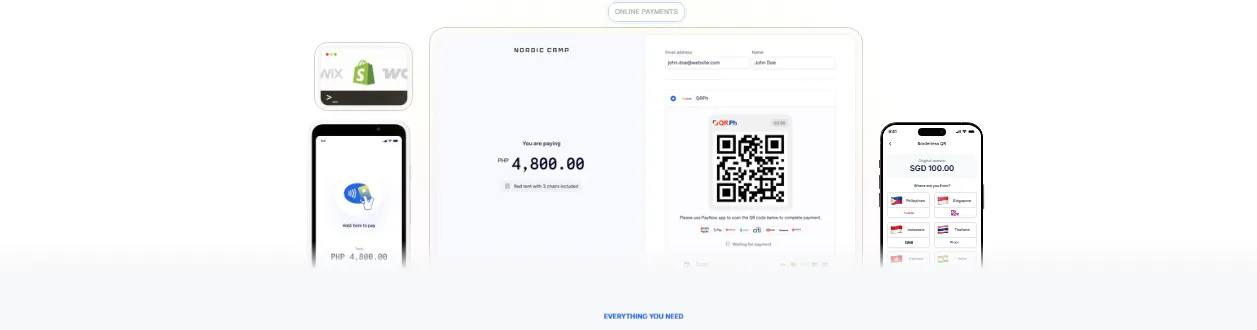

With digital wallets surpassing cash at checkout, choosing the right payment gateway is no longer optional — it's your competitive edge.
55%+
Retail payments now digital (BSP 2025)
100M+
GCash & Maya combined users
₱1.2T
eCommerce GDP contribution est.
The Philippines has undergone one of the most dramatic payment transformations in Southeast Asia. What started as a cash-first, bank-branch-dependent economy has evolved into a mobile-wallet-powered digital marketplace. For businesses of every size — from sari-sari stores in Cebu to tech startups in BGC — the question is no longer whether to accept digital payments, but which platform will serve you best.
This guide breaks down the online payment for business philippines landscape honestly: the top competitors, their real strengths and weaknesses, and how newer platforms are reshaping what small and medium enterprises should expect from their payment stack.
Why the payment gateway you choose matters more than ever
The Bangko Sentral ng Pilipinas (BSP) has been aggressively pushing the country toward a cash-lite economy. QR Ph has become a standardized interoperable payment rail, GCash and Maya are embedded in everyday life, and PESONet and InstaPay have made bank-to-bank transfers faster and cheaper. For merchants, this shift means one critical thing: your checkout experience is now a conversion factor, not just a back-end process.
A customer who can't pay with GCash at checkout doesn't complain — they simply leave. A business that settles payments slowly bleeds cash flow. Choosing the wrong gateway means paying excess fees on every single transaction, for years. These are real costs, and they're avoidable.
Digital wallet payments accounted for 34% of electronic transactions in the Philippines in 2024, while card payments represent 31% of the market — a gap that continues to widen in favor of e-wallets.
The top 5 competitors: an honest breakdown
Top 5 payment gateways · Philippines 2025–2026
1 HitPay
Best for: SMEs, startups & multi-channel Philippine businesses
Strengths
- Native GCash, QR Ph, InstaPay, PESONet — no custom dev needed
- No setup fees, no monthly fees — pay per transaction only
- Next-day payouts — critical for tight cash flow
- Online + POS + invoicing in one dashboard
- BSP & MAS regulated; 50+ payment methods, 150+ currencies
Built for Southeast Asia — strong regional expansion support
Limitations
- Newer brand — less name recognition locally vs. PayMongo
- Developer community still growing in PH market
- Enterprise-tier disbursement features still maturing
- Why it choose: HitPay uniquely combines local payment method depth (GCash, QR Ph, PESONet, InstaPay, OTC) with zero monthly overhead and next-day settlement — the combination that matters most for Philippine SMEs managing cash flow on slim margins. Its single dashboard for online, POS, and invoicing removes the need for multiple tools.
2 PayMongo
Strengths
- Y Combinator-backed — strong local startup credibility
- Clean API; easy no-code payment links
- No setup or annual fees
Accepts GCash, Maya, cards, QR Ph
Limitations
- No PESONet or InstaPay support
- No accounting integrations — manual reconciliation
- Limited e-commerce plugins vs. rivals
- No built-in POS solution
- Bottom line: A solid choice for pure digital businesses that don't need bank transfer rails or offline selling. Falls short for omnichannel or operationally complex setups.
3 Xendit
Strengths
- Full financial infrastructure — payments + disbursements
- Scales from startup to large enterprise
- Strong marketplace payout tooling
- $515M+ total funding — stable long-term bet
Limitations
- Complex setup — not ideal for lean teams
- Indonesia-origin; PH-specific support can lag
- Pricing less transparent for SME tier
- Overkill for most small businesses
- Bottom line: Powerful infrastructure for businesses that need disbursements, marketplace splits, or complex payment flows. Unnecessarily heavy for most MSMEs.
4 Maya Business
Strengths
- Largest non-bank acquirer in the Philippines
- Strong native Maya wallet ecosystem
- Deep POS + online integration for physical stores
- Broad merchant acceptance across everyday verticals
Limitations
- Ecosystem lock-in — ties you to Maya infrastructure
- Cross-border capability limited
- Smaller developer community than PayMongo or Xendit
- Less flexible for pure online-only businesses
Bottom line: Excellent if you're a physical retailer with meaningful Maya-wallet customers. Less compelling for digital-first or export-oriented businesses.
5 Dragonpay
Strengths
- Longest-established gateway in PH — trusted by major brands
- Widest OTC & bank channel coverage
Handles cash-based customers other gateways ignore
Limitations
- High historical setup fee (₱36,000)
- Older tech stack — less developer-friendly
- Not optimised for real-time e-wallet flows
- UI and onboarding feel dated vs. newer players
- Bottom line: Still the best option if a meaningful share of your customers pay via bank deposit or over-the-counter at convenience stores. Otherwise, newer platforms have surpassed it.
What the market is missing — and where HitPay fits
One notable gap across most of the above platforms is a unified solution that handles online payments, physical POS, and invoicing from a single dashboard — without charging monthly fees or requiring custom development for local payment methods. This is where HitPay, a Southeast Asia-focused payment gateway, has found its footing among Philippine SMEs.
HitPay natively supports GCash, QR Ph, InstaPay, PESONet, and over-the-counter payments, alongside international cards. It operates on a pay-per-transaction model with no setup or monthly fees — a structure that tends to work well for businesses with variable or seasonal revenue. It's also regulated by both the BSP and Singapore's MAS, which matters for businesses with cross-border ambitions in Southeast Asia.
For businesses comparing options on fee structures: HitPay charges approximately 3% + ₱15 for local card transactions and around 2.3% for GCash, compared to competitors who typically charge 3.5% + ₱15 for cards and 2.5% for GCash. Next-day payouts are also a differentiator for cash-flow-sensitive operations. That said, the right platform still depends on your transaction mix, volume, and integration needs — no single gateway is universally best.
The real question isn't which gateway has the lowest headline rate. It's which one has the lowest effective blended rate across your actual mix of payment methods, volume, and order values.
How to choose the right payment gateway for your Philippine business
With so many options, the decision framework matters more than any single feature comparison. Here's how to think through it:
- Know your customer's payment preference. If 70% of your customers use GCash, prioritize low GCash rates above card rates.
- Calculate blended effective rate. Run your actual transaction mix through each platform's fee schedule — not just the headline MDR.
- Assess settlement speed. Next-day payouts vs. 3-day cycles can mean thousands in locked cash each month for a growing business.
- Think beyond checkout. Do you need POS? Invoicing? Recurring billing? A platform that handles multiple channels saves you integration headaches.
- Plan for scale. If you plan to expand regionally across SEA, choose a gateway with multi-country infrastructure already in place.
- Check compliance. Confirm the gateway is registered with the BSP as a regulated payment service provider.
The bottom line for Filipino business owners
The Philippine digital payments market is no longer nascent — it is competitive, regulated, and rapidly maturing. Customers expect frictionless GCash or card checkout as table stakes, not a bonus feature. Businesses that still treat online payment as an afterthought are quietly losing sales to competitors who have optimized their checkout flow.
The good news is that the options available to Philippine MSMEs today are genuinely strong. Whether you're a solopreneur sending payment links, an e-commerce store handling hundreds of orders a day, or a multi-location retailer balancing POS and online channels - there is a platform built for your specific situation.
The key is to stop choosing based on brand recognition alone and start choosing based on your actual numbers: transaction volume, average order value, payment method mix, and how fast you need funds to settle. Run that calculation honestly, and the right answer becomes much clearer.
In a market moving this fast, your payment infrastructure isn't just a cost center — it's the foundation your customer experience is built on. Choose accordingly























Sign in to leave a comment.