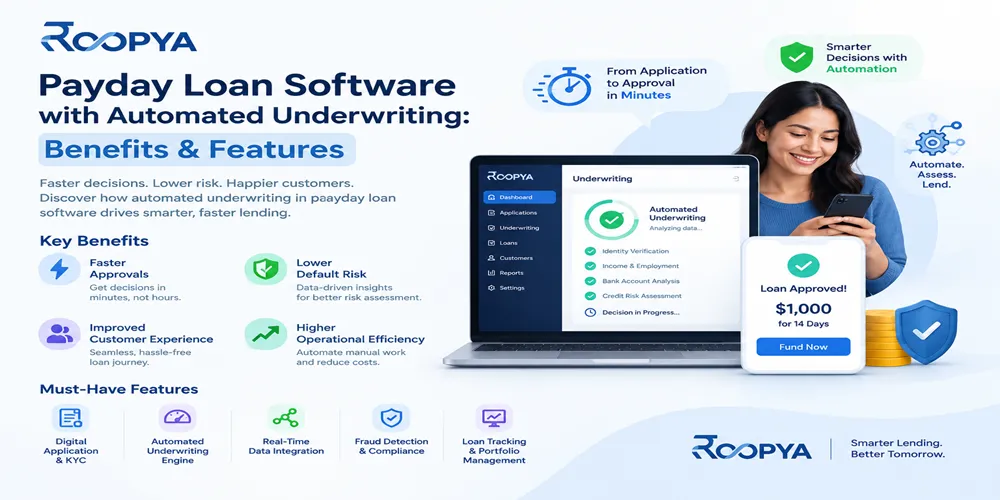

Short-term, small-ticket borrowing — known globally as payday lending and structured in India mainly as instant personal loans and salary-advance products — has grown rapidly because borrowers expect money in minutes, not days. That expectation puts enormous pressure on how a lender underwrites a loan. A manual, document-by-document review process that might be acceptable for a large secured loan simply does not work at payday-loan speed or volume.
Automated underwriting is what makes fast, small-ticket lending commercially viable and operationally sound at the same time. This article explains what automated underwriting actually is, why it matters more than ever under India's updated digital lending rules, how it works step by step, the features to look for in payday loan software, and the benefits — and responsible-use considerations — that come with it.
What Is Automated Underwriting in Payday Loan Software?
Automated underwriting is the use of software to evaluate a loan applicant's eligibility, creditworthiness and pricing without a human manually reviewing each document or data point at every stage. It typically combines three layers: a data layer that pulls credit bureau reports, bank statement or Account Aggregator data, and identity verification results through APIs; a rules layer (a business rule engine) that applies the lender's eligibility and policy criteria; and, increasingly, a scoring layer that uses statistical or machine-learning models to assess risk and recommend pricing.
The result is a system that can take a borrower from application to a funding decision in seconds or minutes, instead of the hours or days a manual process would take — while still producing a documented, auditable basis for every decision.
Why Automated Underwriting Matters More in 2026
Two forces make automated underwriting essential for payday-style lending in India right now: economics and regulation.
On the economics side, payday and small-ticket personal loans carry thin per-loan margins. A lender cannot profitably pay a human underwriter to manually review a loan of a few thousand rupees — the cost of manual review can exceed the interest earned. Automation is what makes the unit economics work at volume.
On the regulation side, the Reserve Bank of India issued the Reserve Bank of India (Digital Lending) Directions, 2025 on May 8, 2025, consolidating and replacing the 2022 Guidelines on Digital Lending and the 2023 Default Loss Guarantee (DLG) Guidelines into a single framework. The directions apply to all digital lending activity by regulated entities — banks, NBFCs and housing finance companies — across the entire loan lifecycle, from customer acquisition to grievance redressal, and they explicitly define digital lending as a "remote and automated lending process."
Crucially, the directions reaffirm that risk-mitigation tools such as a Default Loss Guarantee must never substitute for robust credit underwriting by the regulated entity itself. In other words, automation is expected and encouraged, but the underwriting logic behind it has to be sound, documented and the lender's own responsibility — not outsourced risk-washing. The directions also require loan disbursals and repayments to move directly between the borrower's and the lender's bank accounts (no pass-through accounts), mandate India-based data storage, and call for clear grievance-redressal and disclosure mechanisms — all of which a good automated underwriting platform needs to be built around, not bolted on afterward.
How Automated Underwriting Works, Step by Step
- Digital application and consent capture: The borrower applies online or in-app and gives explicit digital consent before any data is pulled.
- Identity and KYC verification: Aadhaar, PAN and, where required, video-KYC checks confirm the applicant's identity in real time.
- Data aggregation: The system retrieves credit bureau reports, Account Aggregator-based bank statement data, and alternative data such as UPI transaction history, in parallel through APIs.
- Rule-based eligibility checks: A configurable business rule engine screens the application against the lender's eligibility policy — income thresholds, existing exposure, blacklist checks and more.
- Risk scoring and pricing: A scoring model, often machine-learning based, evaluates repayment risk and determines the loan amount, tenure and interest pricing appropriate to that risk.
- Fraud and duplicate checks: Automated fraud detection screens for identity mismatches, device or IP anomalies, and duplicate or stacked applications across lenders.
- Decisioning and audit trail: The system returns an approve, refer-to-human, or decline outcome, and logs the data and logic behind the decision for compliance and audit purposes.
- Disbursal: Approved loans are disbursed directly to the borrower's bank account, consistent with RBI's no-pass-through-account requirement.
Key Features to Look for in Payday Loan Software with Automated Underwriting
- API-based credit bureau integration with CIBIL, Experian, Equifax and CRIF for real-time credit checks.
- Account Aggregator and bank-statement analytics to assess cash-flow and repayment capacity beyond the bureau score.
- A no-code, configurable business rule engine so credit and risk teams can adjust eligibility criteria without engineering support.
- Explainable AI/ML credit scoring that can show why a decision was made, not just what the decision was.
- Real-time fraud detection, including device fingerprinting, document forensics and duplicate-application checks.
- e-KYC and video-KYC with Aadhaar and PAN validation built into the onboarding flow.
- Dynamic, risk-based pricing so loan terms reflect each borrower's assessed risk rather than a flat rate for everyone.
- A complete audit trail of every automated decision, to support RBI inspections and internal governance.
- Default Loss Guarantee (DLG) tracking, where applicable, managed separately from — not as a replacement for — the underwriting decision.
- Direct-to-bank disbursal and repayment workflows, with no pass-through or pooled accounts.
- Built-in grievance redressal and cooling-off period workflows, as required under the RBI's digital lending framework.
- Cloud-based, scalable deployment that can absorb sudden spikes in application volume without manual bottlenecks.
Core Benefits of Automated Underwriting for Payday Loan Businesses
Faster Approvals and Disbursal
Because data retrieval, verification and rule evaluation happen in parallel through APIs rather than sequentially by a human reviewer, decisions that used to take hours or days can be returned in seconds to a few minutes — often while the borrower is still on the application screen.
Lower Cost Per Loan
Automation removes the need for a large manual underwriting team to review every small-ticket application, which is what makes high-volume, low-margin payday lending commercially sustainable in the first place.
Consistent, Documented Decisioning
A rule engine and scoring model apply the same criteria to every applicant, reducing the inconsistency and subjectivity that can creep into manual review, while producing a clear, auditable record of why each decision was made.
Stronger Fraud Prevention
Automated systems can cross-check identity documents, device data and application patterns across thousands of applications in real time — catching duplicate or fraudulent applications far faster and more reliably than manual spot-checks.
Regulatory Alignment and Audit Readiness
A platform built around India-based data storage, direct-to-bank disbursal, consent capture and decision logging helps lenders demonstrate compliance with the RBI's Digital Lending Directions, 2025, rather than retrofitting compliance after the fact.
Scalability During Demand Spikes
Cloud-based automated underwriting can absorb sudden increases in application volume — around salary cycles, festivals, or marketing campaigns — without the delays a manual team would face trying to scale up on short notice.
Better Risk-Adjusted Portfolio Quality
By scoring each applicant individually rather than applying one-size-fits-all criteria, lenders can price for risk more precisely, extend credit to more borrowers responsibly, and keep default rates aligned with underwriting assumptions.
Improved Borrower Experience
A fast, transparent, largely self-service application process — with clear reasons given for approval, referral or decline — builds borrower trust and improves conversion and repeat-borrowing rates.
How Roopya Supports Automated Underwriting for Payday and Short-Ticket Loans
Roopya (roopya.money) is a no-code, unified lending infrastructure platform built for banks, NBFCs, MFIs and loan service providers, and automated underwriting sits at the core of how it works. Its AI-enhanced business rule engine lets credit teams configure eligibility rules, LTV, interest and tenure policies without writing code, while continuously learning from historical approval and rejection patterns to suggest rule improvements under human oversight.
On top of the rule engine, Roopya's AI-powered document analysis automatically extracts and verifies identity and financial documents, and its intelligent credit decisioning layer evaluates alternative data and real-time financial indicators alongside traditional bureau scores to generate a risk assessment in near real time. A dedicated fraud-detection layer screens applications for suspicious patterns, and the platform is designed to meaningfully cut document verification and decisioning time compared with manual review.
For a payday or salary-advance product specifically, Roopya's library of 300+ pre-integrated APIs — spanning credit bureaus, KYC and verification services, and payment gateways — combined with 20+ pre-configured loan products, lets a lender configure and launch a short-ticket, automated-underwriting loan product without building bureau or KYC integrations from scratch, with the platform's no-code setup supporting a go-live in as little as a day on a pay-as-you-use pricing model.
Responsible Automation: Risks to Keep in Mind
Automated underwriting is powerful, but it is not a substitute for sound risk judgment. A few things worth keeping in mind:
- Over-reliance on any single data source or model can embed bias or miss context a human underwriter would catch — most responsible platforms keep a human-in-the-loop for borderline or flagged cases.
- Regulators increasingly expect explainability: being able to show why a model declined or approved a specific applicant, not just that it did.
- Data privacy obligations under the Digital Personal Data Protection Act, 2023, and the RBI's data-localization requirements must be built into the data layer, not treated as an afterthought.
- As noted earlier, a Default Loss Guarantee or similar risk-sharing arrangement should never be used as a substitute for genuine underwriting rigor.
Side-by-Side: Underwriting Speed by Model
| Underwriting Model | Typical Decision Time | Best Fit |
|---|---|---|
| Fully manual review | Hours to multiple days | Very small ticket sizes or niche, low-volume lenders |
| Semi-automated (rules only) | Minutes to a few hours | Lenders with simple, well-defined eligibility criteria |
| Automated underwriting (rules + ML + bureau/AA data) | Seconds to a few minutes | High-volume, small-ticket payday and short-term lending |
How to Choose the Right Payday Loan Software with Automated Underwriting
- Confirm pre-built integrations with the specific bureaus, Account Aggregators and KYC providers you rely on.
- Ask how the rule engine and scoring model can be configured or retrained as your lending policy evolves.
- Check that decisions are explainable and logged in a format that would satisfy an RBI inspection or internal audit.
- Verify the platform supports direct-to-bank disbursal and repayment, with no pass-through accounts.
- Ask for a live demo using representative applicant data, and have the vendor walk through exactly how a decision is generated.
- Compare total cost of ownership — including per-loan or subscription fees — against your expected loan volume and ticket size.
For payday and other small-ticket, high-volume loans, automated underwriting is no longer optional — it's what makes fast disbursal, thin margins and regulatory compliance possible at the same time. The RBI's Digital Lending Directions, 2025 make clear that automation is welcome, but the underwriting logic behind it must remain robust, explainable and the lender's own responsibility.
If you want to see how a no-code platform like Roopya configures automated underwriting for a payday or salary-advance loan product, you can request a free demo here.
Frequently Asked Questions (FAQ)
What is automated underwriting in payday loan software?
Automated underwriting is the use of software — combining a business rule engine, bureau and bank-statement data, and often machine learning scoring models — to evaluate a borrower's eligibility, risk and pricing without manual document review at every step. It typically returns an approve, refer or decline decision within seconds to a few minutes.
How does automated underwriting speed up payday loan approvals?
Instead of a loan officer manually checking documents, calling for bank statements and sequentially running credit checks, automated underwriting pulls bureau data, bank/UPI transaction data and identity verification through APIs in parallel, applies pre-configured eligibility rules and risk models instantly, and returns a decision in real time — often while the borrower is still on the application screen.
Is automated underwriting compliant with RBI's Digital Lending Directions, 2025?
Automated underwriting itself is not prohibited — in fact, the RBI (Digital Lending) Directions, 2025, which took effect on May 8, 2025, were written with automated, remote lending processes in mind. However, the directions are clear that a Default Loss Guarantee or any other credit-risk mitigant must not substitute for robust credit underwriting, so lenders remain responsible for building sound, explainable underwriting logic, maintaining audit trails, and meeting data localization, consent and grievance-redressal requirements.
What data sources do automated underwriting systems use?
Common sources include credit bureau reports (CIBIL, Experian, Equifax, CRIF), Account Aggregator-based bank statement data, Aadhaar/PAN e-KYC data, UPI and digital payment transaction history, and in some cases telecom or utility payment data, all combined through a scoring model or rule engine to assess ability and willingness to repay.
Can automated underwriting eliminate human review completely?
For straightforward, small-ticket payday loans, most applications can be decisioned end-to-end without manual intervention. However, responsible platforms still route borderline, high-risk or flagged cases to a human underwriter, and maintain override and escalation workflows — full automation without any human-in-the-loop oversight is generally discouraged from both a risk and a fair-lending standpoint.
How much faster is automated underwriting compared to manual underwriting for payday loans?
Manual underwriting for a small-ticket loan can take anywhere from a few hours to several days depending on document collection and verification steps. A well-built automated underwriting workflow can typically return a decision in seconds to a few minutes, since data retrieval, verification and rule evaluation happen in parallel through APIs rather than sequentially by a human reviewer.
What is a Default Loss Guarantee (DLG) and how does it relate to underwriting?
A Default Loss Guarantee is an arrangement, common in digital lending partnerships, where a lending service provider or fintech partner guarantees to cover a portion of losses if borrowers default. The RBI's Digital Lending Directions, 2025 retain and regulate the DLG framework, but explicitly state that a DLG arrangement must not be used as a substitute for robust credit underwriting by the lender.
How do I choose the right payday loan software with automated underwriting?
Look for a platform with pre-integrated bureau and KYC APIs, a configurable no-code rule engine, explainable ML scoring, direct-to-bank disbursal (no pass-through accounts), strong audit trails, and features that map to current RBI digital lending requirements. Request a live demo using sample applicant data and ask the vendor to walk through exactly how a decision is generated and documented.





















Sign in to leave a comment.