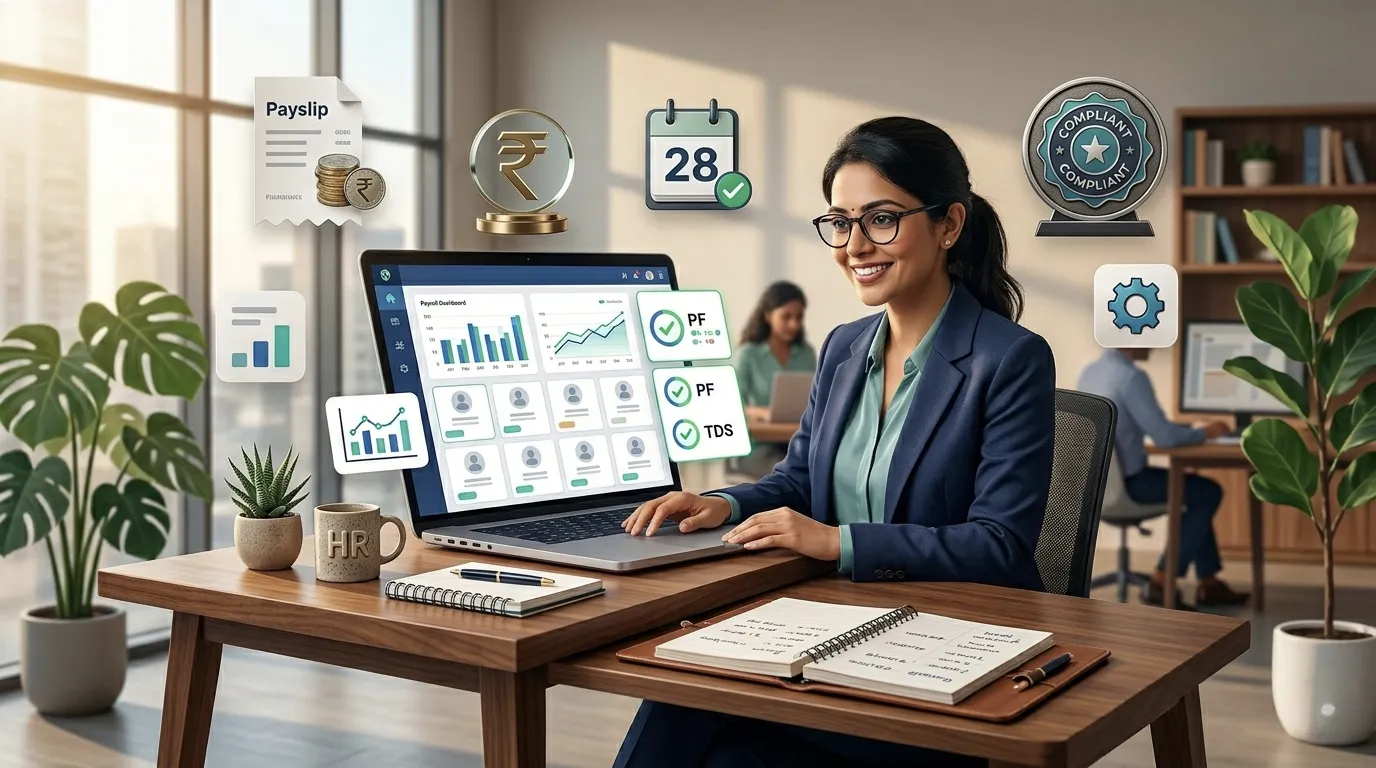

Every month, HR teams across India face the same challenge — calculating salaries accurately, staying on top of PF, ESI, and TDS obligations, managing leave balances, and filing statutory reports, all within a tight deadline. One miscalculation can trigger financial liabilities, delay salary disbursements, and damage employee confidence.
Payroll management software solves this problem. This guide explains exactly what it does, how it works, and what to look for when choosing a platform for your business in 2026.

What Is Payroll Management Software?
Payroll management software is a digital system that automates the full employee compensation cycle. It handles salary calculations, statutory deductions, payslip generation, tax computations, and compliance filings — all from a single platform.
In India specifically, it manages:
- Provident Fund (PF) contributions at 12% of basic salary
- Employee State Insurance (ESI) deductions for eligible employees
- Tax Deducted at Source (TDS) under the correct income slab
- State-wise Professional Tax calculations
- Statutory documents including Form 16, Form 24Q, and ECR challans
The platform updates automatically whenever Indian tax laws or labour regulations change — removing the manual burden from HR teams entirely.
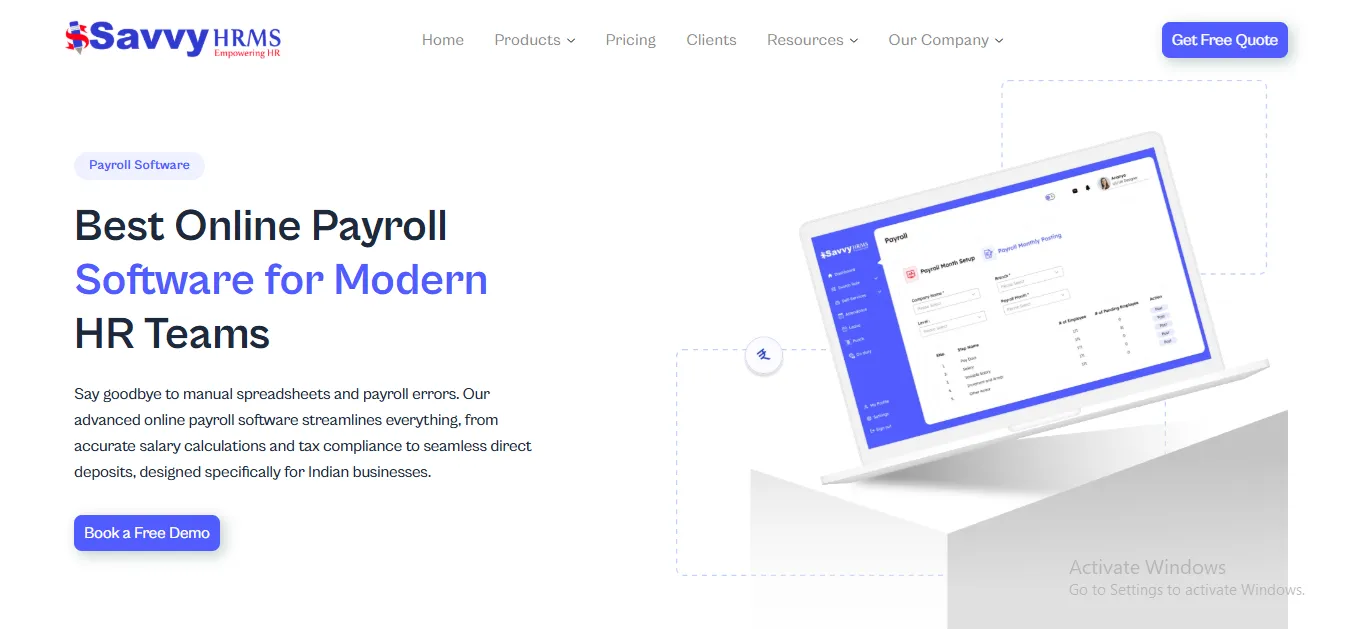
How Does Payroll Software Work in India?
Indian payroll follows three well-defined stages. Understanding these stages helps businesses evaluate whether a platform covers the full cycle or only part of it.
Stage 1 — Pre-Payroll
The system collects all inputs required before salaries are processed. This includes attendance records, approved leave, reimbursement claims, salary revisions, and new joiner or exit data. Integrated platforms pull attendance data automatically from biometric devices and geo-fencing applications, eliminating manual data entry.
Stage 2 — Payroll Processing
Once inputs are verified, the system calculates salaries for every employee. PF, ESI, TDS, and Professional Tax are applied automatically based on each employee's profile and applicable slabs. Variable pay, arrears, overtime, and bonuses are factored in without manual formulas.
Stage 3 — Post-Payroll
After salaries are processed, payslips are generated and distributed to employees. Salaries are disbursed directly to bank accounts. Statutory challans including ECR, ESI returns, and Professional Tax challans are produced ready for submission. A complete audit trail is maintained for every payroll cycle.
The entire process — which once consumed several working days — completes within hours using the right platform.
Why Indian Businesses Need a Purpose-Built Solution
Generic payroll tools designed for global markets fall short in India for several important reasons.
India operates a dual tax regime, giving employees a choice between the old and new income tax structures. Professional Tax rates and thresholds vary by state. ESI eligibility changes with salary revisions. TDS computations depend on individual declarations submitted through Form 12BB. Quarterly Form 24Q filings follow a specific format that most international tools do not support.
A platform built specifically for Indian payroll treats these requirements as core functionality — not workarounds. It applies regulatory updates in real time, keeps businesses protected from financial liabilities, and ensures accurate, on-time salary disbursements every single month.
5 Features Every Indian Business Should Prioritise
1. Real-Time Compliance Updates
India's tax and labour regulations change regularly. The right payroll software applies every regulatory update automatically the moment it is notified — without waiting for manual reconfiguration by the HR team.
2. Attendance and Biometric Integration
Payroll accuracy depends entirely on accurate attendance data. A platform that syncs directly with biometric devices, geo-fencing apps, and leave management modules removes all manual reconciliation at month-end and significantly reduces calculation errors.
3. Employee Self-Service Portal
Employees who can independently access payslips, submit Form 12BB investment declarations, view tax computations, and download Form 16 from a mobile or desktop portal reduce the daily query load on HR teams considerably. Self-service access also improves employee satisfaction and transparency.
4. Multi-Location Payroll Support
Businesses operating across multiple Indian states face layered compliance obligations. The right platform manages different Professional Tax slabs, state-specific labour law requirements, and varied pay structures simultaneously — from a single unified dashboard.
5. Scalability Without Disruption
A growing business should not have to change its payroll platform as headcount increases. The right software handles 50 employees today and 5,000 employees two years from now — without a costly migration, additional infrastructure, or loss of historical data.
Types of Payroll Platforms Available in India
Payroll software in India is available across four broad categories depending on business size and complexity:
Starter platforms — Designed for businesses with fewer than 50 employees. Cover basic salary processing and statutory compliance at low or no cost. Limited in advanced features.
SME-focused platforms — Cloud-based solutions for businesses with 50 to 500 employees. Offer full compliance automation, attendance integration, and employee self-service at an affordable monthly cost per employee.
Mid-market platforms — Built for businesses with 500 to 2,000 employees. Include advanced payroll reporting, multi-location support, and deeper integration with other HR modules.
Enterprise platforms — Comprehensive solutions for large organisations with complex payroll structures, multi-state operations, and thousands of employees. Offer custom implementation, dedicated account management, and deep compliance capabilities.
Choosing the Right Platform for Your Business
Questions to Ask Before Committing
Before selecting a platform, ask the following:
- Does the platform automatically apply Indian statutory updates in real time?
- Does it integrate directly with the attendance and leave system already in use?
- Is an employee self-service portal included in the base plan?
- Can it handle multiple locations and pay structures from one dashboard?
- What is the implementation timeline and what support is included?
Always run a parallel payroll for at least one full month before fully switching platforms. This confirms accuracy and catches any configuration issues before they affect employee salaries.
How Savvy HRMS Addresses These Requirements
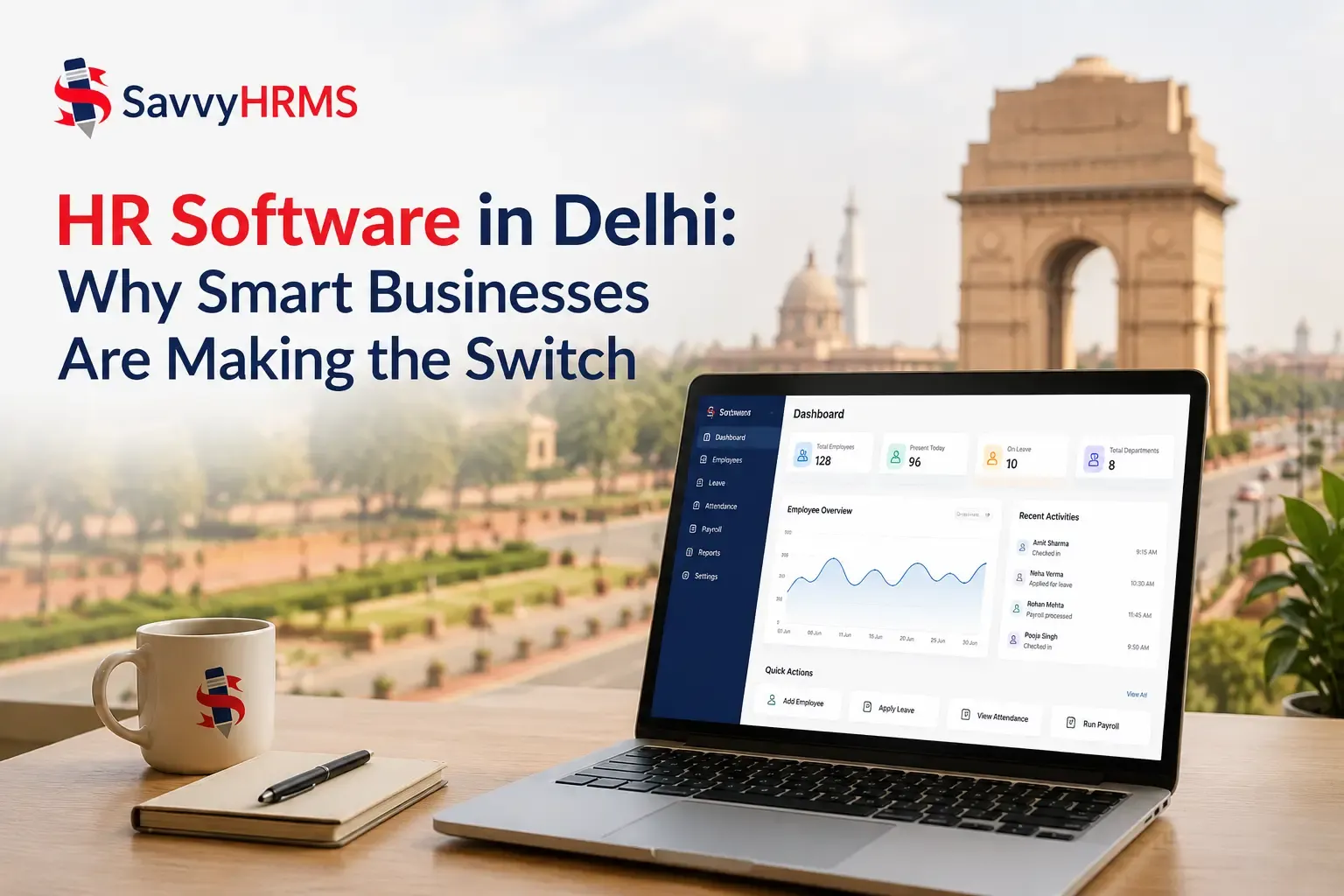
Savvy HRMS is a payroll and HR automation platform designed from the ground up for Indian businesses. It covers the complete payroll cycle — from biometric attendance sync and salary calculation through to statutory filings and payslip distribution — within a single cloud-based system.
Key capabilities include:
- Automated PF, ESI, TDS, and Professional Tax processing with real-time regulatory updates
- Direct biometric attendance integration for accurate, error-free payroll inputs
- Employee self-service portal accessible from mobile and desktop
- Multi-location payroll support for businesses operating across states
- Scalable architecture supporting teams from 20 to over 10,000 employees
Savvy HRMS is used by businesses across manufacturing, information technology, hospitality, retail, logistics, and healthcare — industries where accurate, compliant, and timely payroll is a non-negotiable monthly requirement.
Common Questions About Payroll Software in India
Is Payroll Software Legally Required in India?
It is not legally required, but inaccurate or late filings for PF, ESI, and TDS carry significant financial liabilities. Payroll software is the most effective and consistent way to meet these obligations accurately every single month.
Can Payroll Software Handle Both Old and New Tax Regimes?
Yes. A well-designed platform allows each employee to choose between the old and new tax regimes and computes TDS accordingly for every individual — automatically and without manual adjustments.
How Long Does Implementation Typically Take?
Implementation takes one to four weeks depending on company size and payroll complexity. Dedicated onboarding support and a parallel payroll run for at least one month before full switchover are strongly advisable.
What Statutory Reports Does Payroll Software Generate?
Form 16, Form 24Q, ECR challans, ESI returns, Professional Tax challans, payroll register, bank transfer files, salary variance reports, and complete cycle-wise audit trails.
Is Cloud-Based Payroll Software Secure?
Yes. Established platforms use end-to-end data encryption, role-based access controls, and automated backups. ISO 27001 certification is a reliable baseline indicator of data security standards.
Conclusion
Payroll management software has moved from a convenience to a compliance necessity for Indian businesses. The right platform saves HR teams significant time every month, eliminates statutory liability risk, improves payroll accuracy across the organisation, and gives every employee transparent, self-serve access to their compensation information.
For businesses that want a platform built specifically around Indian compliance requirements — one that scales from a small team to a large enterprise without disruption, and supports HR operations across attendance, leave, and performance alongside payroll — Savvy HRMS is designed to deliver exactly that.
Resource Box:
Savvy HRMS is a widely adopted HR and payroll automation platform used by businesses across manufacturing, IT, hospitality, logistics, and more. Designed ground-up for Indian compliance, it automates salary processing, PF, ESI, TDS, attendance, and leave management — all from a single cloud-based dashboard. Scalable for teams of 20 to 20,000+.


























Sign in to leave a comment.