
The ophthalmic segment is one of the fastest-growing categories in Indian pharma right now. Rising screen time, an ageing population, and better diagnosis of eye conditions have pushed demand for eye drops higher every year. Naturally, more entrepreneurs and pharma professionals want a piece of this growth.
But there's a fork in the road almost everyone hits early on: should you take up an Eye Drops PCD Franchise, or go the route of third-party manufacturing and build your own brand? Both models can be profitable. Both come with different levels of risk, investment, and control. Picking the wrong one for your goals can cost you time and money you didn't need to spend.
This guide breaks down both business models in plain language, compares them side by side, and helps you decide which one actually fits your budget, experience, and long-term plans.
What Is a PCD Franchise for Eye Drops?
PCD stands for Propaganda Cum Distribution. In simple terms, it's a franchise-style arrangement where a pharma company grants you the right to market and sell its already-manufactured eye drop products in a specific area, usually a district, city, or state.
You don't manufacture anything. You don't need a formulation team. You work with an established product range, existing branding, and marketing materials the parent company already has ready.
How the PCD Model Works in Ophthalmic Business
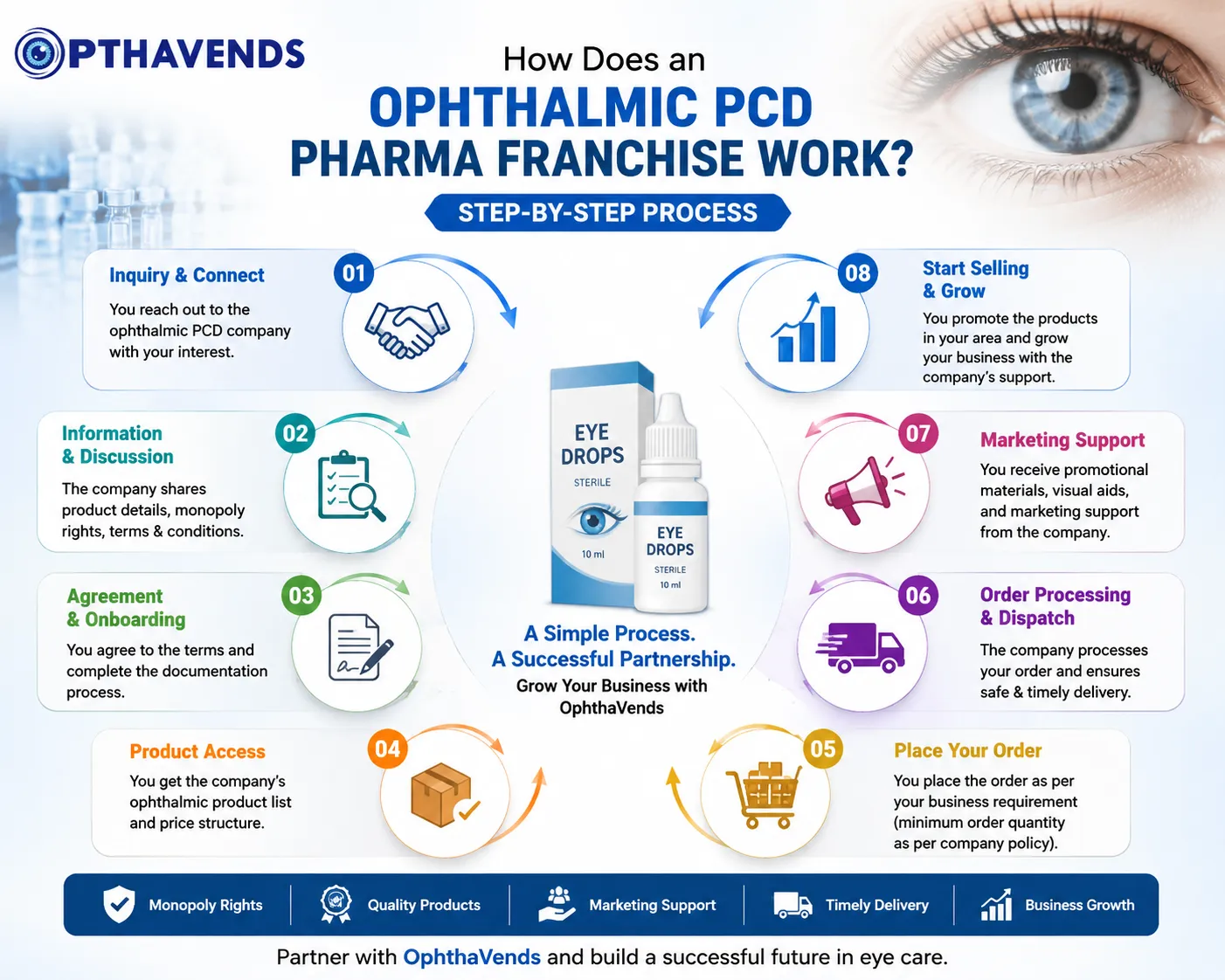
Here's the typical flow:
- You approach an Eye Drops PCD Company in India and review their product list.
- You select the products you want to distribute in your territory.
- The company grants you monopoly rights for that area (in most cases).
- You receive promotional inputs — visual aids, MR bags, sample kits, product literature.
- You order stock, sell to doctors, hospitals, retailers, and chemists, and earn margins on every sale.
The company handles manufacturing, quality control, and regulatory approvals. You handle the sales and distribution side.
Who Should Choose an Eye Drops PCD Franchise
This model tends to suit:
- First-time entrepreneurs with limited pharma experience
- Medical representatives who want to start their own business using existing industry contacts
- People with a smaller budget who still want a foothold in the ophthalmic market
- Anyone who wants faster market entry without dealing with manufacturing logistics
If your strength is field sales, doctor relationships, or local distribution — not production — a PCD Pharma Franchise for Eye Care is usually the smarter starting point.
What Is Third-Party Manufacturing for Eye Drops?
Third-party manufacturing (also called contract manufacturing or loan licensing) is a different arrangement altogether. Here, you own the brand. A manufacturing company produces the eye drops for you under your label, formulation preferences, and packaging design.
Unlike a PCD franchise, you're not distributing someone else's brand — you're building your own, using someone else's manufacturing infrastructure.
How Contract/Third-Party Manufacturing Works
The typical process looks like this:
- You finalize your brand name, product range, and formulations.
- You partner with a certified eye drops manufacturing company India that has the sterile production setup ophthalmic products require.
- You sign a manufacturing agreement covering batch sizes, quality standards, and pricing.
- The manufacturer produces the eye drops under your brand name.
- You handle marketing, sales, and distribution independently, or build your own network.
You get complete control over branding and formulation choices, while the manufacturer takes care of production, sterility compliance, and quality testing.
Who Should Choose Third-Party Eye Drops Manufacturing
Third Party Manufacturing for Eye Drops works well for:
- Established distributors who already have a sales network and now want brand ownership
- Businesses planning to scale into multiple states or export markets
- Entrepreneurs who want long-term brand equity, not just distribution margins
- Companies that already understand regulatory processes and are ready for that responsibility
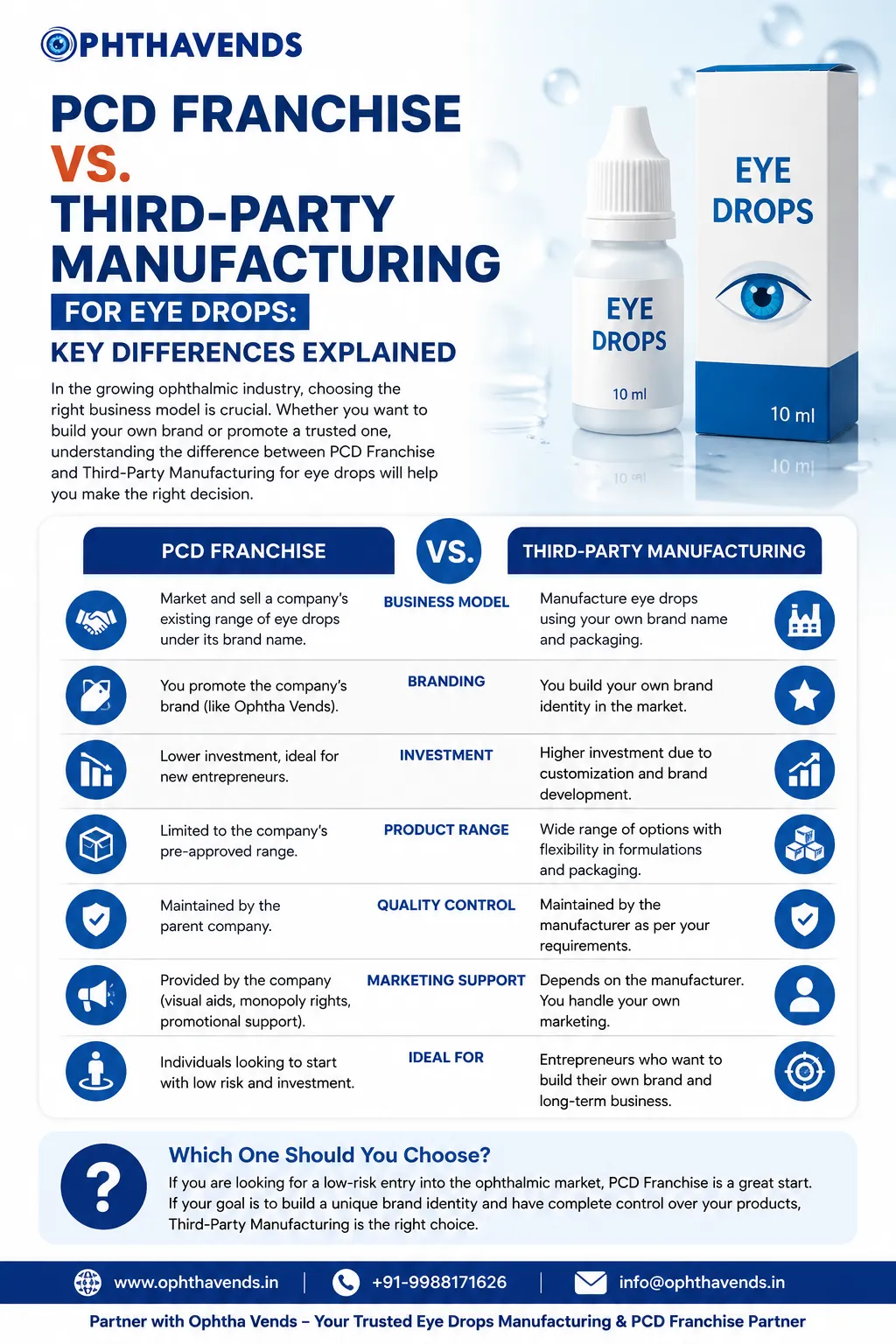
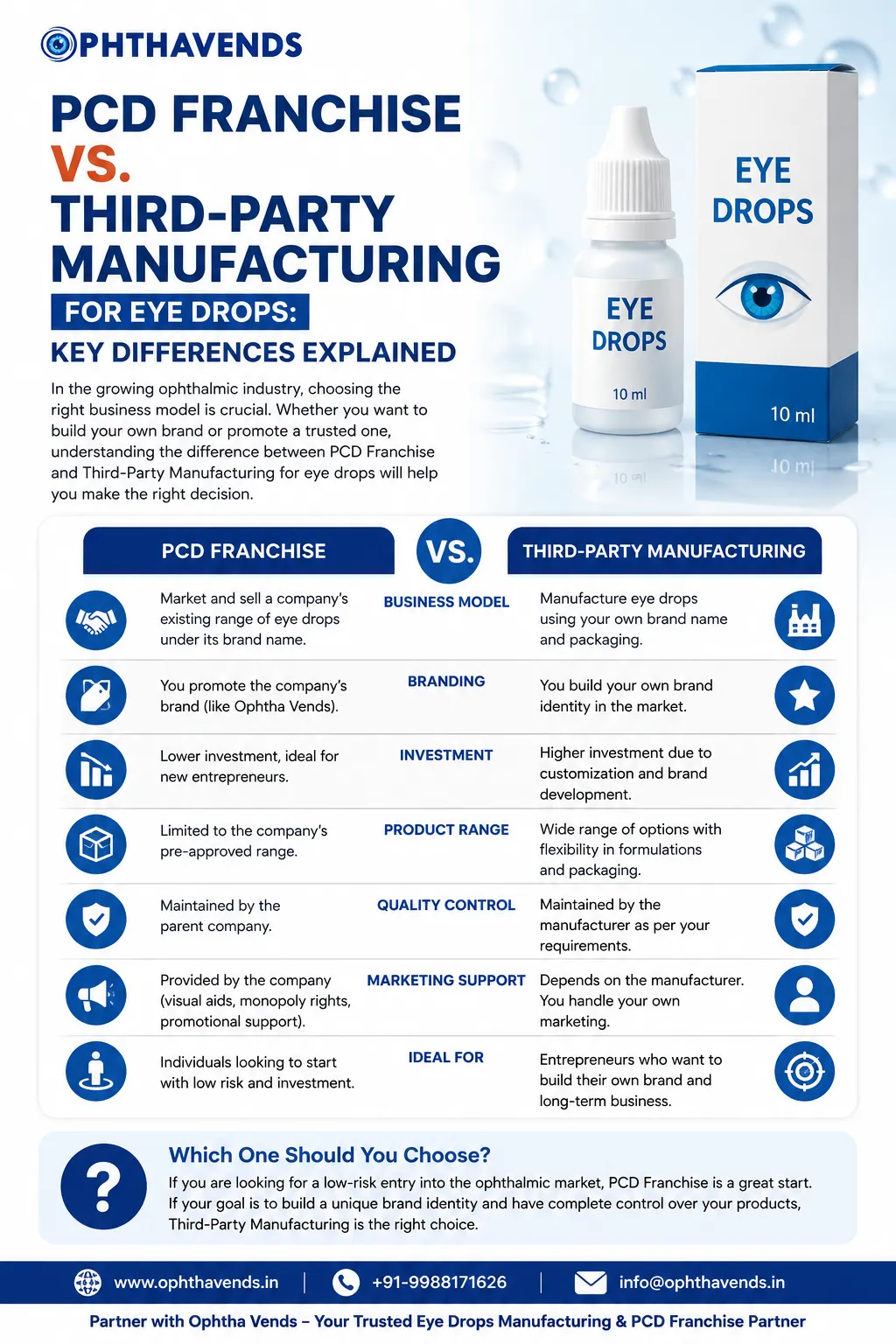
PCD Franchise vs Third-Party Manufacturing: Key Differences (Comparison Table)
| Parameter | PCD Franchise | Third-Party Manufacturing |
|---|---|---|
| Ownership | You distribute the parent company's brand | You own the brand name and formulation rights |
| Investment | Low to moderate | Moderate to high |
| Control over Formulation | Minimal to none | Full control |
| Branding | Limited (parent company's identity) | Complete customization |
| Regulatory Responsibility | Handled by the PCD company | Shared or fully yours, depending on agreement |
| Risk | Lower — established products, tested demand | Higher — new brand, market has to be built |
| Profit Margin | Fixed distribution margins | Higher, since you control pricing |
| Time to Market | Fast — products already exist | Slower — formulation, testing, packaging take time |
This table alone gives you a quick snapshot, but the real decision depends on your capital, risk appetite, and long-term goals — which we'll unpack next.
Investment & Cost Comparison for Eye Drops Business
Capital Needed for a PCD Eye Drops Franchise
A Low Investment Eye Drops PCD Franchise in India typically requires:
- Security deposit or initial order value (often ₹25,000–₹1,00,000 depending on the company)
- Working capital for stock purchase
- Basic infrastructure like a small office or storage space
- No spending on manufacturing equipment, R&D, or plant setup
This is why PCD remains the go-to entry point for people testing the waters in pharma without a heavy financial commitment.
Capital Needed for Third-Party Eye Drops Manufacturing
Third-party manufacturing needs more upfront planning:
- Minimum Order Quantity (MOQ) costs, which are usually higher than PCD stock orders
- Packaging design and brand development expenses
- Regulatory filing and drug license costs
- Marketing budget to build brand recognition from scratch
While you avoid setting up your own factory, the cost of building a brand — labels, cartons, compliance documentation, initial batch runs — adds up faster than most first-timers expect.
Ownership, Branding & Control: Which Model Gives You More?
If ownership and long-term brand value matter to you, third-party manufacturing wins hands down. You decide the formulation, the packaging, the pricing strategy, and you keep whatever brand equity you build over the years.
A PCD franchise, on the other hand, ties your business to the parent company's brand. You build relationships with doctors and chemists, but the brand recall stays with the company you're franchising from — not you.
That said, control comes with responsibility. Third-party manufacturing means you're accountable for quality consistency, regulatory filings, and market building, all at once. PCD lets you skip that learning curve and focus purely on sales.
Regulatory & Licensing Requirements for Eye Drops (Both Models)
Eye drops aren't like regular tablets or syrups. Because they go directly into the eye, they demand sterile manufacturing conditions, preservative-free options for sensitive patients, and strict quality checks that most oral medicines don't require.
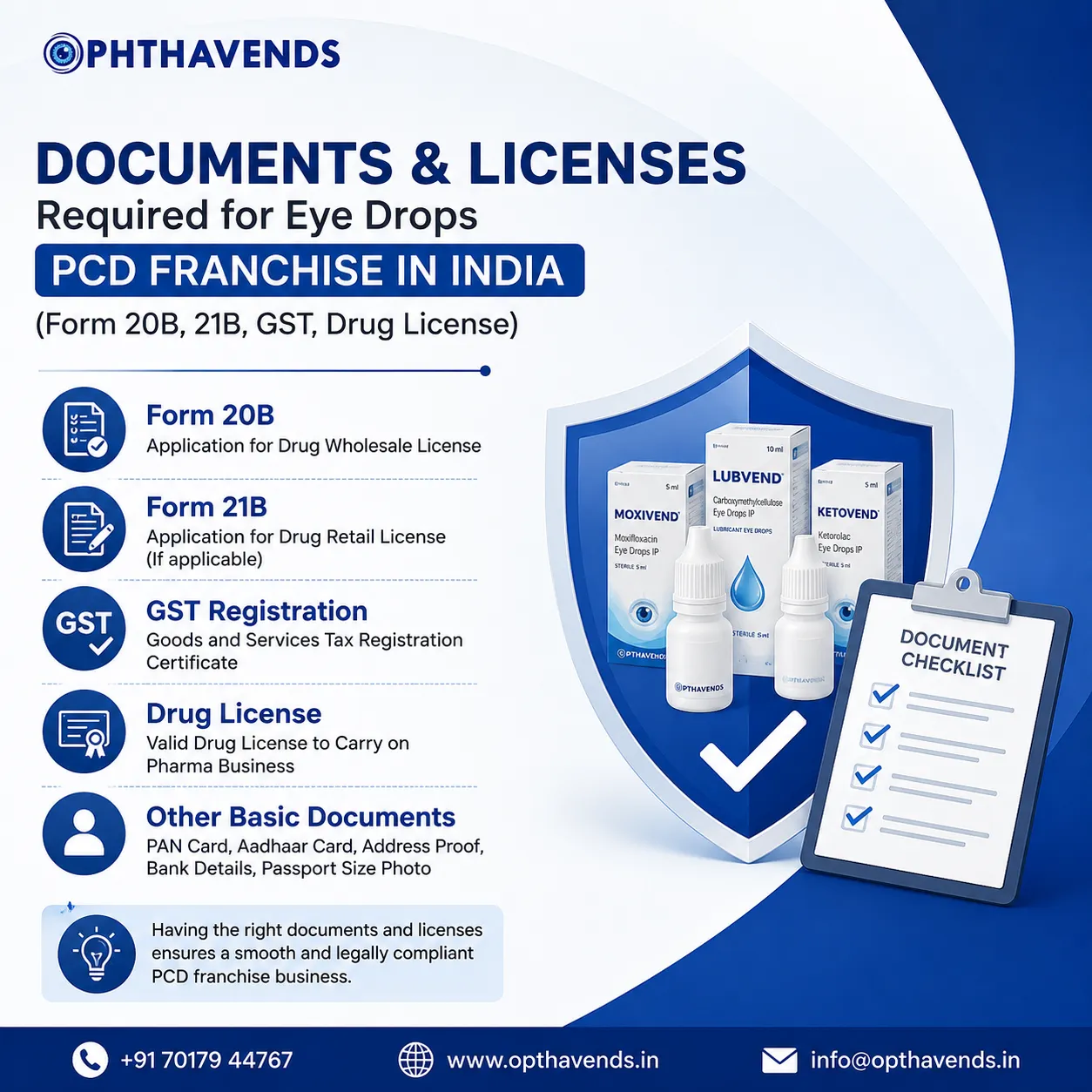
For a PCD Eye Drops Franchise, your main licensing need is:
- A valid drug license (wholesale) to distribute pharmaceutical products
- GST registration
- No manufacturing license required, since the parent company holds that
For third-party manufacturing, requirements are more layered:
- The manufacturing partner must hold a WHO-GMP certified eye drops PCD franchise company-grade facility with proper sterile production lines
- DCGI (Drugs Controller General of India) approval for the formulations
- Loan license or manufacturing license depending on the structure of the agreement
- Batch-wise quality testing certificates for every production run
Because ophthalmic products carry a higher risk of contamination if mishandled, always confirm your manufacturing partner follows WHO-GMP, ISO, and DCGI-approved processes before signing any agreement — regardless of which model you choose.
Risk, Profit Margins & Scalability Compared
Here's a straightforward way to think about risk versus reward:
- PCD Franchise: Lower risk since products already have market acceptance, but margins are fixed by the parent company. Scalability is possible by expanding into new territories, but you're still working within someone else's product range.
- Third-Party Manufacturing: Higher risk since you're introducing a new brand, but profit margins are entirely in your control once the brand gains traction. Scalability is stronger long-term because you can expand product lines, enter new states, or even export under your own name.
If you want steady, predictable income with lower exposure, PCD is friendlier. If you're aiming for a business you can eventually sell, expand nationally, or pass down, third-party manufacturing builds something more permanent.
Which Model Is Right for You? (Decision Checklist)
Choose PCD Franchise If…
- You're new to pharma and want to learn the business first
- Your budget is limited and you want faster returns
- You have strong local doctor and chemist connections
- You prefer minimal regulatory involvement
- You want Monopoly PCD Franchise for Eye Drops rights in your territory without production headaches
Choose Third-Party Manufacturing If…
- You already have distribution experience and a sales network
- You want to build a brand with long-term value
- You're comfortable managing regulatory compliance
- You have the capital to invest in packaging, branding, and marketing
- You're planning to scale across multiple states or export markets eventually
Why Eye Drops Need a Specialized Approach (Not Generic Pharma)
Ophthalmic manufacturing isn't something every pharma company can handle well. Eye drops need:
- Sterile production environments — even a minor contamination risk can cause serious eye infections
- Preservative-free formulation options — increasingly demanded for sensitive patients and post-surgical care
- Specialized packaging — tamper-proof droppers, UV-protected bottles, and proper sealing to maintain sterility until first use
- Cold chain handling for certain formulations that are temperature-sensitive
A generic pharma manufacturer without ophthalmic-specific infrastructure can struggle with these requirements. This is exactly why choosing a manufacturing or franchise partner that specializes in eye care — rather than a company that treats eye drops as just another SKU — makes a real difference to product quality and, ultimately, your business reputation.
How OphthaVends Supports Both Business Models
Whether you're leaning toward franchising or building your own brand, working with a partner that understands both sides of the business helps you avoid costly mistakes.
OphthaVends operates as a eye drops PCD franchise company offering monopoly-based distribution rights across India, alongside WHO-GMP and ISO-certified third-party manufacturing for entrepreneurs who want to launch their own ophthalmic brand. From antibiotic and anti-glaucoma eye drops to anti-allergic and lubricant ranges, the product portfolio is built specifically for ophthalmic use — not adapted from general pharma lines.
If you're still weighing your options, speaking with a team that works across both models can help you see which path fits your capital, experience, and growth plans before you commit.
Frequently Asked Questions
Is PCD franchise or third-party manufacturing more profitable for eye drops?
Third-party manufacturing generally offers higher long-term profit margins since you control pricing and own the brand. PCD franchise offers steadier, lower-risk income through fixed distribution margins, especially useful for beginners with limited capital.
Can I switch from a PCD franchise to my own brand later?
Yes. Many entrepreneurs start with a PCD franchise to understand the market, build doctor relationships, and generate cash flow, then transition into third-party manufacturing once they're ready to launch their own branded eye drop range.
What licenses are required for an eye drops PCD franchise in India?
You typically need a wholesale drug license and GST registration. Since the parent company handles manufacturing and quality compliance, you don't need a manufacturing license to operate as a PCD Pharma Franchise for Eye Care distributor.
How much investment is needed to start an eye drops PCD franchise?
Most PCD franchises require between ₹25,000 and ₹1,00,000 as an initial investment, covering security deposit and first stock order. This makes it one of the more accessible entry points into the pharma business.
Is third-party manufacturing better for launching my own eye drop brand?
Yes, if brand ownership matters to you. Third-party manufacturing lets you control formulation, packaging, and pricing while an experienced manufacturer handles production, making it ideal for building a lasting, independent ophthalmic brand.
What is the difference between PCD franchise and contract manufacturing?
A PCD franchise means distributing an existing brand's products under monopoly rights. Contract manufacturing (third-party) means a manufacturer produces products under your own brand name, giving you full ownership and control over formulation and branding.
Do I need a WHO-GMP certified manufacturer for eye drops?
Yes. Since eye drops require sterile production, a WHO-GMP and DCGI-approved manufacturing facility is essential for both safety and regulatory compliance, regardless of whether you choose a PCD franchise or third-party manufacturing model.
Conclusion
There's no universal "better" choice between a PCD Franchise and third-party manufacturing for eye drops — it genuinely depends on where you stand today. If you're starting out with limited capital and want a faster, lower-risk entry into the ophthalmic market, an Eye Drops PCD Franchise gives you established products, marketing support, and monopoly rights without the burden of manufacturing compliance.
If you already have industry experience, a distribution network, and the appetite to build something that's entirely your own, third-party manufacturing lets you create a brand with long-term equity and stronger control over margins.
Either way, the ophthalmic segment rewards partners who understand sterility, formulation quality, and regulatory discipline — not just anyone offering the lowest price. Take time to evaluate your goals, your budget, and your risk tolerance before signing on with any franchise or manufacturing partner.























Sign in to leave a comment.