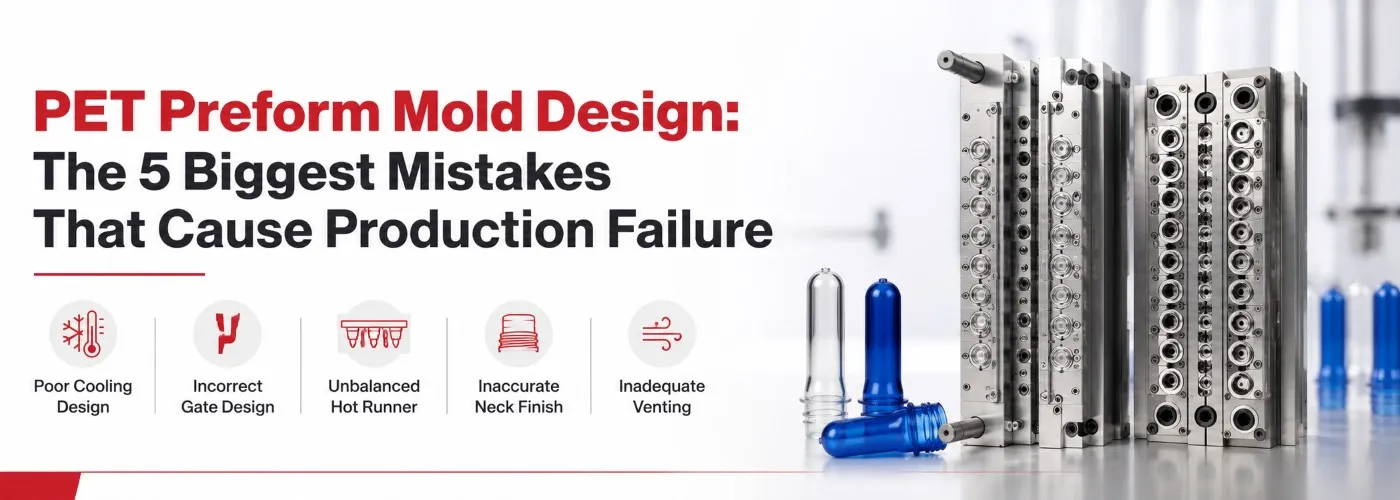

PET preform mold design directly affects cycle stability, preform quality, and machine uptime. A mold can meet basic dimensional requirements yet still create flash, uneven walls, leakage, or repeated stoppages. Many production failures begin during mold design, long before the injection machine starts running.
Here are five design mistakes that can create costly problems in PET preform production.
1. Why Does Poor Cooling Design Create Unstable Preforms?
Cooling is not simply about adding more water channels. The channels must remove heat uniformly around the cavity and core. Poor channel placement can leave hot zones that cool more slowly than other areas. This may cause inconsistent shrinkage, dimensional variation, and longer cycles.
A well-designed PET preform mold needs balanced cooling across cavities. Temperature differences between cavities should be controlled because even small variations can affect preform weight, wall distribution, and subsequent bottle blowing.
2. Can Gate Design Affect Preform Quality?
Yes. The gate is one of the most sensitive areas in a PET preform mold. Incorrect gate dimensions, positioning, or geometry can increase stress, create an uneven gate area, or make trimming difficult.
Gate design also influences how molten PET enters the cavity. Poor flow conditions may contribute to orientation differences and visible defects near the gate. The gate should therefore be designed according to the preform's weight, neck finish, material flow, and required cycle conditions.
3. What Happens When the Hot Runner Is Poorly Balanced?
A multi-cavity mold depends on consistent melt delivery. If the hot runner system is poorly balanced, different cavities may receive PET at different rates or temperatures. This can produce cavity-to-cavity variations in weight, dimensions, and filling behavior.
Common warning signs include:
- Different preform weights from individual cavities
- Uneven filling or visible flow-related defects
- Variation in gate quality between cavities
- Higher rejection from specific cavities
For high-cavity production, hot runner balance becomes increasingly important. PET preform mold manufacturers such as Ashish Tools need to consider runner layout, thermal control, gate design, and cavity balance together rather than treating them as separate components.
4. Why Is Neck Finish Accuracy So Important?
The neck finish determines how the finished bottle interacts with its closure. A small dimensional error in the neck area can later appear as loose caps, leakage, poor sealing, or inconsistent closure application.
The core, cavity, neck ring, and related components must maintain accurate alignment during production. Thermal expansion and machining tolerances also need consideration. A mold that produces an attractive preform but fails to maintain neck dimensions consistently is still a production problem.
5. Does Poor Venting Really Cause Production Failure?
Venting is often overlooked because PET preforms are relatively small components. However, trapped air cannot escape properly when venting is inadequate. This can interfere with cavity filling and contribute to burn marks, surface defects, or inconsistent replication of the cavity.
Vents must provide a controlled path for displaced air without creating unwanted flash. Their location and dimensions should match the mold geometry and material flow. Proper venting becomes especially important when producing complex preform shapes or running demanding cycle conditions.
Design Checks That Should Happen Before Production
A reliable mold design should be reviewed before steel is committed to final machining. Key checks include:
- Cavity-to-cavity filling balance
- Cooling-channel placement and flow balance
- Gate geometry and gate cooling
- Hot runner thermal uniformity
- Neck and thread dimensional accuracy
- Core and cavity alignment
- Adequate air venting
- Ejection and maintenance access
These checks help identify design weaknesses before they become production defects.
Good Mold Design Starts Before the First Trial
Production failure is rarely caused by one isolated component. Cooling, gating, hot runner balance, neck accuracy, and venting interact throughout the injection cycle. A weakness in one area can create problems in another.
For PET preform mold design, the practical objective is not simply to produce one acceptable preform. The mold must maintain dimensional consistency, thermal stability, and repeatable filling across extended production runs. That is where engineering decisions made during design have their greatest impact.



























Sign in to leave a comment.