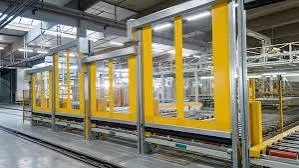

Pharmaceutical manufacturing depends on control. Ingredients, equipment, people, air, surfaces, temperature, humidity, and cleaning procedures all have to work together to create an environment suitable for producing medicines and other regulated products.
One building component that plays a surprisingly important role in this process is the door.
A pharmaceutical cleanroom door is not simply an entrance that separates one room from another. In a controlled manufacturing environment, the door can help support cleanliness, manage movement, maintain room separation, and make everyday work easier for employees.
Think about opening the refrigerator door at home. Every time the door opens, outside air enters and some of the cold air escapes. A cleanroom door works within a much more carefully controlled environment. Frequent or unnecessarily long openings can affect the conditions that the facility is trying to maintain.
This is why pharmaceutical manufacturers pay close attention to the design, materials, operation, and maintenance of doors used around controlled spaces.
This article explains pharmaceutical cleanroom doors in straightforward language, including what they do, where they are used, what features matter, and how facilities can choose a suitable solution.

What Is a Pharmaceutical Cleanroom?
Before discussing doors, it helps to understand what a cleanroom actually is.
A cleanroom is a controlled space designed to limit airborne particles and maintain specified environmental conditions appropriate to the work taking place inside.
That does not necessarily mean every cleanroom has exactly the same requirements.
Different pharmaceutical operations can have different cleanliness classifications and environmental needs. The appropriate controls depend on the process, product, facility design, and applicable requirements.
A cleanroom may control factors such as:
- Airborne particles
- Temperature
- Humidity
- Air pressure relationships
- Airflow
- Cleaning conditions
- Personnel movement
- Material movement
The room itself is only one part of the system.
Ventilation equipment, filtration, cleaning practices, employee procedures, equipment design, and building materials all contribute to the controlled environment.
The door is another piece of that puzzle.
Why Doors Matter in Pharmaceutical Facilities
A cleanroom can be carefully designed, but employees and materials still need to enter and leave.
Every opening creates an opportunity for movement between environments.
When a door opens, air can move from one side to the other. People can pass through. Equipment can enter. Materials can be transferred.
That is why a door needs to support the facility's overall operating strategy.
Imagine a swimming pool with a carefully maintained water level. The pool works because several systems operate together. If one part is poorly managed, maintaining the desired conditions becomes harder.
A cleanroom works in a similar way.
The door does not create cleanliness by itself, but an appropriately designed door can help the facility maintain the separation it has established.
The Main Purpose of Cleanroom Doors
The basic purpose of a pharmaceutical cleanroom door is to provide controlled access between spaces while supporting the environmental conditions of the facility.
Depending on its location, a cleanroom door may need to:
- Provide a smooth, cleanable surface
- Reduce unnecessary air exchange
- Support controlled personnel movement
- Separate different work areas
- Accommodate frequent opening and closing
- Resist regular cleaning procedures
- Minimize areas where dirt or particles can collect
- Integrate with other facility systems
The exact requirements vary from one pharmaceutical facility to another.
A door connecting two highly controlled rooms may have different requirements from a door leading from a warehouse into a production area.
Smooth and Easy-to-Clean Surfaces
Cleanability is an important consideration in pharmaceutical environments.
Doors in controlled areas should generally be designed so that employees can clean their surfaces effectively according to the facility's established procedures.
Why does this matter?
Imagine trying to clean a rough wooden table with deep grooves. Dust and residue can become trapped in places that are difficult to reach.
Now compare that with a smooth countertop.
The second surface is much easier to wipe down thoroughly.
The same basic principle applies to cleanroom construction.
Door surfaces should be evaluated for smoothness, durability, joints, edges, hardware, and other details that could affect cleaning.
The specific materials selected should also be compatible with the cleaning agents and methods used at the facility.
Minimizing Places Where Particles Can Collect
A cleanroom environment is designed to control particles, so unnecessary ledges, gaps, recesses, and difficult-to-clean surfaces can become undesirable features.
Door construction should therefore be considered carefully.
The goal is to create an installation that is practical to clean and maintain.
This does not mean every cleanroom door must look identical.
Different facilities have different layouts and requirements.
However, the basic design principle remains useful: surfaces and details should support the facility's cleaning program rather than make it more difficult.
Managing Air Movement
Air movement is another important consideration.
Pharmaceutical cleanrooms often use carefully designed ventilation systems to establish particular airflow patterns and pressure relationships.
The door is part of the physical boundary between spaces.
When it opens, that boundary is temporarily interrupted.
A door that closes quickly after authorized passage can help reduce the duration of that interruption.
This is one reason some facilities consider high speed cleanroom doors in areas with frequent traffic.
However, door speed is only one factor.
The overall room design, ventilation system, pressure relationship, traffic pattern, and operating procedures all contribute to environmental control.
A fast door cannot compensate for a poorly designed ventilation system.
Why Door Speed Can Matter
Consider an employee who needs to move through a doorway dozens of times during a shift.
If the door opens slowly and takes a long time to close, the opening remains exposed for longer.
That can create unnecessary delays and increase air exchange between rooms.
A rapidly operating door can reduce the amount of time required for each cycle.
Over many daily cycles, this can also improve workflow.
The benefit is similar to an automatic supermarket door. Customers do not have to stop and manually operate it each time they enter. The building can manage movement more smoothly.
In pharmaceutical environments, however, door operation needs to be considered alongside the site's specific cleanliness and safety procedures.
Supporting Personnel Movement
Employees are an essential part of pharmaceutical manufacturing.
Operators, quality personnel, maintenance teams, cleaning staff, supervisors, and other authorized workers may need to move through controlled areas.
The door should therefore support the way people actually work.
If a doorway is difficult to use, employees may be more likely to prop it open or find inconvenient alternatives.
That can undermine the intended separation between spaces.
Good facility design makes the correct behavior the easiest behavior.
If employees can move through an appropriate door quickly and conveniently, they are more likely to follow the established process consistently.
Supporting Material Transfer
People are not the only things moving through pharmaceutical facilities.
Raw materials, containers, packaging components, equipment, samples, tools, and finished products may also need to move between areas.
The door must therefore match the type of traffic.
A small personnel door may be suitable for employees but completely unsuitable for a large cart.
The facility should consider the dimensions of the equipment and materials being transferred.
Questions may include:
- How wide is the typical load?
- How tall is the equipment?
- How frequently does material move through?
- Does the door need automatic operation?
- Is hands-free operation beneficial?
- Does the opening connect areas with different environmental requirements?
Answering these questions helps determine the appropriate design.
Automatic Operation
Automatic door operation can be useful in certain pharmaceutical environments.
Employees may be wearing protective clothing or carrying materials, making manual operation inconvenient.
Hands-free or automated operation can reduce unnecessary contact with the door surface and help maintain a predictable traffic pattern.
However, automation should always be evaluated alongside safety requirements.
The door must respond appropriately to people and equipment using the opening.
Sensors, controls, emergency features, and operating procedures should all be considered as part of the overall system.
Material Selection
The materials used in a cleanroom door matter because the door will be exposed to the facility's cleaning routine and operating environment.
Depending on the application, facilities may consider materials such as stainless steel or other suitable surfaces designed for controlled environments.
Stainless steel cleanroom doors are often considered where durability, cleanability, and resistance to corrosion are important.
But material selection should never be based on the name of the material alone.
The facility should consider the actual environment.
For example, what cleaning chemicals are used? How frequently is the surface cleaned? Is the door exposed to moisture? Does the area require resistance to particular substances?
These questions provide a better basis for choosing a material.
Door Frames and Hardware Matter Too
It is easy to focus on the large visible surface of a door and overlook the surrounding components.
The frame, hinges, handles, seals, sensors, fasteners, and other hardware are also part of the installation.
These components should be selected and maintained with the same care as the door itself.
A beautifully designed door does not solve a problem if the surrounding frame creates difficult-to-clean gaps or the hardware repeatedly fails.
The complete assembly needs to function as one system.
Separating Different Cleanroom Areas
Not every pharmaceutical room has identical environmental requirements.
A facility may contain areas for preparation, processing, packaging, storage, cleaning, personnel changing, and material transfer.
These areas can have different operating requirements.
Doors help create physical boundaries between them.
The design team should therefore look at the movement between each space rather than treating the entire facility as one environment.
For example, a high-traffic connection may require a different door strategy from a rarely used service entrance.
Door Interlocking
Some controlled facilities use door interlocking systems, sometimes called interlocks or airlocks.
The basic idea is simple.
Two doors are arranged so that both are not normally open at the same time.
This can help maintain separation between adjacent spaces.
Imagine entering a building through a small vestibule. You enter the first door, the door closes, and then you open the second door.
The small intermediate space acts as a buffer.
In controlled manufacturing, such arrangements can be used as part of a broader environmental-control strategy.
The exact design and operation depend on the facility's requirements.
Safety Considerations
Cleanroom performance should never come at the expense of employee safety.
Doors need to operate predictably.
People should be able to understand how the door works, and emergency procedures should be clear.
Automatic doors should have appropriate safety features for their application.
Facilities also need to consider what happens during a power failure or equipment malfunction.
A good design anticipates these situations rather than dealing with them only after an incident occurs.
Maintenance Is Essential
A cleanroom door is not a "fit it and forget it" product.
Frequent operation creates mechanical wear.
Cleaning creates repeated exposure to chemicals and moisture.
Sensors may require attention. Moving parts can wear. Seals can deteriorate.
Regular inspection and preventive maintenance help identify problems early.
Maintenance teams can check:
- Door alignment
- Operating speed
- Sensors
- Seals
- Hinges and moving components
- Hardware
- Surface condition
- Control systems
- Safety functions
If a door begins operating differently from normal, that can be an early warning sign.
Addressing small issues early is usually easier than waiting for a complete failure.
Cleaning and Sanitation Procedures
Cleaning requirements vary according to the pharmaceutical process and facility.
The door should be compatible with the established cleaning method.
Employees should know which cleaning products can be used and how surfaces should be treated.
This is important because an unsuitable cleaning chemical can damage a surface over time.
The goal is to make cleaning both effective and repeatable.
A good cleanroom door should support the facility's sanitation procedures rather than require an entirely different maintenance routine.
Choosing the Right Cleanroom Door
Selecting a pharmaceutical cleanroom door should begin with the application.
Facility managers can evaluate several factors.
Traffic Level
How often will the door open and close?
A high-cycle doorway may require a more specialized solution than a rarely used entrance.
Environmental Conditions
What are the temperature, humidity, cleaning, and exposure conditions?
Room Classification
What level of environmental control does the connected space require?
Opening Size
Will only people pass through, or will carts and equipment also use the opening?
Cleaning Requirements
What cleaning chemicals and procedures are routinely used?
Access Control
Who should be able to use the door, and does it need to connect with an access-control system?
Maintenance
Can the door be inspected and serviced efficiently?
These considerations help prevent a common mistake: selecting a door based on appearance or price without understanding the actual operating environment.
How Newport Company Fits Into the Picture
Pharmaceutical manufacturers need industrial building products that match the specific demands of controlled environments.
Newport Company offers door solutions for industrial applications where factors such as controlled movement, durability, and environmental separation can be important.
The most useful approach is to evaluate the individual application first and then determine which door design is appropriate.
A pharmaceutical facility should not select equipment simply because it is marketed as a cleanroom product. The door needs to work with the facility's layout, operating procedures, environmental controls, cleaning program, and traffic requirements.
Designing the Door Around the Workflow
One of the smartest ways to select a cleanroom door is to observe the actual workflow.
Watch how employees move.
Observe how materials arrive.
Look at where carts stop.
Identify which entrances are constantly used and which ones are rarely opened.
This can reveal problems that are difficult to see on a floor plan.
For example, a door may appear perfectly positioned on paper but become a bottleneck when three departments use it simultaneously.
A small change to the layout or door operation may solve the issue.
The Bigger Picture
A pharmaceutical cleanroom is a complete environment.
The door is only one component.
Air-handling systems control airflow. Cleaning procedures address surfaces. Employees follow gowning and movement procedures. Equipment is maintained. Materials are handled according to established processes.
The door connects these elements by controlling one of the most basic activities in the facility: movement between spaces.
That is why its design deserves careful consideration.
Conclusion
Pharmaceutical cleanroom doors play an important supporting role in controlled manufacturing environments.
They provide physical separation while allowing employees, equipment, and materials to move between areas. Depending on the application, they may also support cleanability, environmental control, access management, workflow efficiency, and safe operation.
The most effective solution is not necessarily the fastest or most expensive door.
It is the door that fits the facility's actual requirements.
Manufacturers should consider traffic levels, room conditions, cleaning practices, opening dimensions, access requirements, maintenance, and safety before making a selection.
When these factors are evaluated together, the door becomes more than a simple entrance. It becomes a practical part of the facility's overall strategy for maintaining controlled conditions and supporting reliable pharmaceutical production.
In a highly regulated industry where consistency matters every day, even something as ordinary as a doorway deserves thoughtful design.





















Sign in to leave a comment.