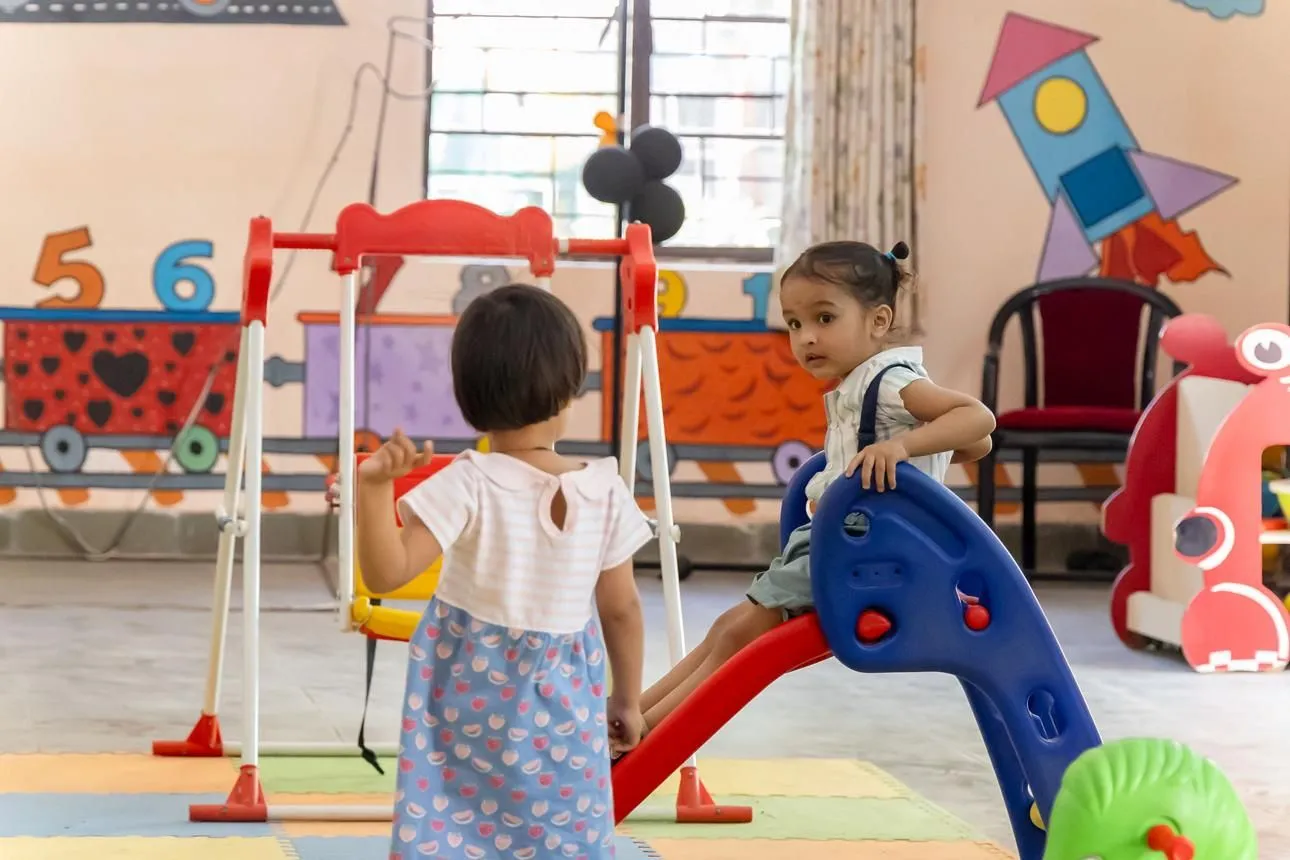

In early childhood education, the word “play” is often used so frequently that its true educational significance can become blurred. While many schools proudly claim to use play-based learning, not all institutions apply play in the same way. Some use play merely as an activity added to structured lessons, while others build the entire curriculum around play itself. Understanding this distinction is critical for educators, parents, and preschool franchise owners who wish to provide meaningful early learning experiences.
Understanding Play as a Curriculum Component
When play is treated as a curriculum component, it becomes one of many teaching tools used during the day. In this approach, traditional academic instruction remains the primary focus, while play is inserted between lessons to reinforce concepts or give children a break from formal learning.
For example, children may complete worksheets on numbers and then play a counting game afterward. Here, play supports learning, but it does not drive the curriculum. The educational goals are predetermined by adults, and play activities are designed to match those goals.
This method is common in many institutions because it balances academic expectations with child-friendly engagement. However, it may limit creativity, spontaneous exploration, and deeper emotional learning if not carefully implemented.
Parents looking for balanced academic and playful environments often explore institutions connected with a strong play school franchise in kolkata that integrates structured learning with engaging activities suitable for early learners.
Understanding Play as a Curriculum Base
In contrast, when play becomes the curriculum base, the entire educational philosophy revolves around children learning through exploration, imagination, and hands-on experiences. Instead of teaching first and allowing play later, educators design environments where play itself becomes the pathway to learning.
In this model, children develop literacy, numeracy, communication, emotional intelligence, and problem-solving skills naturally through activities they genuinely enjoy. Teachers act as facilitators rather than direct instructors, carefully observing and guiding children's interests.
For example, if children are pretending to run a grocery store, they may learn counting, social interaction, language development, and decision-making all within one playful scenario. The learning outcomes emerge organically from the experience rather than being imposed beforehand.
Many educators associated with a reputed play school franchise in ghaziabad are increasingly adopting this philosophy because it aligns better with modern research in child psychology and brain development.
Why This Distinction Matters
The difference between these two approaches affects every aspect of preschool education — from classroom setup and teacher training to assessment methods and child behavior.
When play is merely a curriculum component:
- Teacher-led instruction dominates
- Fixed lesson plans are prioritized
- Academic outcomes are measured traditionally
- Play sessions may have strict boundaries
When play forms the curriculum base:
- Child-led exploration becomes central
- Flexible learning environments are encouraged
- Creativity and emotional growth are equally valued
- Teachers focus on observation and facilitation
This distinction matters because young children learn differently from older students. Their brains develop best through active engagement, movement, storytelling, experimentation, and social interaction rather than passive instruction.
Institutions recognized as leading centers for Preschool in Hyderabad are increasingly redesigning classrooms to support play-driven learning environments where children can explore safely and independently.
The Role of Teachers in Play-Based Curriculums
Teachers in play-centered environments require specialized skills. They must observe carefully, understand developmental milestones, and know how to extend children's thinking without interrupting natural curiosity.
In a curriculum where play is only a component, teachers mainly deliver content and supervise activities. But when play is the curriculum base, educators become researchers of children's behavior and learning patterns.
This shift demands deeper training and a more flexible teaching mindset. Teachers must learn how to:
- Create meaningful play environments
- Encourage open-ended questioning
- Support social-emotional learning
- Document developmental progress naturally
These advanced practices are often emphasized in training systems provided by established Preschool Franchise in Kolkata networks that focus on modern early childhood methodologies.
The Impact on Child Development
Research consistently shows that children in authentic play-based environments often demonstrate:
- Better communication skills
- Stronger creativity
- Improved emotional regulation
- Greater confidence
- Enhanced problem-solving abilities
Play-based curriculums also reduce early academic pressure and help children build positive relationships with learning from a young age.
However, it is important to understand that play-based education does not mean unstructured chaos. Effective play-centered learning is intentionally designed, carefully guided, and developmentally appropriate.
The goal is not to remove learning objectives but to achieve them through meaningful engagement rather than rigid instruction.
Challenges Schools Face
Despite the benefits, implementing play as a curriculum base is not always easy. Many schools face pressure from parents who expect visible academic results such as reading, writing, and memorization at very early ages.
Additionally, some educators misunderstand play-based learning and assume it requires less planning. In reality, designing purposeful play experiences often demands more creativity, observation, and preparation than traditional teaching.
Infrastructure, teacher training, and assessment methods also need significant adjustments when shifting toward a true play-based model.
Moving Toward Balanced Early Education
The ideal preschool environment may not always lie at either extreme. Some schools successfully combine intentional academic guidance with child-led exploration. The key is ensuring that play remains meaningful rather than superficial.
Educators must ask important questions:
- Is play driving discovery?
- Are children making choices?
- Are teachers facilitating curiosity?
- Is learning emerging naturally?
When these elements are present, play becomes more than entertainment — it becomes the foundation of lifelong learning.
Conclusion
Understanding the difference between play as a curriculum component and play as a curriculum base is essential for anyone involved in early childhood education. While both approaches use play, their educational philosophies are fundamentally different.
A curriculum where play is merely added may still support learning, but a curriculum built upon play recognizes how young children naturally think, explore, and grow. As modern education evolves, more schools are beginning to appreciate that meaningful play is not separate from learning — it is learning itself.
For educators, parents, and preschool entrepreneurs, recognizing this distinction can lead to more thoughtful educational choices and healthier developmental outcomes for children.


























Sign in to leave a comment.