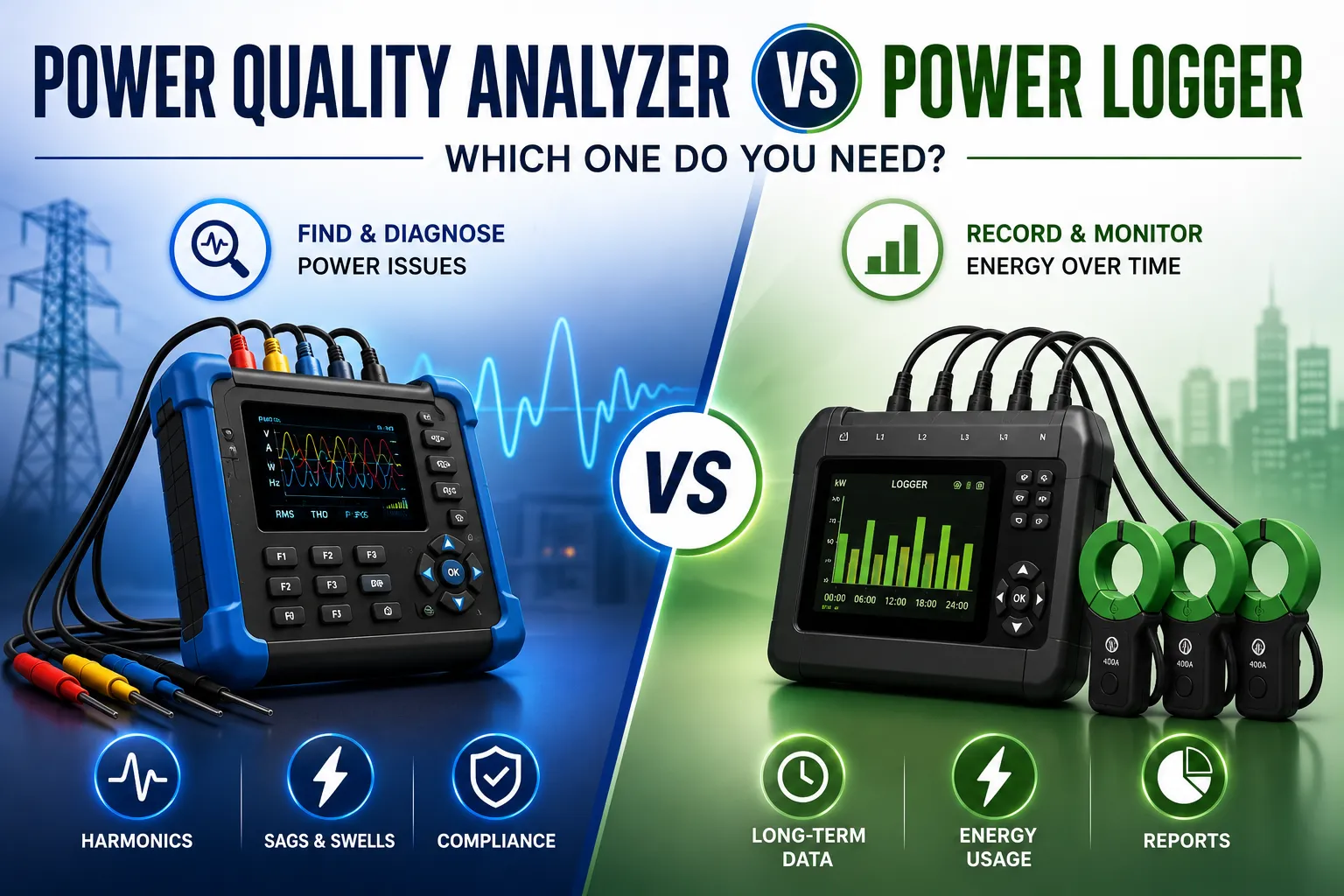
Choosing between a Power Quality Analyzer and a power logger can be confusing. Both devices monitor electrical systems, but they are built for different jobs. A Power Quality Analyzer helps identify issues like voltage sags, harmonics, and transients, while a power logger focuses on recording electrical data over time.
Using the wrong device can lead to inaccurate data, wasted time, and unnecessary costs. Understanding the difference helps you choose the right tool for troubleshooting, energy monitoring, or long-term system analysis.
Let's compare both devices to help you choose the right one for your needs.
Power Quality Analyzer vs Power Logger: Key Differences at a Glance
| Feature | Power Quality Analyzer | Power Logger |
|---|---|---|
| Primary purpose | Finds and analyzes power quality problems | Records electrical and energy data over time |
| Best for | Troubleshooting electrical issues | Long-term energy monitoring |
| Harmonics analysis | ✔ Yes | Limited |
| Voltage sag & swell detection | ✔ Yes | Limited |
| Transient detection | ✔ Yes | Usually No |
| Energy monitoring | ✔ Yes | ✔ Yes |
| Long-term logging | ✔ Yes | ✔ Yes |
| Typical users | Electrical engineers, maintenance teams | Energy managers, facility managers |
| Ideal application | Fault diagnosis and compliance testing | Load studies and energy audits |
What Is a Power Quality Analyzer?
A Power Quality Analyzer is a specialized instrument used to measure, record, and analyze the quality of electrical power. It helps identify problems that can affect the performance, efficiency, and lifespan of electrical equipment.
Unlike a basic meter, it captures detailed information about how power behaves in real time. This allows engineers to detect hidden electrical issues before they cause equipment failure or unexpected downtime.
A portable power quality analyzer is ideal for field testing because it can be moved between different sites. For larger commercial and industrial installations, a 3 phase power quality analyzer provides accurate monitoring across all three phases of the electrical system.
A Power Quality Analyzer can measure:
- Voltage and current
- Harmonics and Total Harmonic Distortion (THD)
- Voltage sags and swells
- Power factor
- Frequency
- Flicker
- Transient events
- Energy consumption
Common applications
A Power Quality Analyzer is commonly used for:
- Troubleshooting electrical faults
- Investigating equipment failures
- Harmonic analysis
- Power quality audits
- Compliance testing
- Preventive maintenance
- Industrial and commercial power monitoring
If your goal is to understand why electrical problems are happening, a Power Quality Analyzer is the right choice.
What Is a Power Logger?
A power quality logger, also known as an energy data logger, is designed to record electrical measurements over an extended period. Instead of diagnosing complex power quality issues, it focuses on collecting data that helps users understand how an electrical system performs over time.
A power logger continuously records information such as voltage, current, power demand, and energy consumption. This historical data helps engineers and facility managers identify usage patterns, monitor loads, and improve energy efficiency.
Some models also function as a clamp energy monitor, allowing measurements without disconnecting existing wiring. This makes installation faster and reduces disruption during testing.
A power logger is commonly used for:
- Long-term energy monitoring
- Load profiling
- Energy audits
- Demand analysis
- Peak load identification
- Performance trend analysis
While a power logger records valuable operational data, it usually does not provide the detailed analysis needed to diagnose power quality problems like harmonics or transient events.
When Should You Choose a Power Quality Analyzer?
A Power Quality Analyzer is the best choice when you need to find the cause of electrical problems. It provides detailed measurements that help engineers troubleshoot issues and improve system reliability.
Choose a Power Quality Analyzer if you need to:
- Investigate equipment failures.
- Detect harmonics and voltage disturbances.
- Perform power quality audits.
- Verify compliance with industry standards.
- Troubleshoot recurring electrical issues.
- Monitor complex three-phase electrical systems.
If you regularly work across different sites, a portable power quality analyzer offers flexibility and convenience for field testing.
When Is a Power Logger the Better Choice?
A power logger is designed for long-term monitoring rather than troubleshooting. It records electrical data continuously, making it useful for understanding energy usage and system performance over time.
Choose a power logger if you need to:
- Monitor energy consumption.
- Perform energy audits.
- Record load profiles.
- Track peak demand.
- Analyze long-term performance trends.
An energy data logger or clamp energy monitor is often a practical choice for facilities focused on energy management rather than fault diagnosis.
Can One Device Do Both?
Yes. Many modern instruments combine the features of a Power Quality Analyzer and a power logger in a single device. These solutions allow users to monitor energy consumption while also detecting issues such as harmonics, voltage sags, and transient events.
If your work involves both troubleshooting and long-term monitoring, a combined device can save time and reduce the need for multiple instruments.
Why Choosing the Right Equipment Matters
Using the correct monitoring equipment leads to faster troubleshooting, more accurate data, and better decisions. Working with an experienced power quality solutions provider can also help ensure you select the right instrument for your application.
At CHK Power Quality, engineers can access advanced monitoring solutions designed for industrial, commercial, and utility environments.
Find the Right Monitoring Solution
Choosing between a Power Quality Analyzer and a power logger depends on what you want to measure and achieve. If you're looking for expert guidance or reliable monitoring equipment, CHK Power Quality can help you select the right solution for your electrical system and operational needs.
Frequently Asked Questions
Is a power logger the same as a Power Quality Analyzer?
No. A power logger records electrical data over time, while a Power Quality Analyzer identifies and analyzes power quality issues.
Can a Power Quality Analyzer measure energy consumption?
Yes. Many modern analyzers measure energy while also detecting electrical problems such as harmonics, voltage sags, and transients.
What is a 3 phase Power Quality Analyzer?
A 3 phase Power Quality Analyzer monitors and analyzes three-phase electrical systems commonly used in commercial and industrial facilities.
Is a portable Power Quality Analyzer suitable for field testing?
Yes. A portable power quality analyzer is designed for on-site testing, making it ideal for engineers and maintenance teams.
Which device is better for an energy audit?
A power logger is suitable for long-term energy monitoring. If you also need to identify electrical faults, a Power Quality Analyzer is the better choice.

























Sign in to leave a comment.