

Manufacturing sales teams often sell products that are far more complex than standard business offerings. A single customer order may involve multiple configurations, product options, pricing rules, engineering requirements, delivery terms, and contractual conditions. Creating an accurate proposal that reflects all these details can take hours—and even a small error can delay a deal or reduce profitability.
This is where proposal automation software can make a significant difference. By connecting product configuration, pricing, quoting, and document generation into a single workflow, manufacturers can create accurate, professional proposals faster while reducing manual work for sales teams.
For organizations selling highly configurable products, the ideal solution goes beyond simply creating documents. It should help sales representatives move from product configuration to pricing and proposal generation without repeatedly entering the same information.
Why Manufacturing Sales Teams Need Proposal Automation
Traditional proposal creation often involves multiple disconnected systems. A salesperson may configure a product in one application, calculate pricing in a spreadsheet, copy the information into a CRM, and then manually create a proposal using a document template.
This process creates several challenges.
Manual data entry increases the possibility of errors. A pricing change may not be reflected in an old spreadsheet. A product option may be missed when information is transferred between systems. Sales representatives may also spend valuable selling time formatting documents rather than engaging with customers.
For complex manufacturers, these problems become even more significant because product configurations can contain hundreds or thousands of possible combinations.
Proposal automation addresses this challenge by creating a more connected process. Instead of building every proposal from scratch, sales teams can use approved product information, configuration rules, pricing logic, and templates to generate customer-ready documents.
What Is Automated Proposal Software?
Automated proposal software is technology that helps businesses generate proposals with less manual effort. It can automatically populate documents using information from a sales opportunity, product configuration, pricing system, CRM, or quoting application.
For manufacturing organizations, automation becomes particularly valuable when proposals must accurately reflect configured products.
For example, a customer may request a specialized piece of industrial equipment with specific dimensions, materials, accessories, service options, and delivery requirements. The sales representative can configure the appropriate solution, calculate the associated price, and use that information to generate a proposal.
Instead of manually transferring information between applications, the proposal can be created using data that has already been validated during the quoting process.
From Product Configuration to Proposal
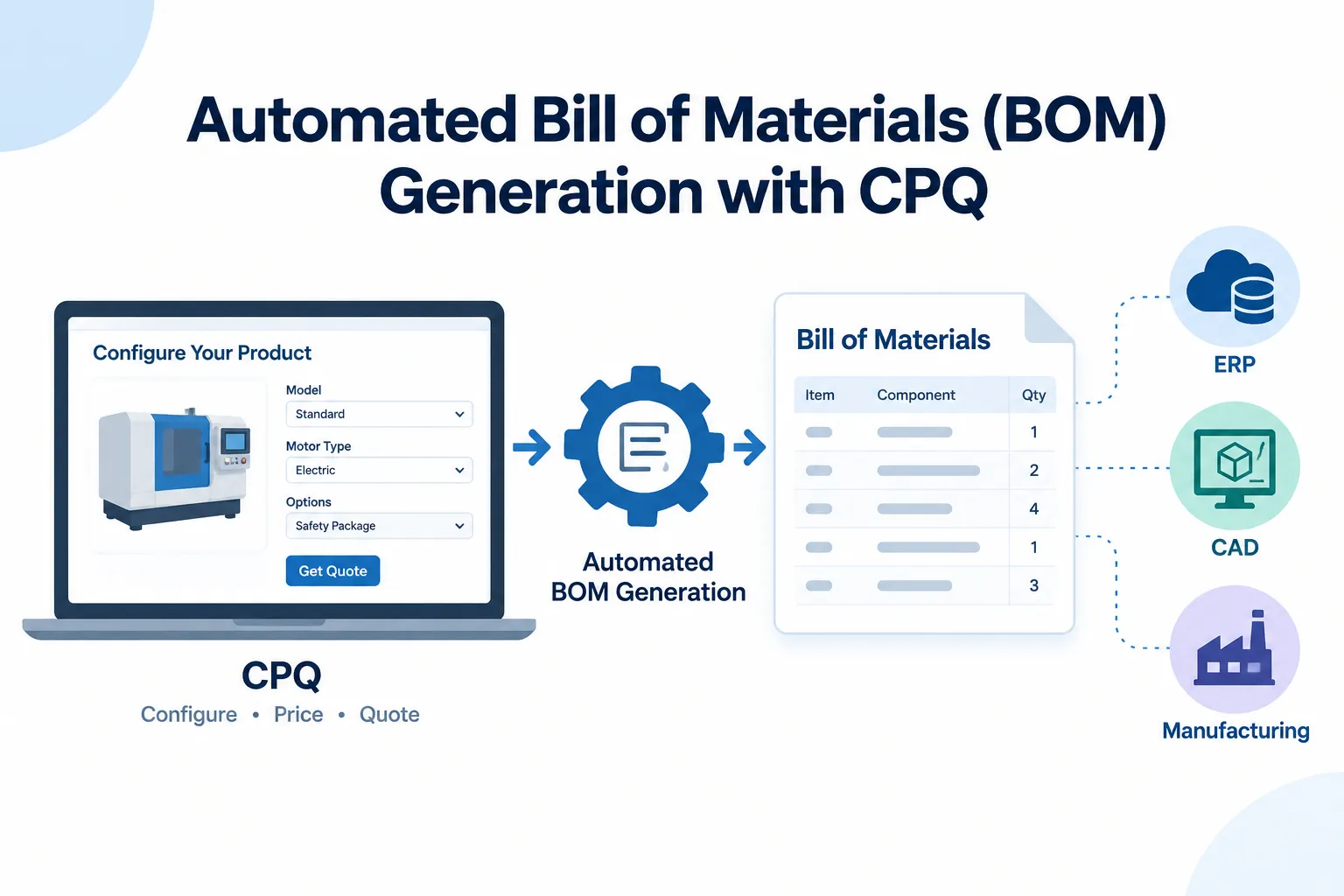
One of the biggest advantages of integrating proposal automation with CPQ technology is the ability to connect configuration directly to customer-facing documents.
A manufacturing sales process might follow this sequence:
Configure → Price → Quote → Generate Proposal → Contract
The product configuration determines what can be sold. Pricing rules determine how much it costs. The quote brings those details together, while proposal automation transforms the approved quote into a professional customer document.
This approach helps maintain consistency throughout the sales process.
If a customer changes the configuration, the pricing and proposal should also change accordingly. Sales teams should not have to manually update several separate documents every time an option changes.
Need a Quoting Tool That Generates Proposals and Contracts Automatically From a Configuration?
For manufacturers with complex products, this is an important requirement when evaluating a quoting platform.
A quoting tool should ideally allow sales representatives to configure a product and then use that configuration as the foundation for the quote, proposal, and contract. This eliminates repetitive data entry and helps ensure that customer-facing documents accurately represent what has been quoted.
Imagine a salesperson configuring an industrial machine with a particular production capacity, optional components, installation services, and warranty package. Once the configuration is approved, the system can use those same details to calculate pricing and populate the proposal.
When the customer accepts the offer, the relevant information can then flow into the contract process.
This connected approach can significantly reduce administrative work and create a more consistent quote-to-contract experience.
How Proposal Generator Software Helps Sales Teams
Proposal generation software can help manufacturing sales teams produce documents quickly using predefined templates and business data.
Instead of manually creating every proposal, organizations can establish standardized templates for different products, industries, regions, or types of customers.
The software can automatically insert information such as:
- Customer details
- Configured products
- Quantities
- Pricing
- Discounts
- Terms and conditions
- Delivery information
- Service options
- Company information
The result is a proposal that is faster to create and easier to maintain.
Automation also helps organizations maintain brand consistency. Every proposal can follow approved formatting, messaging, and document standards without requiring sales representatives to manually format each file.
The Benefits of Industrial Manufacturing Proposal Software
Manufacturers have unique requirements that general-purpose proposal applications may not fully address. Industrial manufacturing proposal software should work with the complexity of configurable products rather than treating every sale as a simple document-generation exercise.
A manufacturing-focused approach can provide several benefits.
Faster Proposal Creation
Sales representatives can generate proposals from existing quote and configuration data instead of rebuilding documents manually. This can shorten the time between customer discussions and proposal delivery.
Fewer Errors
When information flows automatically from configuration and quoting into the proposal, there are fewer opportunities for transcription errors or outdated pricing to appear in customer documents.
Greater Pricing Consistency
Pricing rules can be managed centrally, helping ensure that approved prices, discounts, and commercial policies are applied consistently.
Better Sales Productivity
Salespeople can spend less time preparing documents and more time working with prospects, understanding requirements, and progressing opportunities.
Improved Customer Experience
Customers expect fast and accurate responses. A professional proposal delivered quickly can create a better buying experience, particularly when customers are comparing multiple suppliers.
Connecting CPQ and Proposal Automation
The strongest proposal automation workflows often begin before the proposal itself is created.
Configure, Price, Quote (CPQ) software can help sales representatives select valid product options, apply product rules, calculate pricing, and generate accurate quotes. Proposal automation can then use the resulting information to create the customer-facing document.
This creates a connected sales workflow rather than treating proposal generation as an isolated activity.
For manufacturers, this distinction matters. The objective isn't simply to generate documents faster. The objective is to automate the path from customer requirements to an accurate commercial proposal.
What Should Manufacturers Look for in Proposal Automation Software?
When evaluating proposal automation technology, manufacturing sales leaders should consider how well the solution supports their existing sales process.
Important capabilities include integration with CRM and ERP platforms, configurable product support, pricing automation, document templates, approval workflows, contract generation, and the ability to update proposals when configurations change.
Integration is particularly important. A proposal system that requires sales representatives to manually re-enter information from the CRM, CPQ, or ERP can simply move the administrative burden from one application to another.
Manufacturers should therefore look for a solution that can connect configuration, pricing, quoting, proposals, and downstream processes.
Automating the Manufacturing Quote-to-Cash Process
Proposal automation can become an important component of a broader quote-to-cash strategy.
When configuration, pricing, quoting, proposal generation, approvals, contracting, and order processing are connected, organizations can reduce unnecessary handoffs between sales, operations, finance, and other departments.
This can help manufacturers create a more scalable sales process as deal volume increases.
For complex manufacturers, automation isn't about removing salespeople from the process. Instead, it gives them better tools to manage complexity while spending more time on customer relationships and revenue-generating activities.
Conclusion
Manufacturing sales teams need more than basic document creation tools. When products are highly configurable, proposals must accurately reflect product options, pricing, services, terms, and customer requirements.
Proposal automation software can help manufacturers streamline this process by connecting product configuration and quoting with automated proposal and contract generation.
With the right proposal generator software, sales teams can reduce manual data entry, improve proposal accuracy, accelerate response times, and create a more consistent customer experience.
For manufacturers evaluating industrial manufacturing proposal software, the most valuable approach is to look beyond document automation. The ideal solution should connect the entire sales workflow—from configuration and pricing through quoting, proposal generation, and contracting.
When these processes work together, manufacturing organizations can turn complex quotes into faster, more accurate, and more scalable sales experiences.
























Sign in to leave a comment.