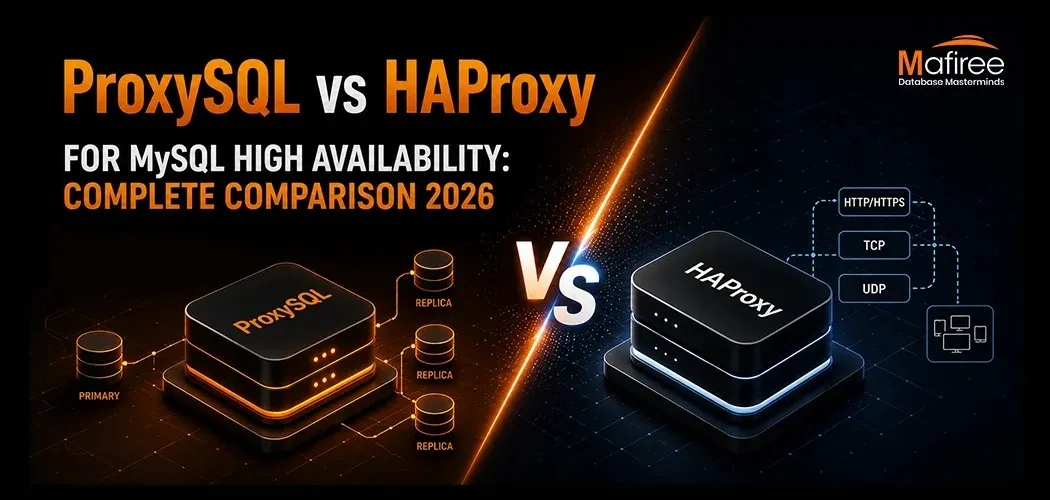

For teams managing MySQL infrastructure, ProxySQL vs HAProxy is a frequent decision point. Both are open-source tools that strengthen database reliability through load balancing, failover, and query routing - but each takes a distinct path to get there.
What Is ProxySQL
ProxySQL is a high-performance proxy designed specifically for MySQL and MySQL-compatible systems. Positioned between the application and the database servers, it handles read/write splitting, query caching, load balancing, failover management, and performance monitoring.
What Is HAProxy
HAProxy is a popular, general-purpose load balancer supporting HTTP, HTTPS, TCP, and UDP traffic. Though it was originally created for web applications, it has been extended to manage database connections as well. Its strengths lie in handling multiple protocols, offering advanced load-balancing algorithms, performing health checks with failover, and providing SSL termination along with compression.
How They Differ
Protocol handling: ProxySQL is tailored exclusively to MySQL, with built-in support for query rewriting, transaction management, and connection pooling. HAProxy, by contrast, spans a broader set of protocols but doesn't match ProxySQL's MySQL-level depth.
Load balancing approach: ProxySQL directs queries intelligently by evaluating server health and query type. HAProxy delivers dependable TCP-level balancing through standard algorithms like round-robin and least connections.
Read/write splitting: ProxySQL clearly leads here, automatically sending queries to the correct destination - primary server or read replica - and allowing configuration updates without any downtime. HAProxy typically needs supplementary setup or third-party tools to accomplish similar splitting, making the process less native.
Caching and query optimization: ProxySQL comes with built-in caching for SELECT statements, plus query rewriting capabilities and detailed performance data. HAProxy has no equivalent caching or optimization functionality, since its role is limited to the transport layer.
Failover capability: Both tools handle failover, though with different levels of intelligence. ProxySQL makes failover decisions using server health data and query execution status, giving it database-aware precision. HAProxy relies on health checks to reroute traffic toward backup servers but doesn't have that deeper database context.
Monitoring and metrics: ProxySQL supplies granular, MySQL-focused monitoring, including query execution statistics, connection tracking, and server health summaries. HAProxy's monitoring is more generalized, centered on transport-level statistics rather than database internals.
Choosing the Right Tool
ProxySQL makes sense when MySQL-specific performance tuning matters, read/write splitting is a core need, advanced caching or query rewriting is required, or the environment relies heavily on MySQL replication setups.
HAProxy is the better fit when traffic spans multiple protocols (HTTP, HTTPS, TCP), general-purpose load balancing across various services is needed, SSL termination and compression are priorities, or a simpler, lightweight proxy is preferred.
A Note on Performance
The blog points out that although ProxySQL is engineered to enhance MySQL performance through smart routing, connection pooling, caching, and read/write splitting, the actual improvement depends on the specific workload. Rather than citing fixed performance numbers, it recommends benchmarking against your own workload to gauge real gains.
Side-by-Side Comparison
| Feature | ProxySQL | HAProxy |
| Protocol Support | MySQL-specific | TCP/UDP, HTTP/HTTPS |
| Read/Write Splitting | Native | Requires external tools |
| Query Caching | Built-in | None |
| Failover Handling | Advanced, database-aware | Basic health checks |
| Performance Monitoring | Detailed MySQL metrics | Generic transport stats |
Final Takeaway
Ultimately, the decision hinges on your infrastructure priorities. Teams that depend on MySQL-specific capabilities - read/write splitting, caching, and fine-tuned performance - will find ProxySQL the stronger choice. Teams needing a flexible, multi-protocol load balancer to manage traffic across several types of services will benefit more from HAProxy.





























Sign in to leave a comment.