

In chemical manufacturing, some materials play a crucial role without becoming part of the finished product. Para-Toluene Sulphonic Acid (PTSA) is one such compound. Valued for its strong acidic properties and catalytic activity, PTSA is used in selected reaction processes across the resin, coatings, plasticizer, pharmaceutical, dye, and agrochemical industries.
For manufacturers, choosing the right catalyst is not simply a matter of accelerating a reaction. Reaction selectivity, conversion, product quality, processing time, and downstream purification all influence the economics of production. PTSA can help address these requirements when its properties are suited to the chemistry involved.

Its versatility has made it an established material in specialty chemical manufacturing, particularly in processes that require acid catalysis under controlled conditions. Understanding where PTSA is used, how it works, and what factors influence its performance helps manufacturers make better-informed process decisions.
What Is Para-Toluene Sulphonic Acid?
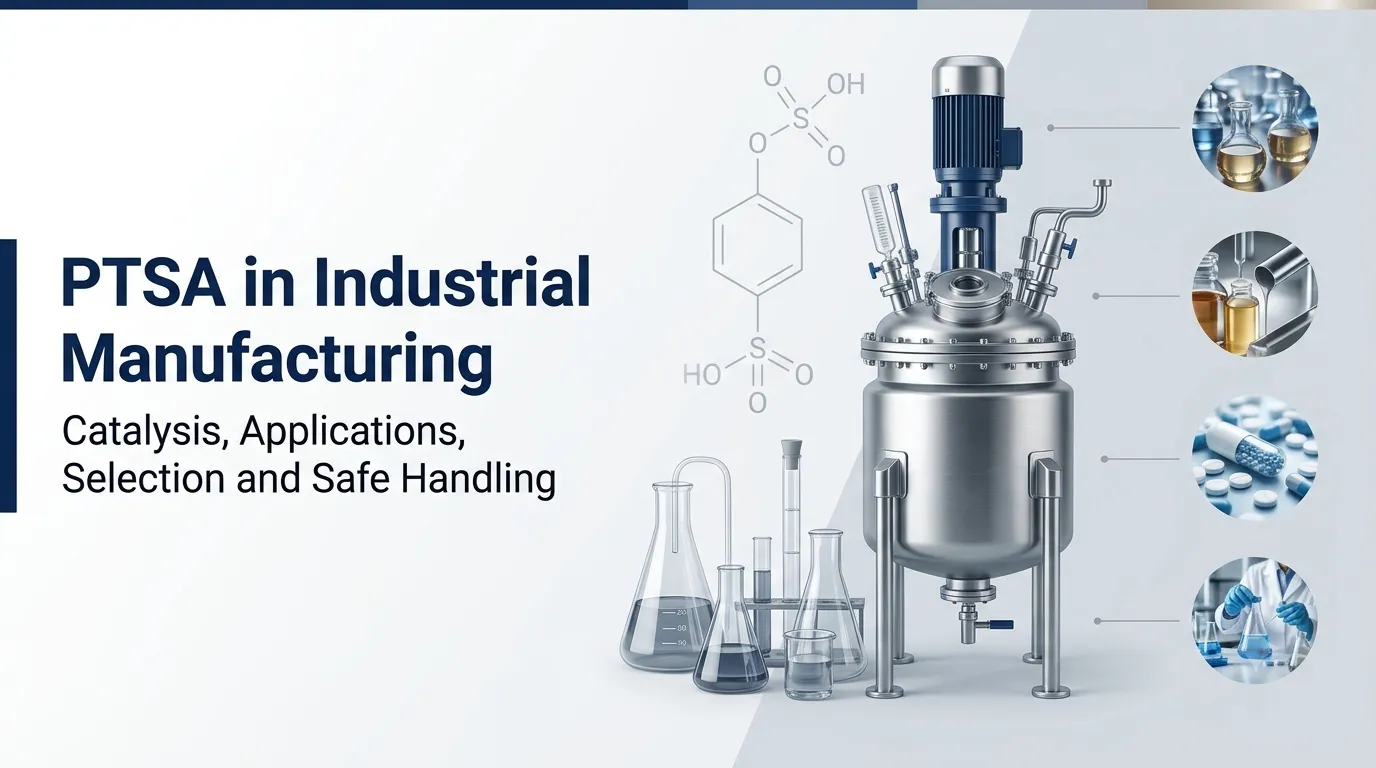
Para-Toluene Sulphonic Acid, commonly abbreviated as PTSA or p-TSA, is an aromatic organic sulfonic acid derived from toluene. Its chemical name is 4-methylbenzenesulfonic acid, and its molecular formula is C₇H₈O₃S.
PTSA is commercially available in solid form, commonly as a white crystalline material, and in suitable liquid formulations. The solid material may be supplied in anhydrous or hydrated form, depending on the grade. Its physical characteristics and water content are important considerations when selecting a product for a particular manufacturing process.
One of its principal advantages is its strong acidic character, which makes it useful as a catalyst in various organic reactions. Unlike a catalyst designed for only one narrow application, PTSA can be considered for several acid-catalysed processes, provided the reaction conditions and material compatibility are appropriate.
PTSA is also soluble in water and many polar organic solvents. However, its solubility and behaviour in a particular reaction mixture depend on the solvent system, temperature, concentration, and grade supplied.
For industrial users, the choice between solid PTSA and a liquid formulation generally depends on dosing requirements, moisture sensitivity, process design, and handling preferences.
Why Is PTSA Used as an Acid Catalyst?
Acid catalysts are widely used to facilitate chemical transformations by making certain reaction steps easier to carry out. PTSA provides an acidic environment that can promote reactions such as esterification, condensation, and other acid-catalysed organic transformations.
Its effectiveness depends on the substrate, solvent, reaction temperature, catalyst concentration, and presence of water or other reaction components. For this reason, PTSA is not automatically the best choice for every process, but it can be an effective option in appropriately designed reaction systems.
Manufacturers evaluate PTSA for several practical reasons:
- Reaction efficiency: It can accelerate suitable acid-catalysed reactions.
- Conversion and yield: Optimised reaction conditions may improve the conversion of starting materials and the yield of the desired product.
- Process control: Appropriate catalyst dosing can help maintain consistent reaction conditions.
- Product quality: Selecting the right catalyst and operating conditions can help control unwanted by-products.
- Production economics: Reduced reaction time or improved conversion may lower processing costs, depending on the process.
These benefits must be confirmed through process trials rather than assumed for every application. Catalyst selection is most effective when supported by reaction data, product specifications, and a clear understanding of downstream requirements.
PTSA in Plasticizer Manufacturing
Plasticizers are used to improve the flexibility, workability, and performance of selected polymer materials. They have applications in flexible PVC, cables, flooring, synthetic leather, and other industrial products.
PTSA can serve as an acid catalyst in esterification reactions used to manufacture certain ester-based plasticizers. In these processes, the catalyst helps promote the reaction between an alcohol and a carboxylic acid or another suitable acid derivative.
The overall performance of the process depends on several factors, including the reactant ratio, catalyst concentration, temperature, reaction time, and management of water formed during esterification.
When properly optimised, PTSA may contribute to:
- Improved reaction rates under suitable operating conditions.
- Higher conversion of reactants.
- More efficient use of production equipment.
- Consistent product quality across manufacturing batches.
- Potential reductions in processing time and operating costs.
PTSA is not required for every plasticizer manufacturing route. Its suitability depends on the specific product chemistry and the requirements of the production process.
For manufacturers, the objective is to select a catalyst that delivers the required conversion and product quality without creating unnecessary challenges during neutralisation, separation, or purification.
Applications in Resins and Industrial Coatings
Resin manufacturing is another important area in which PTSA finds application. Acid catalysts are used in selected resin systems to promote condensation, cross-linking, and curing reactions.
PTSA may be used in processes involving amino resins, including certain melamine-formaldehyde and urea-formaldehyde systems, as well as other acid-catalysed resin formulations.
In coating applications, the catalyst can influence curing behaviour and the development of the final film properties. These properties may include hardness, adhesion, chemical resistance, and durability, depending on the resin formulation and curing conditions.
Industrial applications can include:
- Wood coatings and furniture finishes.
- Industrial and protective coatings.
- Selected automotive coating systems.
- Amino-resin-based finishes.
- Resin formulations used in manufactured wood products.
The amount of PTSA added, the formulation's buffering capacity, the curing temperature, and the required working time all affect the final result. Excessive acidity or unsuitable catalyst loading may cause premature curing, formulation instability, or undesirable changes in the finished material.
Consequently, PTSA concentration and compatibility should be established through formulation testing. The objective is not simply to achieve faster curing, but to obtain the required balance of processing time, film performance, and product stability.
PTSA in Pharmaceutical and Fine Chemical Synthesis
Pharmaceutical and fine chemical manufacturing involves a wide range of reactions in which acidity must be controlled carefully. PTSA is used as a catalyst or acid reagent in selected organic synthesis routes.
Depending on the reaction, it may facilitate esterification, condensation, or other transformations involved in producing intermediates and specialised organic compounds.
Its potential advantages include the ability to provide a defined acidic environment and compatibility with certain organic reaction media. These characteristics can be useful during process development and reaction optimisation.
However, pharmaceutical applications place strict demands on impurity profiles, residual materials, and product consistency. PTSA use must therefore be evaluated in the context of the specific synthesis route, purification process, and applicable quality requirements.
Manufacturers should assess:
- The effect of PTSA on reaction selectivity and impurity formation.
- Catalyst removal or neutralisation requirements.
- Residual sulfonate and related impurity controls, where applicable.
- Compatibility with the intended solvent and process conditions.
- Suitability of the supplied grade for the intended application.
PTSA is not a universal pharmaceutical catalyst. Its value lies in its suitability for particular reactions where the required chemistry, process conditions, and quality controls can be demonstrated.
The Role of PTSA in Agrochemical Manufacturing
Agrochemical production involves the synthesis of active ingredients, intermediates, and formulation components used in crop protection and agricultural applications.
PTSA can be used in selected agrochemical synthesis routes where acid catalysis is required. Depending on the chemical pathway, it may help facilitate esterification, condensation, or other organic reactions used to prepare intermediates.
The practical benefits depend on the individual reaction and may include improved conversion, controlled reaction rates, and more efficient production when suitable operating conditions are established.
For agrochemical manufacturers, catalyst selection is closely connected to process economics and product quality. A catalyst must support the intended reaction while allowing the resulting material to meet the required purity and performance specifications.
The use of PTSA should therefore be assessed on a route-specific basis. It is not a standard ingredient in all pesticides or crop protection products, and its relevance depends on the chemistry used to manufacture a particular active ingredient or intermediate.
PTSA in Dyes, Pigments, and Colour Chemistry
The production of dyes and pigments often involves multistep synthesis, with reaction conditions influencing colour strength, purity, stability, and batch-to-batch consistency.
PTSA can be useful in selected reactions involved in the preparation of dye intermediates and other specialty organic compounds. Its acidic properties may help promote transformations required during synthesis.
In these applications, manufacturers must consider more than reaction speed. The formation of coloured impurities, the solubility of intermediates, and the ease of product isolation can all influence the final outcome.
PTSA may be evaluated where acid catalysis is appropriate and where the catalyst can be incorporated into the manufacturing process without compromising the required product specifications.
Its role varies according to the dye or pigment chemistry. It should not be assumed that every colourant manufacturing process requires PTSA or that the catalyst directly determines the final shade.
Applications in Adhesives and Sealants
Adhesive and sealant manufacturing uses different resin chemistries to achieve the required bonding strength, flexibility, durability, and resistance to environmental conditions.
In selected resin systems, PTSA may be used as an acid catalyst to promote curing or condensation reactions. Its suitability depends on the adhesive formulation, the type of resin, and the intended manufacturing or application conditions.
Potential areas of use include selected industrial adhesives, wood-bonding formulations, and resin-based products for construction or manufacturing.
When evaluating PTSA for these applications, formulators generally need to consider catalyst concentration, pot life, curing temperature, substrate compatibility, and the final adhesive's performance requirements.
An increase in curing speed does not necessarily mean an improvement in overall product performance. The appropriate catalyst level must balance manufacturing productivity with application time, bond development, and storage stability.
PTSA Compared with Traditional Mineral Acid Catalysts
Sulfuric acid, hydrochloric acid, and other mineral acids are widely used in industrial chemistry. PTSA provides an alternative for certain reactions, but the two groups of acids should not be considered interchangeable.
The correct choice depends on the chemistry, process equipment, reaction medium, separation requirements, and safety considerations.
| Evaluation factor | PTSA | Traditional mineral acids |
|---|---|---|
| Chemical character | Strong organic sulfonic acid | Inorganic acids with different chemical properties |
| Typical role | Catalyst or acid reagent in selected organic reactions | Catalysts, reagents, or processing acids, depending on the process |
| Solvent compatibility | Useful in many aqueous and organic reaction systems, subject to solubility | Varies significantly with the acid and solvent |
| Corrosion considerations | Requires assessment of concentration, temperature, moisture, and materials of construction | Also depends on acid type, concentration, temperature, and materials |
| Product separation | Depends on the reaction and downstream purification method | Depends on the reaction and downstream purification method |
| Selection criteria | Reaction performance, handling, compatibility, and process economics | Reaction performance, handling, compatibility, and process economics |
A common misconception is that PTSA is inherently non-corrosive or always easier to handle than mineral acids. PTSA is still an acidic chemical that can cause harm and requires appropriate handling, protective equipment, and storage arrangements.
Likewise, using PTSA does not automatically reduce waste or improve sustainability. These outcomes depend on catalyst loading, reaction efficiency, neutralisation requirements, solvent use, and waste-treatment practices.
A meaningful comparison should therefore be based on the complete manufacturing process rather than acidity alone.
Factors to Consider When Selecting Industrial-Grade PTSA
Choosing the correct PTSA grade is important for maintaining reliable manufacturing performance. Differences in purity, moisture content, physical form, and other quality parameters can affect catalyst dosing and reaction behaviour.
Before selecting a supplier or changing an existing catalyst grade, manufacturers should evaluate the following factors.
1. Purity and assay
The specified assay should meet the requirements of the intended reaction. Buyers should review the supplier's certificate of analysis and confirm the applicable test method.
2. Moisture content
Water can influence equilibrium in some reactions, particularly esterification processes. The moisture specification should therefore match the needs of the application.
3. Physical form
Solid PTSA and liquid formulations may differ in concentration, water content, storage requirements, and ease of dosing. The selected form should be compatible with the production setup.
4. Batch consistency
Consistent material quality helps manufacturers maintain repeatable operating conditions. A defined specification and suitable batch documentation are important for routine procurement.
5. Packaging and storage
Packaging should be compatible with the supplied grade and protect the material against contamination and moisture exposure where relevant. Storage and handling must follow the supplier's safety data sheet.
6. Technical documentation
Depending on the intended use, buyers may require a technical data sheet (TDS), safety data sheet (SDS), certificate of analysis (COA), and relevant transport or regulatory documentation.
A supplier's ability to provide clear specifications and consistent documentation can be an important part of the overall purchasing decision.
Handling, Storage, and Process Safety
Although PTSA is widely used in chemical manufacturing, it should not be treated as a low-risk material simply because it is an organic acid.
Appropriate controls depend on the grade, concentration, physical form, and operating environment. Workers should follow the applicable safety data sheet and site-specific procedures.
- Use suitable chemical-resistant gloves, eye protection, and other protective equipment specified by the risk assessment.
- Prevent contact with the skin and eyes and avoid generating or inhaling dust from solid material.
- Use appropriate ventilation and controlled transfer or dosing arrangements.
- Store the material in compatible, clearly labelled containers under the conditions specified by the supplier.
- Evaluate compatibility with process equipment and other chemicals before use.
- Establish suitable procedures for spills, exposure, neutralisation, and waste disposal.
Industrial users should also consider the heat generated during neutralisation and other potentially exothermic operations. Appropriate engineering controls and trained personnel are essential when handling acids at production scale.
The Future of PTSA in Specialty Chemical Manufacturing
Manufacturers across the chemical industry continue to look for ways to improve productivity, maintain consistent product quality, and manage operating costs. Acid catalysts such as PTSA remain relevant wherever their properties suit the chemistry involved.
Potential opportunities span resin and coating production, ester synthesis, fine chemicals, and selected agrochemical and dye intermediates. However, future demand will depend on the performance of individual applications, the availability of alternative catalysts, regulatory requirements, and the economics of each manufacturing route.
Process optimisation is likely to remain an important consideration. Better control of catalyst dosage, reaction conditions, water content, and purification can help manufacturers improve process performance without relying on catalyst selection alone.
Sustainability must also be evaluated across the complete process. Reduced reaction time or improved conversion may offer benefits, but the overall environmental impact depends on energy consumption, solvent recovery, waste generation, and downstream treatment.
For manufacturers, the long-term value of PTSA will depend on how effectively it meets these practical requirements within specific production systems.
Para-Toluene Sulphonic Acid is an established acid catalyst with applications across several areas of specialty chemical manufacturing. Its use in selected plasticizer synthesis routes, resin and coating systems, pharmaceutical intermediates, agrochemical production, and dye chemistry demonstrates the versatility of this organic acid.
Its contribution to manufacturing performance depends on more than its acidic strength. Reaction selectivity, moisture content, catalyst concentration, material compatibility, purification requirements, and safe handling all influence whether PTSA is the right choice for a particular process.
For chemical manufacturers, the most effective approach is to evaluate PTSA against the technical and economic requirements of the intended application. When the chemistry is suitable and operating conditions are properly controlled, it can be a valuable component of an efficient and consistent production process.
The broader lesson is straightforward: selecting the right catalyst is not simply about accelerating a reaction. It is about achieving the required product quality, process reliability, and manufacturing performance.
Frequently Asked Questions
What is Para-Toluene Sulphonic Acid (PTSA) and why is it important?
Para-Toluene Sulphonic Acid (PTSA) is an aromatic organic sulfonic acid derived from toluene, known for its strong acidic properties. It plays a crucial role as a catalyst in various chemical manufacturing processes, particularly in industries such as resins, coatings, and pharmaceuticals, due to its ability to enhance reaction efficiency and product quality.
How does PTSA function as an acid catalyst in chemical reactions?
PTSA functions as an acid catalyst by providing an acidic environment that facilitates chemical transformations such as esterification and condensation. Its effectiveness hinges on factors like substrate type, solvent choice, and reaction conditions, making it essential to evaluate its suitability for specific processes.
What are the advantages of using PTSA in plasticizer manufacturing?
In plasticizer manufacturing, PTSA can improve reaction rates and conversion of reactants during esterification processes. It helps ensure consistent product quality and may reduce processing time and costs, but its effectiveness depends on optimizing various factors like reactant ratios and catalyst concentration.
Can PTSA be used in pharmaceutical manufacturing, and what are the considerations?
Yes, PTSA can be used in pharmaceutical manufacturing as a catalyst for certain organic synthesis routes. However, its application requires careful evaluation of impurity profiles and compatibility with specific reactions and purification processes to ensure product quality and compliance with stringent industry standards.
What factors should be considered when selecting the right grade of PTSA?
When selecting PTSA, it's important to consider factors like purity, moisture content, physical form, and batch consistency. These parameters impact catalyst dosing and overall reaction performance, so reviewing supplier specifications and technical documentation is essential for reliable manufacturing.
How does PTSA compare to traditional mineral acid catalysts?
PTSA provides an alternative to traditional mineral acids, but they are not interchangeable due to differing chemical properties and compatibility with solvents. The choice between PTSA and mineral acids should be based on specific reaction requirements, process design, and safety considerations.
Is PTSA always a better choice than other acid catalysts?
PTSA is not universally the best choice; its effectiveness depends on the specific chemistry and reaction conditions. Manufacturers should conduct process trials to evaluate PTSA's performance relative to other catalysts and ensure it meets their production and quality needs.





















Sign in to leave a comment.