
Introduction
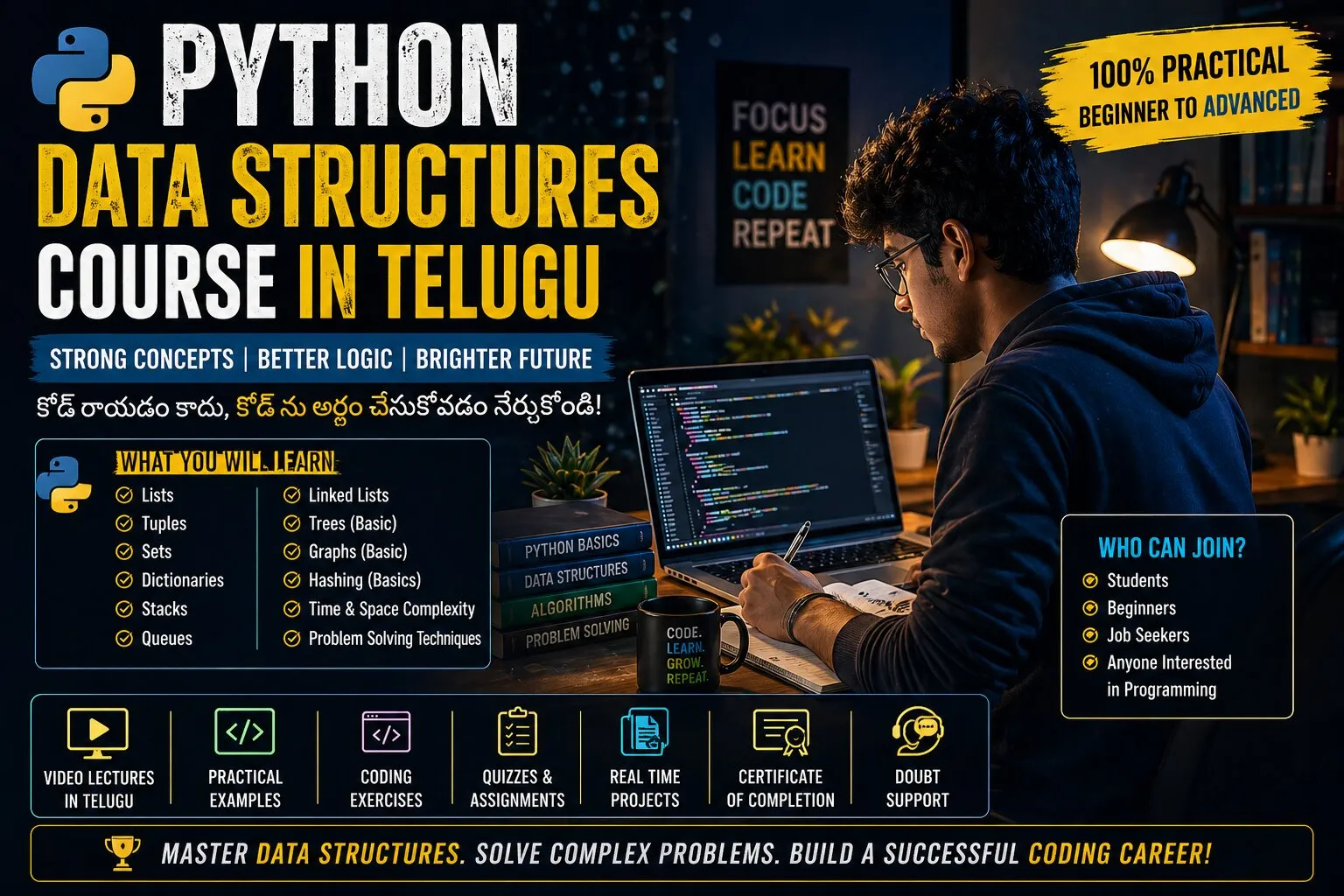
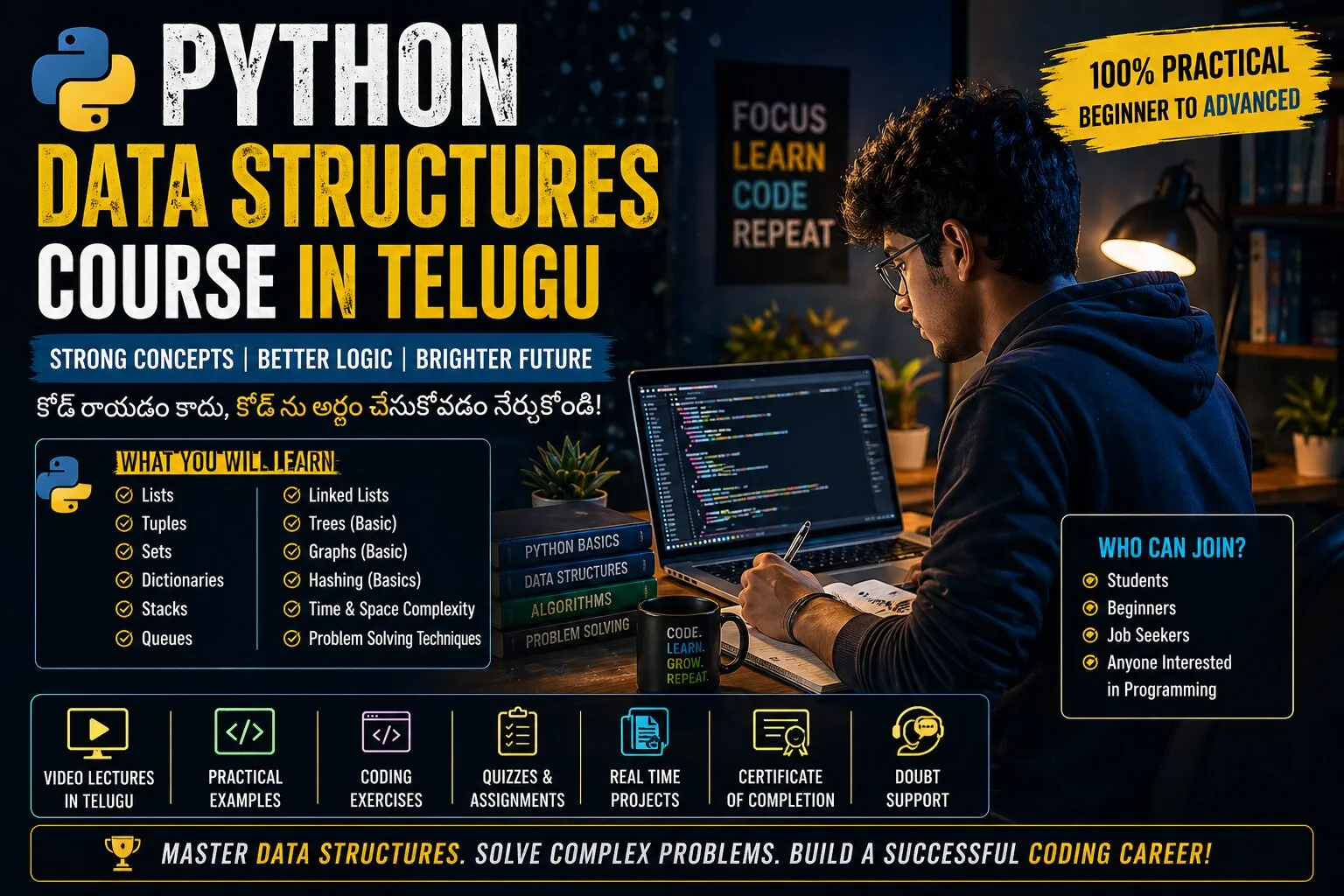
Programming can feel overwhelming when you are starting from scratch. The terminology is unfamiliar, the concepts feel abstract, and it is hard to know where to begin. But here is what experienced developers will tell you: every complex program ever written is built on a small set of fundamental ideas. Data structures are the most important of those ideas — and Python makes them more accessible than any other language. If you have been searching for a Python Data Structures Course in Telugu, this guide maps the complete journey from absolute beginner to advanced programmer — honestly, practically, and without shortcuts.
Why Python Is the Right Starting Point
Python did not become the world's most popular programming language by accident. Its syntax reads almost like English. A beginner can write a working program on their first day. But simplicity at the surface does not mean shallow depth — Python powers data science, artificial intelligence, backend web development, and automation at enterprise scale.
Python is used in many areas such as web development, data analysis, automation, artificial intelligence, and cloud computing — and its broad range of libraries allows developers to build efficient solutions to real-world problems faster than most other languages.
For Telugu-speaking learners from Andhra Pradesh and Telangana, learning Python in your native language removes the one barrier that slows most beginners down — the energy spent translating before understanding.
The Beginner Phase: Building the Foundation
Every programming journey starts at the same place. Variables, data types, conditions, loops, functions — these are the building blocks. In Python, they are easier to write than in almost any other language.
What beginner-level Python covers:
- Variables and data types — integers, strings, floats, booleans
- Conditional logic — if, elif, else statements
- Loops — for and while loops, iterating over collections
- Functions — defining reusable blocks of logic
- Basic input and output — taking user input, printing results
A Telugu instructor who walks through these concepts with local examples — familiar scenarios, familiar comparisons — builds the foundation faster and more solidly than English documentation alone.
The Intermediate Phase: Data Structures
This is where programming transforms from writing simple scripts to solving real problems. Data structures store and organize data efficiently, while algorithms define the logic to process it — together, they form the foundation for writing optimized and scalable Python programs used in real-world applications. Statista
The four core Python data structures:
Lists — ordered, changeable collections. Used when sequence matters and elements need to be added or removed.
Tuples — ordered but immutable. Used when data should not change after creation — coordinates, database records, configuration values.
Sets — unordered collections of unique elements. Used when duplicates need to be eliminated automatically.
Dictionaries — key-value pairs. Used when data needs to be looked up by a label rather than a position.
Understanding when to use each structure — not just how to use them — is what separates intermediate programmers from beginners.
The Advanced Phase: Algorithms and Efficiency
Once data structures are solid, the advanced phase introduces how to use them efficiently.
Advanced concepts a structured Telugu course covers:
- Sorting algorithms — bubble, selection, merge, quicksort
- Searching algorithms — linear search, binary search
- Recursion — functions that call themselves to solve divided problems
- Stack and Queue implementations using lists
- Linked lists, Trees, and Graphs — for complex data relationships
- Time and space complexity — understanding why some solutions are faster than others
Knowing your data structures and algorithms is vital for writing efficient code and solving problems — and these are exactly what you will be tested on in technical interviews at top companies. Data Insights Market
In a Telugu-medium course, these advanced topics do not feel like a wall. They feel like a natural progression from what came before — because the foundation was built properly.
Projects That Tie It All Together
Theory without application is forgettable. A complete Python data structures course builds practical projects at every stage:
- Beginner: A simple calculator, a number guessing game
- Intermediate: A contact book using dictionaries, a student grade manager using lists
- Advanced: A search engine simulation, a task scheduler using queues, a family tree using trees
Each project forces the use of real data structures in real scenarios. That experience is what produces genuine programming ability.
Conclusion
The path from complete beginner to advanced programmer is not a mystery. It is a sequence — fundamentals, data structures, algorithms, projects — repeated consistently until skills are solid. A Python Data Structures Course in Telugu makes that sequence accessible in a language where every concept lands completely. Telugu-speaking learners who follow this path do not just learn to code. They learn to think like programmers — and that thinking opens every door the technology industry has to offer.


























Sign in to leave a comment.