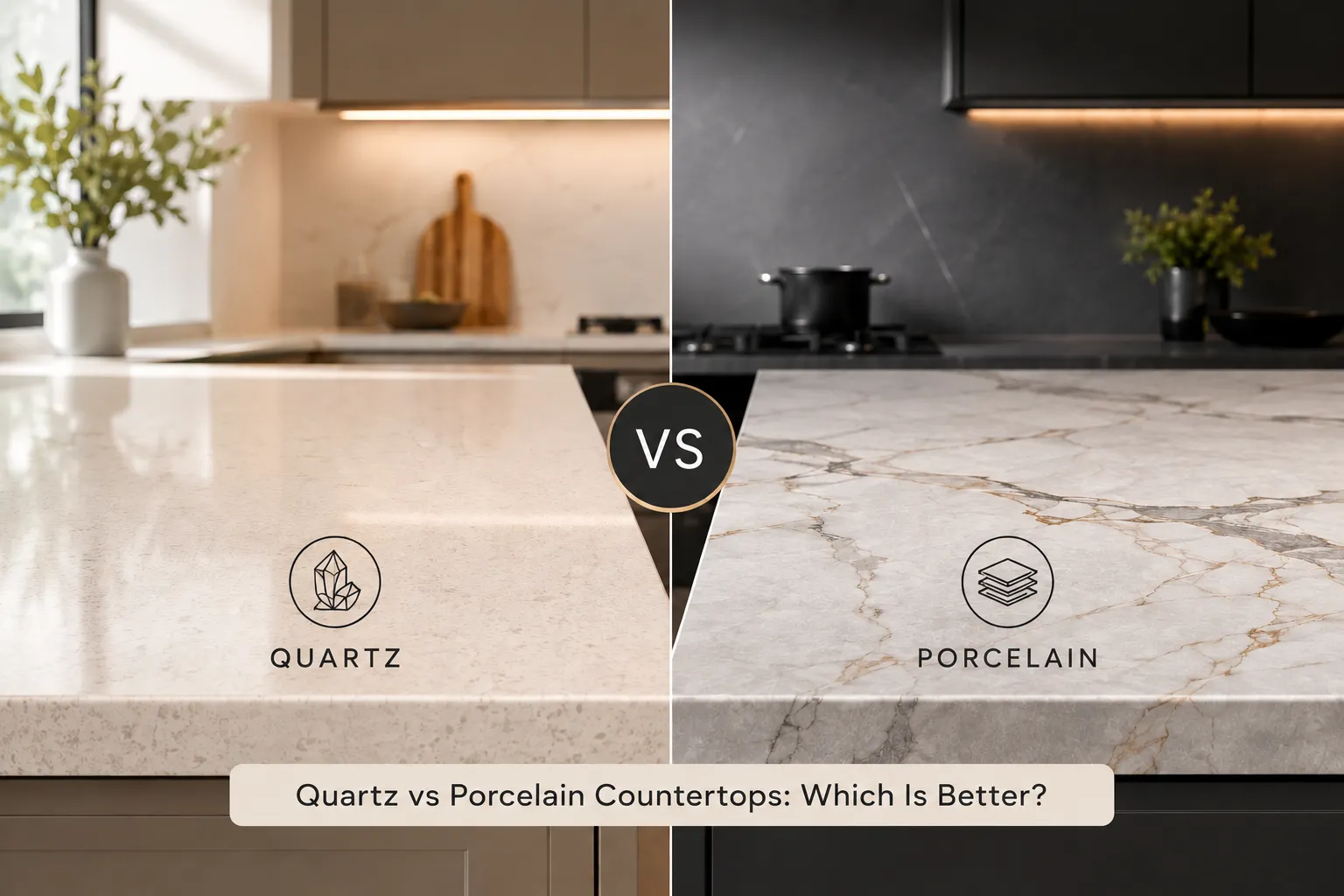

Picking a countertop feels bigger than it should.
You touch it every day. You cook on it, lean on it, and stare at it for years.
So when someone says just pick one, it never feels that simple.
Quartz and porcelain are the two names people keep bringing up. Both look premium. Both promise durability.
But they are not the same material. And they do not act the same way in a real kitchen.
This guide breaks down quartz vs porcelain countertops in plain language so you can pick what actually fits your home.
What Is a Quartz Countertop?
Quartz countertops are man-made. They mix crushed natural quartz stone with resin and pigment, then press it into slabs.
That mix is what gives quartz its strength.
Because it is engineered, quartz comes in very consistent colours and patterns. You get the same look on every slab.
This makes quartz popular for kitchens where you want a clean, uniform surface. It also explains why quartz countertops feel so smooth to the touch.
What Is a Porcelain Countertop?
Porcelain countertops are different. They are made from natural clay, minerals, and other raw materials fired at very high temperatures.
That firing process is what makes porcelain so hard and so resistant to heat.
Porcelain slabs can also be made incredibly thin, which is part of why architects and designers like using them for large surfaces.
Evvolution manufactures porcelain slabs under recognised certifications, including CE, ISO, and UKCA, so quality checks are built into every batch.
Quartz vs Porcelain: Durability
Both materials are tough. But they are tough in different ways.
Quartz resists chipping and cracking well because of the resin inside it. It can handle daily kitchen use without much worry.
Porcelain is harder than quartz on a technical level. It resists scratches better and does not wear down easily over time.
Neither one cracks easily under normal use.
Quartz vs Porcelain: Heat and Scratch Resistance
This is where the difference gets real.
Quartz does not love direct heat. Put a hot pan straight from the stove onto quartz, and you risk a mark.
Porcelain handles heat much better. You can place hot cookware on porcelain without worrying about damage.
As for scratches, porcelain wins again. It is one of the hardest countertop materials you can buy today.
Quartz vs Porcelain: Maintenance
Neither material needs much babying, which is good news if you are busy.
Quartz does not soak up spills easily. Wipe it down and you are done.
Porcelain is also easy to clean. It resists stains and does not need sealing like natural stone does.
Both are low maintenance overall. Neither needs polishing, waxing, or special treatments to stay looking good.
Quartz vs Porcelain: Look and Design
Looks matter just as much as performance.
Quartz gives you very even, predictable patterns. If you want a marble look without the upkeep, quartz does that well.
Porcelain can mimic almost anything. Marble, wood, concrete, natural stone, and porcelain slabs copy these looks with surprising detail.
If you want bold, large-scale designs with fewer visible seams, porcelain often has the edge.
Quartz vs Porcelain: Cost
Cost is where people get surprised.
Quartz countertops usually cost less upfront than premium porcelain slabs. This is true for standard kitchen sizes.
Porcelain can cost more, especially for large format slabs. But it often lasts longer, which changes the real cost over time.
Think about lifetime value, not just the price tag on installation day.
Quick Comparison
Quartz
- More consistent color and pattern
- Lower cost for standard kitchens
- Less heat resistant
Porcelain
- Higher heat and scratch resistance
- Larger slab sizes with fewer seams
- Often costs more upfront
Which One Should You Choose?
There is no universal winner here. This is really what the quartz vs porcelain countertops decision comes down to.
If you want a clean, low-maintenance surface with steady patterns, quartz countertops make sense.
If you want maximum heat resistance, scratch resistance, and bold large scale design, porcelain countertops are the stronger pick.
Your kitchen habits matter more than trends. Think about how you cook, clean, and use your counters daily.
That answer is more useful than any generic recommendation.
Evvolution's quartz collection uses Integrated Stone Technology, a first in Asia, built for exactly this kind of daily performance.
FAQs
Is quartz cheaper than porcelain?
Usually, yes. Quartz countertops tend to cost less upfront, especially for standard kitchen sizes.
Which is more heat resistant: quartz or porcelain?
Porcelain. It handles hot pans and direct heat far better than quartz does.
Can porcelain crack like natural stone?
Rarely. Porcelain is dense and hard, so it resists cracking and chipping well.
Do quartz countertops need sealing?
No. Quartz is nonporous, so it does not need sealing like natural stone.
Which countertop lasts longer, quartz or porcelain?
Porcelain often lasts longer overall, especially in high heat or heavy use kitchens.
Bottom Line
Quartz and porcelain are not competing for the same crown.
One wins on consistency and cost. The other wins on toughness and heat.
Pick based on how your kitchen actually gets used, not how a showroom looks under bright lights.
That decision will serve you a lot longer than any trend does.
Quartz and porcelain are not competing for the same crown.
One wins on consistency and cost. The other wins on toughness and heat.
Pick based on how your kitchen actually gets used, not how a showroom looks under bright lights.
If you are still weighing your options, our earlier guide on choosing the right surface for your home walks through a few more real-world examples worth reading.
That decision will serve you a lot longer than any trend does.






















Sign in to leave a comment.