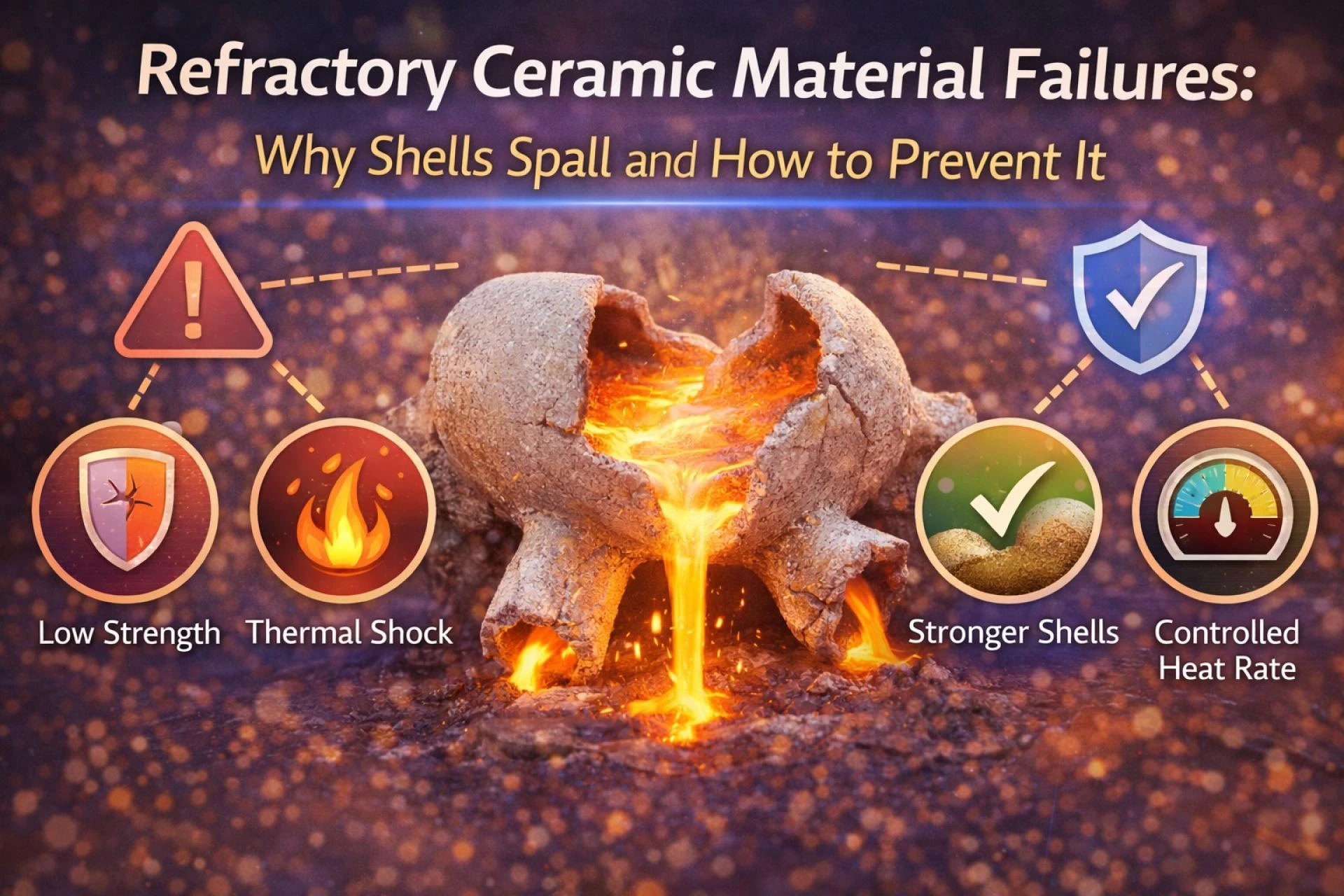

In the world of investment casting, shell integrity isn’t just important—it’s everything. A cracked or broken shell doesn’t just ruin a casting; it disrupts schedules, wastes materials, and hurts your bottom line. One of the most frustrating and common failures in refractory ceramic material used for shells is spalling. It often starts subtly—a flake here, a crack there—but left unchecked, it leads to catastrophic failure.
Understanding why shells spall and how to prevent it is crucial for any foundry or manufacturer looking to maintain quality and avoid costly rework. This issue goes beyond surface-level defects. It reflects deeper problems in material selection, process control, and environmental conditions. But here’s the good news: with a little insight and proactive management, you can reduce shell spalling significantly—even eliminate it altogether.
In this blog, we’ll unpack the main reasons refractory ceramic materials fail through spalling, explore the science behind it, and outline proven strategies to prevent it, even in high-stress casting environments.
Refractory Ceramic Material behavior can be precisely managed through proper formulation and monitoring. SHENZHEN LONNMETER GROUP offers advanced ceramic viscosity monitoring solutions that help maintain shell consistency, reduce thermal mismatch, and improve resistance to spalling. Their tools empower casting professionals to catch problems before they turn into failures, making process optimization easier and more reliable.
What Is Shell Spalling?
Spalling is the term used when a ceramic shell begins to crack, flake, or break apart—especially during the high-heat stages of dewaxing, preheating, or metal pouring. It’s a form of mechanical or thermal failure that originates internally but often appears suddenly.
Unlike surface cracks that may stay superficial, spalling penetrates deeper, causing large chunks of the shell to detach. This not only exposes the core of the mold to damage but can also lead to molten metal leakage, casting distortion, or complete mold collapse.
Spalling often masquerades as minor cracking until stress thresholds are crossed. What makes it dangerous is its unpredictability: a shell may look fine on the surface but disintegrate when exposed to sudden heat, cooling, or pressure.
Top Causes of Shell Spalling in Refractory Ceramics
Let’s break down the major culprits:
1. Thermal Shock
Shells often spall when exposed to rapid temperature changes, like when molten metal is poured into a cold or unevenly heated mold. If different parts of the shell expand at different rates, internal stress builds until the shell fractures from within.
Factors that amplify thermal shock risk:
- High thermal expansion materials (e.g., silica)
- Uneven heating or cooling cycles
- Moisture trapped in the shell layers
2. Poor Slurry Viscosity Control
If the ceramic slurry is too thick or too thin, it results in uneven layer thickness, leading to inconsistent thermal behavior. Thicker areas retain moisture longer or heat up slower, increasing thermal gradients that trigger spalling.
3. Improper Drying
Incomplete drying traps moisture within the shell. During dewaxing or preheating, that moisture turns into steam, expanding rapidly and exerting pressure on the inner shell structure. Result? The shell flakes or bursts.
4. Binder Incompatibility
Different binders react differently to temperature. Using incompatible or poorly mixed binders may cause uneven shrinkage, which introduces weak points into the shell. These weak points become the origin of spall cracks.
5. Grain Size Imbalance
Too coarse? The shell becomes porous and weak. Too fine? The shell becomes overly rigid and susceptible to thermal stress. A poorly selected or imbalanced grain distribution affects how the shell reacts under heat and pressure.
6. Environmental Factors
High humidity, dust contamination, or fluctuating ambient temperatures during shell building can introduce flaws. Even minor inconsistencies in drying conditions or storage can weaken a shell’s structural integrity.
How to Prevent Spalling in Ceramic Shells
Now that we know the causes, let’s talk prevention. Spalling isn’t inevitable—it’s manageable with the right material choices, process controls, and testing routines.
1. Use Low-Expansion, Thermal Shock Resistant Materials
Materials like fused silica or zircon have lower thermal expansion coefficients and handle rapid temperature changes better than standard silica. They are especially effective in the face coat where thermal gradients are most intense.
But since these materials are more costly, many facilities use a hybrid approach:
- High-quality material in face coats
- Lower-cost backup materials in later layers
This balances performance and cost while improving spall resistance.
2. Maintain Slurry Viscosity with Precision
Inconsistent viscosity causes uneven layers and introduces stress points in the shell. Regular viscosity testing—using simple tools like a Zahn cup—can help ensure uniform slurry behavior.
Better yet, real-time monitoring systems from SHENZHEN LONNMETER GROUP allow you to detect deviations immediately, adjusting the slurry before problems arise. This kind of control reduces human error and ensures every dip meets the same standard.
3. Ensure Proper Drying Between Coats
Never rush the drying process. Each layer of the shell must dry completely before the next is applied. This prevents moisture entrapment and uneven layer bonding.
Best practices:
- Use controlled drying rooms with consistent temperature and humidity
- Allow longer drying time for thicker coats or in humid environments
- Visually inspect and physically test dryness before layering
This extra attention pays off tenfold when you avoid shell blowouts or steam-induced spalling during dewaxing.
4. Control the Dewaxing and Preheat Curve
Rapid heating is a spalling trigger. During dewaxing or shell preheating, temperature ramp-ups should be gradual and uniform.
Pro tips:
- Use programmable kilns or ovens with accurate ramp settings
- Avoid “thermal shocks” by letting shells equilibrate to room temperature before heating
- If possible, preheat shells in stages to slowly release internal moisture
These steps allow the shell to expand gently, reducing the chance of internal cracking.
5. Optimize Grain Size and Particle Distribution
You want a grain distribution that promotes strength without sacrificing permeability or flexibility. Many foundries use bimodal or multimodal mixes to strike the right balance—fine grains for surface quality, coarse grains for strength and airflow.
Avoid overprocessing or using ultra-fine materials that can make the shell brittle. If in doubt, run small test batches and track shell performance through dewaxing and casting.
6. Test Shell Strength Before Firing
Simple strength tests before dewaxing can catch weak or compromised shells. You can:
- Apply gentle pressure to sample areas
- Scratch test with a sharp tool
- Weigh coated patterns after each dip to ensure layer consistency
These checks might seem basic, but they often catch early signs of poor adhesion, over-thinning, or under-curing.
To explore more on testing techniques and the role of ceramic slurry behavior, visit https://www.lonnmeter.com/ceramic-slurry-viscosity-in-investment-casting/.
Real-World Example: What Happens When Spalling Is Ignored
A mid-size foundry manufacturing aerospace components faced repeated casting failures. After investigation, they found the root cause was inconsistent drying times between shell layers, leading to moisture entrapment. When molten alloy was poured, steam pressure built inside the shell, causing severe spalling and blowouts.
Once they implemented:
- Viscosity monitoring
- Controlled drying rooms
- Slower preheat curves
…they cut defect rates by 80% in two weeks.
This is the power of proactive process control—and why preventing spalling is more about discipline and monitoring than expensive materials.
Final Thoughts: Stop Spalling Before It Starts
Spalling in refractory ceramic material is frustrating, costly, and often preventable. It’s not just a materials problem—it’s a process problem. With the right tools, practices, and attention to detail, you can significantly reduce or eliminate spalling in your shells.
Start by understanding your materials. Monitor your slurry. Respect drying times. And always keep an eye on how thermal conditions are applied to your shells. These steps don’t just improve quality—they save money, time, and headaches.
With support from precision control systems like those offered by SHENZHEN LONNMETER GROUP, even small operations can manage complex shell-building processes with confidence, predictability, and consistency.































Sign in to leave a comment.