
Managing inventory in a modern retail environment goes far beyond simple stock counts. With e-commerce, omni-channel retail, and real-time customer expectations, you need more than spreadsheets or basic tools. This is where retail inventory management software becomes a strategic asset, delivering visibility, agility, and data-driven decisions.
👉 Explore the full guide: Retail Inventory Management Software
🔍 Why Retailers Need Inventory Management Software
- Real-Time Stock Visibility – Know exactly what you have on hand, across stores, warehouses and online.
- Demand Forecasting & Replenishment – Use automation to reorder smartly and avoid both stockouts and overstock.
- Omni-Channel Support – Seamless inventory across in-store, online, BOPIS (buy-online-pickup-in-store) and dropship.
- Integration & Automation – Sync your POS, ERP, e-commerce, logistic platforms into one view.
- Analytics & Insights – Dive into trends: what sells, what sits, how fast stock turns.
According to market research, the inventory management software market was estimated at USD 3.58 billion in 2024 and is projected to reach USD 7.14 billion by 2033. Grand View Research
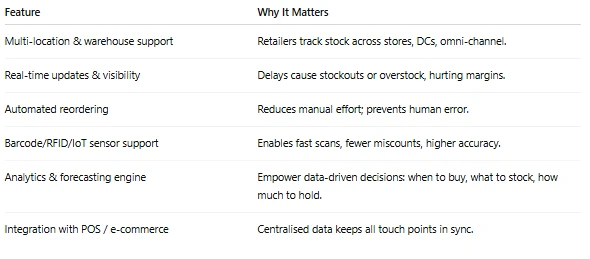
🧰 Key Features & What to Look For
🏪 Real-World Use Cases & Examples
- Fashion Retailers – Use software to monitor seasonal variants. A “slow-moving size” flag triggers promotional offers to avoid markdowns.
- Electronics Stores – High-value stocks require tight cycle counts and integrated POS-ERP systems to reduce shrinkage.
- Grocery Chains – Perishables demand FEFO (first expired first out) logic plus high-velocity replenishment.
Automated mobile robots, IoT sensors, and cloud-native inventory systems are now standard components in top retail operations. NetSuite+1
🚀 Trends & Innovations to Watch
- AI-powered forecasting & demand sensing – Reduce human guess-work, increase accuracy. eturns.com+1
- Sensor / RFID / IoT inventory tracking – Real-time, low-error counts without manual intervention. interlakemecalux.com
- Cloud SaaS inventory platforms – Offer accessibility, faster updates, lower infrastructure cost. Manufacturing.net
- Omni-channel inventory management – Stock flows seamlessly between online, in-store, pickup & dropship.
- Retail up-skilling & automation – Robots + automation handle repetitive tasks; staff focus on value-adds.
📰 Recent news
Recent inventory‑software & retail tech developments
- Starbucks is rolling out AI‐driven inventory counting across 11,000+ stores to automate shelf scans and reduce stock-out occurrences. Reuters
- Old Navy is deploying RFID + AI in 1,200 stores for real-time inventory tracking and better in-store fulfilment. The Sun
- Lowe’s partners with Dell and NVIDIA to integrate AI into inventory forecasting across 1,700+ locations. Lifewire
💡 Tips for Implementation
- Audit your current system – What works? What doesn’t? Where are stock leaks happening?
- Master data first – Ensure your SKUs, locations, and cycle counts are accurate before layering tech.
- Start with a pilot – Choose one store or warehouse and implement automation/tracking to prove ROI.
- Train your team – The best software fails if users don’t adopt it.
- Ensure integration – POS, e-commerce, ERP must speak the same “inventory” language.
- Measure meaningful KPIs – Stock-out rate, inventory turns, holding cost, fulfilment time.
🔚 Final Thoughts
Retail inventory management software is no longer a nice-to-have—it’s mission-critical for survival and growth in 2025-26. The right tools empower you to manage stock intelligently, reduce waste, boost profitability, and deliver the seamless experience today’s consumers expect.
Read the full guide for architecture tips, software comparison, and implementation strategies:





























Sign in to leave a comment.