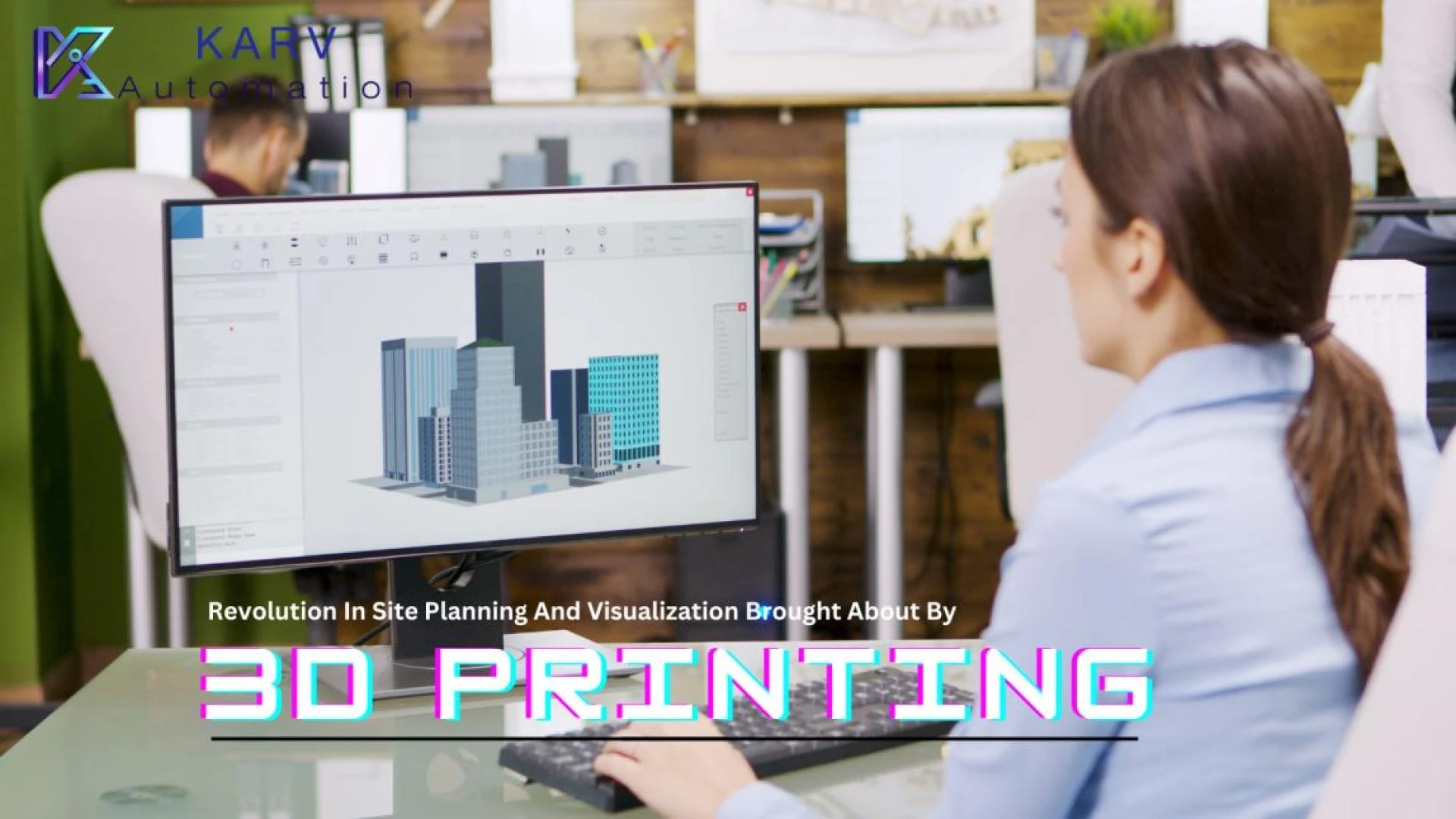

Ideas are the foundation for architectural design development, developing into actual designs. In earlier times, designers used physical models and drawings to communicate their ideas. Nevertheless, these techniques are frequently needed to accurately and practically convey all of the design's distinctions.
The way that architects convey their ideas has changed as a result of 3D Printing. Architects can now produce lifelike digital designs and realistic models that faithfully capture their vision. These models enable thorough analysis and feedback, producing a more polished final design. They are practical tools for client presentations. This blog explores the innovative developments and breakthroughs that 3D Printing has brought about in site planning, opening up fresh possibilities for exploration and revolutionizing how we imagine and realize projects.
Applications in Architectural Site Planning
The architectural industry can progress and improve, becoming more focused, all because of the most influential and improved 3D printing tools available. There will be additional changes soon if we consider all of the most recent technological developments in the industry.
Architects will have the ability to produce truly remarkable and exceptional works. However, improving the efficiency, speed, and quality of design and construction is where 3D printing tools genuinely stand out. It will be feasible to eradicate human error, produce building elements and components at a higher level, collaborate on digital engineering projects, and much more.
In addition to improving communication and teamwork between the client and the architect, the most progressive 3D Printing will accelerate and enhance the purpose of project approval and presentation. The immensely engaging and remarkable visuals of the future will develop from this.
Advantages of 3D Printing over Traditional Model-Making Techniques
Being able to offer multiple clear benefits over conventional methods, 3D Printing stands out as a game-changer.
Accuracy and Complexity
The ability to convert complex digital designs into exact physical models with exceptional precision is a strength of 3D Printing. A level of precision that was impossible before is now available to architects and designers using 3D Printing, which effortlessly brings complicated details to life. At the same time, traditional model-making techniques frequently fail to replicate complex geometries.
Effectiveness and Time Savings:
3D Printing simplifies the production process compared to labor-intensive and time-consuming traditional model-making techniques. This technology makes it possible to quickly create detailed models, which shortens the time needed for prototyping and facilitates more frequent variations. This efficiency is beneficial in industries that move quickly and where time is of the essence.
Personalization and Recursion:
Customization and recurrence are made easy with 3D Printing. Architects can quickly change designs without much manual labor and create multiple versions. This adaptability encourages a dynamic and responsive design process, allowing designers to promptly refine their ideas and explore various concepts.
Cost-Effectiveness:
3D Printing is more affordable than traditional model-making methods, which can be very expensive. Making complex and detailed models with 3D Printing is an economical choice because of its minimal use of various materials and its streamlined production process, which lowers labor costs.
How Will 3d Printing For Architecture Develop In The Future?
In the construction sector, 3D Printing offers many advantages, and the businesses that have already adopted it have seen great success. From the project's inception to completion, 3D technologies aid in managing the entire production process. Due to nearly zero material waste, structures can now be 3D printed for a fraction of the usual cost and time. They are also much more environmentally friendly.
In addition to these amazing experiments pushing the boundaries of technology, you can make your next architectural model and reconsider how you develop your models and construction projects by utilizing some remarkable technologies like SLS.
The construction industry can benefit from the innovations brought about by additive manufacturing, and you can increase your output right now by working with us. We provide you with various technologies for 3d printing in houston, including CNC machining and metal 3D printing. Please don't wait for your rivals to implement this cutting-edge technology; start using it in your company right now.
Conclusion
Applying 3D printing technology to building projects has several benefits that completely change the nature of the sector. The substantial cost savings realized through lowering labor costs, minimizing material waste, and cutting transportation expenses highlight the economic efficiency that 3D Printing brings. Technology also helps accelerate project completion, reducing delays and improving overall productivity in construction projects. With 3D Printing, architects and builders can now design complex and creative structures without being constrained by traditional constraints.
Moreover, the favorable sustainable consequence, defined by sustainable methodologies and a reduced carbon imprint, situates 3D Printing as an inhibitor for environmentally conscious building, with its ability to be customized and adjusted to meet the needs of individual projects, such as those looking for 3D Printing in Houston. 3D Printing proves to be a revolutionary tool. In the future, the construction industry's ability to innovate and remain competitive will depend on how willing it is to utilize additive manufacturing's capabilities as technology advances fully. Construction projects can look forward to a future characterized by improvements in quality, speed, and cost-effectiveness by utilizing this potential.


























Sign in to leave a comment.