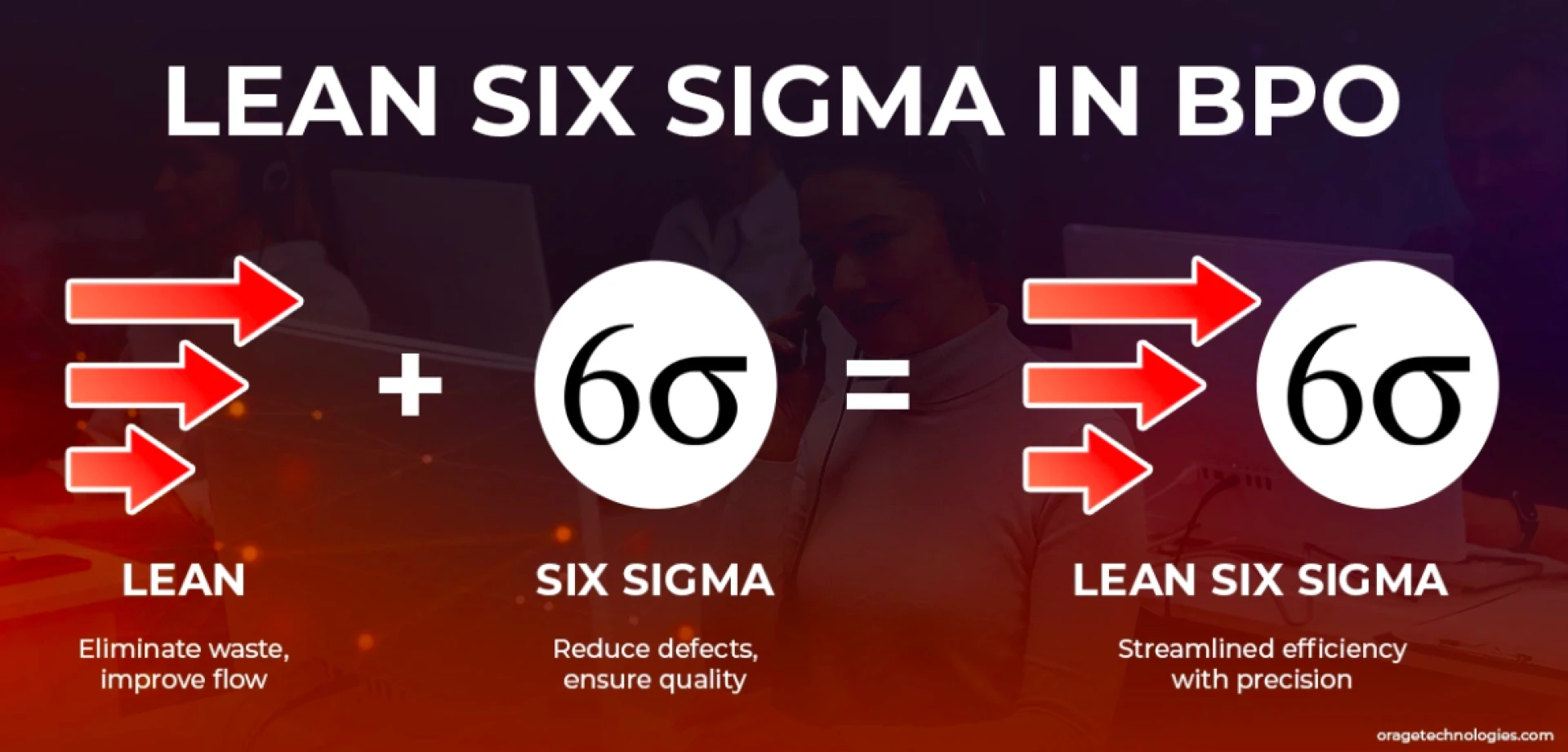

Business Process Outsourcing (BPO) sectors usually focus on efficiency, quality, and customer satisfaction in a competitive market. However, achieving these three desires, while still keeping BPO competitive, is a challenge. Lean Six Sigma in BPO provides an evidence-based road-map for organizations to improve their processes and reduce costs, while improving delivery and service. Lean utilizes waste reduction and simplicity, while Six Sigma polices the defects. Lean provides principles of simplicity and waste reduction, while Six Sigma policies justifiable limits of delivery failure. This guide will focus on the impact Lean Six Sigma can bring in the context of BPO and offer over 200 'how-to' examples, industry examples, and information to address pertinent questions. Let us start the analysis of how Lean Six Sigma will change the BPO industry, its employees, and most importantly its clients.
What is Lean Six Sigma and How Does It Work in BPO?
Lean Six Sigma in BPO combines two important methodologies; Lean eliminates non-value added activities while Six Sigma reduces process variation in order to achieve consistent quality. In BPO settings, where activities like customer service, data entry, and billing require ongoing accuracy, it offers paradigm-shifting possibilities. As an example, a BPO functioning as a customer query and complaint ticket could take Lean Six Sigma into their methodology and strategy - both to reduce the time taken to respond to clients, and to improve accuracy in resolving complaints, increasing the value they provide to their clients.
Importantly, Lean Six Sigma touches on several of the key challenges faced by BPOs: cost concerns, timeline pressures, high expectations from clients, and obtaining overall efficiencies. In fact, a 2024 report indicates BPO firms implementing Lean Six Sigma obtained 25% reductions in cost and 20% reduction in process times. By focusing on efficiencies and quality, BPO providers can add value to their service delivery. Want to know how it works? Let’s take a look at it in practice.
How is lean six sigma applied in BPO environments?
Lean six sigma in BPO projects is followed in a DMAIC cycle. DMAIC stands for define, measure, analyze, improve, and control. Initial teams define the problem such as too many errors in the processing of claims. Next, the teams measure performance with metrics such as error rates or cycle times. Teams then analyze data to determine root causes, i.e., lack of appropriate software or training. Improvements happen through the implementation of solutions such as automation or training. Finally, control ensures sustainable results in the way of ongoing monitoring of the process and standardization.
For example, one BPO in the Philippines was able to use DMAIC to decrease call center wait time by 22% and increase customer satisfaction. Also, methods such as process mapping and fishbone diagrams can help expose the details of poorly applied processes. A structured approach ensures that BPO processes are handled with an eye with attention to speed and accuracy. Curious about the particular benefits? Let’s discuss that next.
What Are the Main Benefits of Lean Six Sigma in BPO?
Lean Six Sigma in BPO provides the benefits that generate a competitive advantage. Below are the benefits:
Cost Savings: Reducing waste in the form of steps, such as eliminating duplicate data entry, can save an organization up to 30% on costs.
Quality Enhancement: Reducing defects, such as errors from processing an invoice or errors in customer service, is critical, and implementing Six Sigma prevents defects, as it reduces problems, reducing errors of execution.
Speed of Execution: Lean reduces waste in the form of lead times, which reduces time and improves productivity, so your turnaround time for task execution, such as processing an order or correcting a function of a customer's query, is improved.
Customer Satisfaction: Lean Six Sigma helps organizations provide consistent services. A good service will improve customer relations, resulting in increased client retention - on average, firms report a 15% increase in retention.
Employee Empowerment: By involving employees in collaborative projects, organizations create a sense of ownership. Increased morale and motivation promote innovation.
An example is a BPO dealing with health claims that was able to reduce its documented error rate by 18% while using Lean Six Sigma, resulting in a happier clientele. Furthermore, as documented above, all key benefits cascade and will affect your reputation and profitability, two of the deciding factors when acquiring new customers. So, how do BPO firms gets started with such an approach? We'll elaborate on your next steps.
What Actions Can BPO Companies Take To Implement Lean Six Sigma Successfully?
Implementing Lean Six Sigma in BPOs requires proper planning and execution. First, get executive commitment and support. The executive team or CEOs have to take ownership of the support structures and provide these resources for appropriate levels of goal impact as demonstrated in organizations where CEOs drive Lean Six Sigma commitment. Second, train employees in the different levels of belts - Yellow Belts, Green Belts, and Black Belts - to lead projects. For example, a Green Belt can improve the customer onboarding process, while a Black Belt can improve the most complex workflows.
Third, use the tools available with Lean Six Sigma systematically, like value stream mapping to inspect for bottlenecks or control charts to check performance. For example, a BPO business could value stream map the company's data processing workflow to remove actions that do not add value and reduced costs by 12%. Fourth, start small by using different types of pilots to beta-test the solutions before full implementation. In 2023, the case study on a BPO pilot project demonstrated how a BPO organization optimized payroll processing time by 15%. Lastly, create a culture of continuous improvement to ensure sustainability. Now, you are probably thinking, “show me examples in the real world,” glad you asked, let’s find out.
What Other Real-World Examples of Lean Six Sigma in BPO Success?
Lean Six Sigma in BPO has been used with great success across a variety of industries. Here are some strong examples of successful implementations:
Customer Service: A US based BPO was able to significantly reduce average call times by 20% using Lean Six Sigma techniques to improve call center operations and improve customer satisfaction scores.
Data Processing: An Indian based BPO applied DMAIC to reduce the time it took them to process financial data to meet deadlines for their clients, reducing their cycle time from 8 hours to 5 hours.
Back-Office Work Automation: A BPO that handled HR services realized efficiency gains by process mapping its repetitive back-office work and automating it and an overall reduction in error rates of approximately 10% in the process while allowing staff to work on higher value work.
The examples above demonstrate Lean Six Sigma in BPO processes yields tangible improvements. With a focus on data-driven solutions, companies can enhance quality and efficiency outcomes. What types of challenges could be encountered while getting to this level of process improvement? I will address them next.
What barriers face BPO enterprises implementing Lean Six Sigma?
There are challenges in implementing Lean Six Sigma in a BPO. First, expect some resistance from employees. It is common for employees to push back on efficiency improvements thinking they will lose their job because of it. Deal with this by explaining the positive outcomes, including skill development, enhanced work environment, and other strategies. Data collection can be hard, especially with manual processes. A BPO firm addressed this by investing in automated tools to measure customer service metrics.
Furthermore, working with client demands can be challenging and needs to be carefully managed. Organizations need to be careful the implementation of Lean Six Sigma initiatives do not negatively impact Service Level Agreements (SLA's) that firms have made contracts for. Firm communication with clients is needed here. Also, the operational capacity of a BPO organization, i.e. budget perspectives for example or trained employees available for the project, etc. can slow or halt Lean Six Sigma progress. Starting with small, low-stakes, and high-impact projects to a firm and using their best people and building their internal capacity can help in this regard.
Despite the barriers, the potential benefits are massive. Let's address some frequently asked questions next.
Frequently Asked Questions About Lean Six Sigma in BPO
How Quickly Can BPO Firms See Results from Lean Six Sigma?
Results depend on project scope, but pilot initiatives often yield improvements within 3-6 months. For example, a BPO reduced query resolution times by 18% in five months using DMAIC. Larger projects may take 6-12 months for full impact.
Which Lean Six Sigma Tools Are Most Effective in BPO?
Tools like process mapping, Pareto charts, and control charts are highly effective. They help identify waste, prioritize issues, and monitor performance in processes like customer support or data entry.
Do All BPO Staff Need Lean Six Sigma Training?
Not everyone needs training, but key team members should pursue Yellow or Green Belt certifications. Black Belts can lead major projects, while trained staff support smaller initiatives, embedding a culture of improvement.
How Does Lean Six Sigma Enhance Client Relationships in BPO?
By improving quality and speed, Lean Six Sigma ensures reliable service delivery. For example, fewer errors in billing or faster query resolution boosts client trust, often leading to longer contracts.
Can Lean Six Sigma Benefit Small BPO Firms?
Absolutely. Small firms can start with targeted projects, like optimizing a single process, to achieve cost savings and quality improvements without significant investment, scaling up as expertise grows.
Conclusion: Unleashing the Potential of Lean Six Sigma in BPO
Lean Six Sigma in BPO is a game-changer, driving efficiency, quality, and client satisfaction. By eliminating waste and reducing defects, firms can save up to 30% on costs and deliver 20% faster processes. Tools like DMAIC and process mapping empower BPOs to tackle challenges and stay competitive. What inefficiencies will you address with Lean Six Sigma in your BPO operations? Start today to transform your processes and elevate your business.




























Sign in to leave a comment.