
A spinal X-ray uses radiation to capture detailed images of the vertebral column, which allows doctors to identify the causes of back pain or neck pain. Such scans are also used to measure the bone density and predict the probability of vertebral fractures, scoliosis, and congenital anomalies. A spinal X-ray is also performed to detect broken bones, arthritis, tumors, osteoporosis, spinal disc problems, infections, abnormal spinal curves, and congenital spinal problems.
Similarly, computed tomography (CT) is used to diagnose spinal column damage in patients. It reveals internal injuries and bleeding in a fast and accurate manner and provides support in saving lives. CT scans create images that can be formatted in multiple planes. to generate three-dimensional pictures. CT scans of internal organs, bones, and blood vessels are more detailed than traditional X-rays.
The bony structure of the vertebrae can be viewed through CT. A scan is performed for various purposes, such as assessing spinal fractures caused by injury and evaluating the spine before and after surgical treatment. It further helps in diagnosing spinal pain causes, such as a herniated intervertebral disc. CT also facilitates the detection of various types of tumors in the vertebral column and those that have spread to another part of the body.
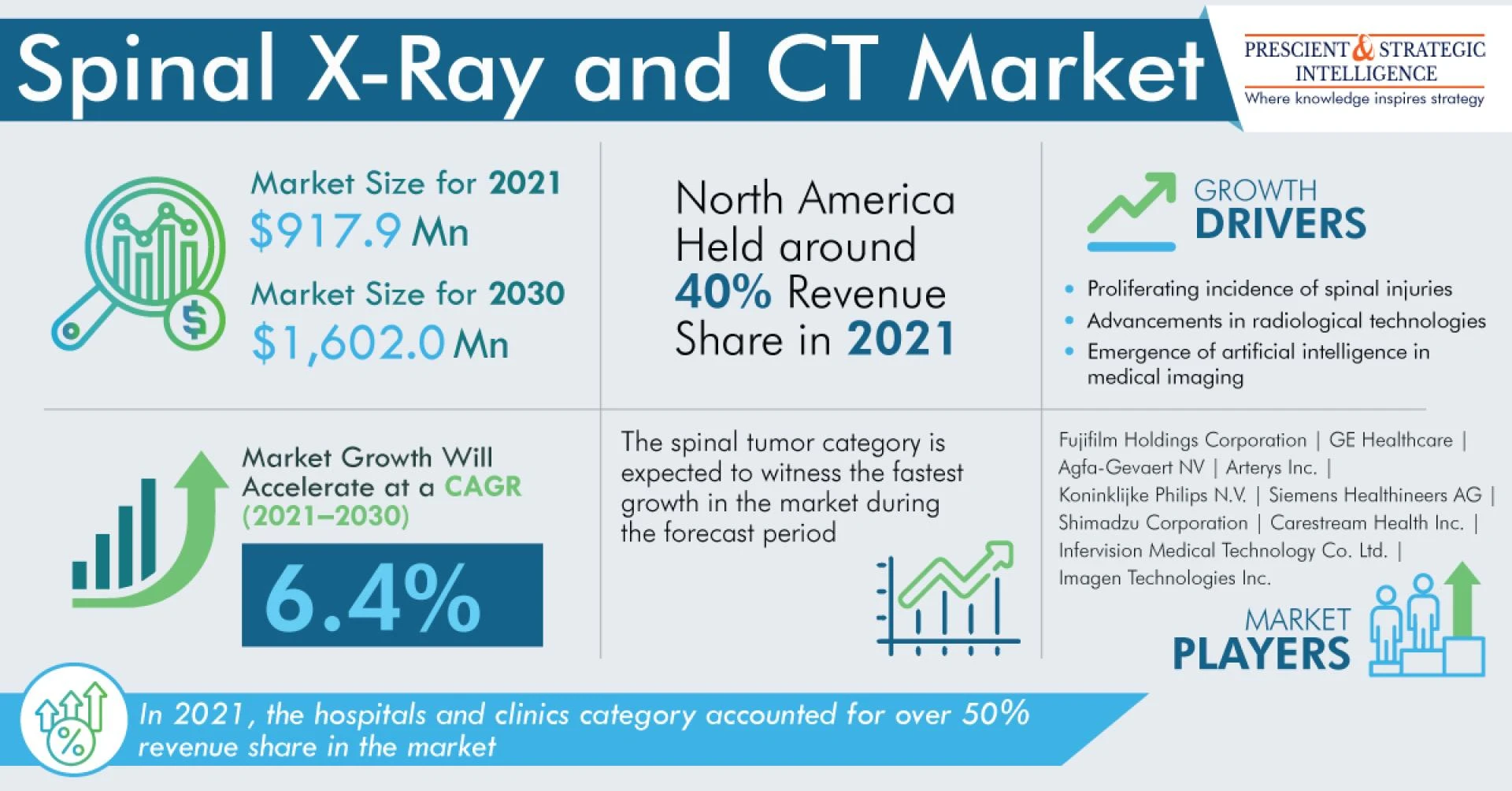
Hence, with the burgeoning usage of these modalities, the spinal X-ray and CT market stood at $917.9 million in 2021, and by 2030, it is predicted to hit $1,602.0 million, progressing at a rate of 6.4%. Around 80 million CT scans are performed each year in the U.S., ascribed to the improved diagnosis and treatment achieved with the elimination of exploratory surgeries and other invasive and risky procedures.
Your doctor may ask you to bring detailed X-rays or CT scans of different parts of your spine as it is constituted of 33 small bones known as vertebrae. The human spine can be split into sections such as the cervical, thoracic, lumbar, coccyx, and sacral. As such, the rising prevalence of spinal tumor has led to an increasing requirement for X-ray and CT machines for diagnoses. Moreover, spinal infections affect the paraspinal tissue, intervertebral discs, and the vertebral body. The diagnosis of such infections is time-consuming and requires multiple imaging modalities.
Download sample pages of this report: https://www.psmarketresearch.com/market-analysis/spinal-x-ray-ct-market/report-sample
Additionally, the elderly population is at a higher risk of osteoporosis, which can result in vertebral compression fractures due to a lower bone density. Therefore, the elderly are more likely to utilize spinal X-rays and CT scans for diagnosis and treatment. In addition, people more than 60 years of age are more likely to suffer from spinal injuries. For instance, in the U.S, around 20,000 new spinal cord injuries are reported every year, which creates a high demand for appropriate and quick imaging.
The advent of artificial intelligence in the spinal X-ray and CT technologies has made medical imaging and diagnosis more efficient and accurate. AI in radiology has the potential to offer more-differentiated diagnoses, eliminate the interpretation variations that come from multiple doctors viewing the scans. It could also speed up the anomaly detection and reading, thus quickening up the provision of the appropriate care.
Therefore, the increasing geriatric population and prevalence of vertebral problems leads to the rising demand for spinal X-rays and CT scans, especially those integrated with AI.
0





























Sign in to leave a comment.