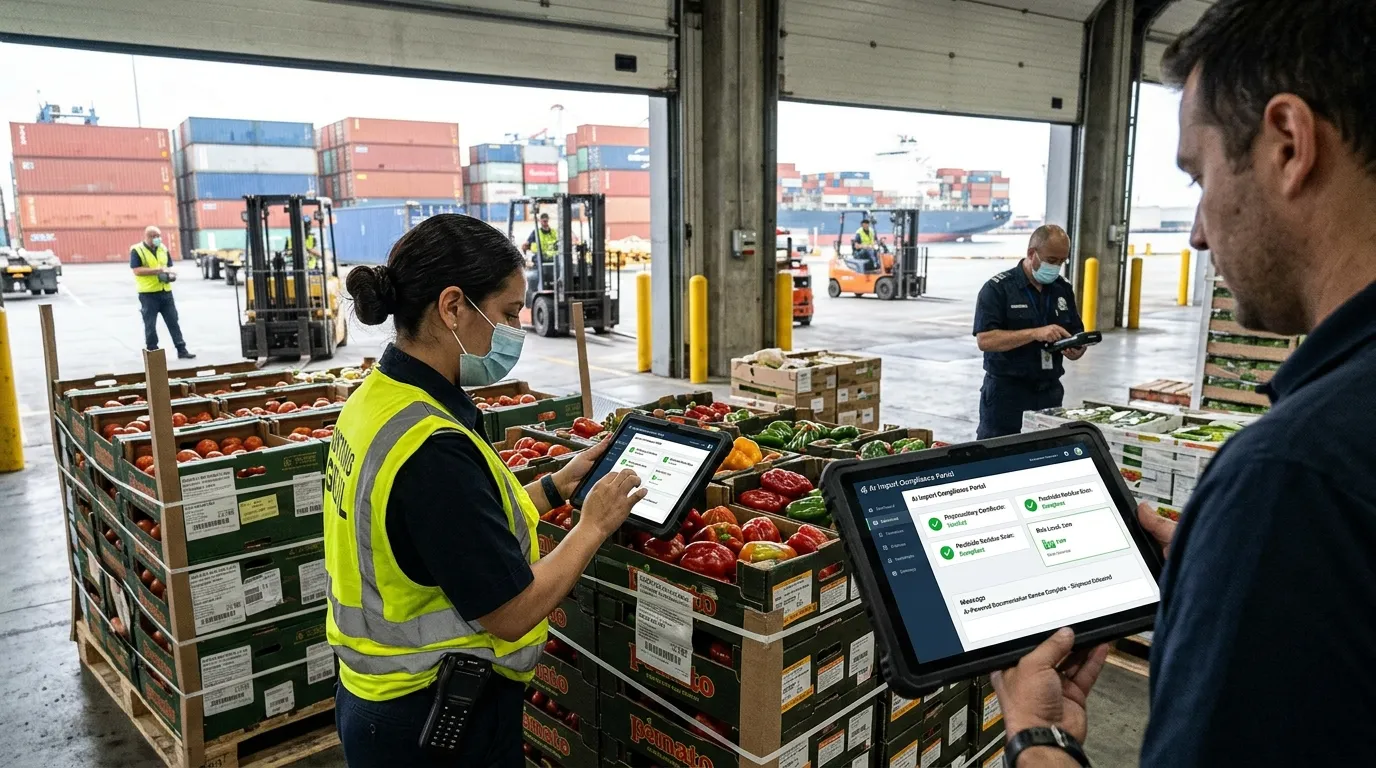

Cross-border food trade is one of the most heavily regulated sectors in global commerce. Import permits, phytosanitary certificates, customs declarations, tariff classifications, country-of-origin documentation, and food safety certifications — the paperwork burden alone can overwhelm a mid-sized trading company.
Compliance failures are costly. A single incorrect tariff classification can result in significant customs penalties. A missing food safety certificate can cause an entire shipment to be quarantined at port, resulting in spoilage losses and buyer penalties. Repeat violations can trigger audit flags that slow down all future shipments.
AI is increasingly being applied to this compliance challenge in ways that reduce manual effort and error rates simultaneously. Document verification tools can review uploaded certificates against regulatory requirements, flagging discrepancies before shipment rather than discovering them at customs. This shifts compliance from a reactive fire-fighting activity to a proactive quality control process.
Tariff classification is another area where AI excels. Harmonized System (HS) codes govern how goods are classified for duty purposes, and the correct classification of processed food products can be surprisingly complex. AI tools trained on customs databases can suggest the correct HS codes with high accuracy, reducing the risk of classification errors.
Supplier documentation is equally important. Before a supplier's goods can be imported, their certifications — organic, halal, non-GMO, or food safety standards — must be current and verifiable. ProcurePro includes a supplier portal where vendors can upload and manage their certifications directly, with automated expiry alerts ensuring no certificate lapses go unnoticed.
The business case for AI-assisted compliance is compelling. Reducing customs delays by even a few days per shipment has significant working capital implications for an importer. Eliminating compliance penalties and associated legal costs adds further to the financial benefit.
Food traders who invest in compliance technology gain a competitive advantage that extends beyond cost savings. They become preferred suppliers for buyers who need reliable, compliant sourcing. Prosessed AI is building compliance intelligence directly into its procurement platform to help food traders navigate these complexities with confidence.
























Sign in to leave a comment.