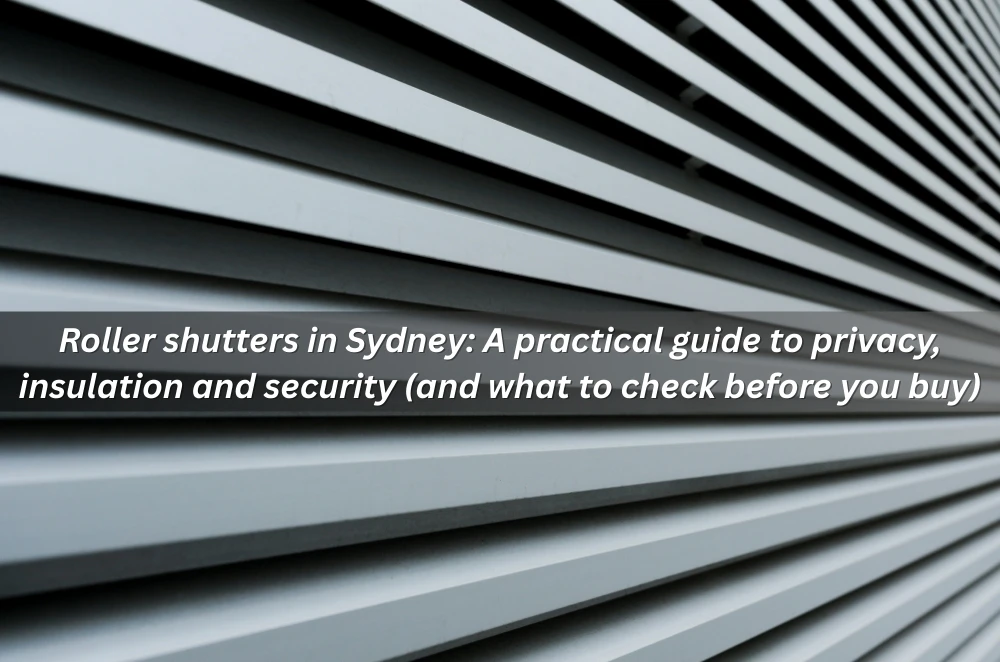

Sydney homes deal with a mix of heat, glare, street noise, and the usual privacy worries that come with close neighbours and busy streets. Roller shutters can help, but only if you pick the right setup for the right opening.
This guide covers what roller shutters do, what to look for before you buy, and how to avoid the common mistakes that lead to regrets later.
Roller shutters should make life easier.
Not become another thing you have to manage.
What roller shutters are (in plain English)
A roller shutter is made of interlocking slats that roll up into a box above a window or door. When lowered, the shutter sits in side guides and forms a tighter barrier than curtains or standard blinds.
Most residential shutters are aluminium, often with insulating foam inside the slats.
You’ll usually choose between:
- Manual operation (winder or strap)
- Motorised operation (wired or battery, controlled by switch, remote, or grouped controls)
They’re a practical building feature, not just a decorative window covering.
Why Sydney homeowners consider roller shutters
People usually come to shutters for one (or more) of these reasons:
Privacy and light control
For street-facing rooms, shutters create privacy fast, especially at night when indoor lights make it easy to see inside. They can also reduce early morning light and make bedrooms darker.
Temperature comfort
Closed shutters add a layer between the glass and the outside air. That can reduce heat gain on hot days and slow heat loss on cooler nights. It won’t replace roof insulation, but it can help problem rooms feel more stable.
Noise reduction
Roller shutters won’t “soundproof” a home, but they can take the sharpness out of traffic noise and general street sound, especially when window seals are decent.
Security and peace of mind
A properly fitted shutter creates a tougher barrier than curtains or internal blinds. It can discourage opportunistic attempts on accessible windows and doors.
Security works best in layers.
Shutters are a useful layer.
Start with the goal, not the product
Before you compare quotes, get clear on what you want each shutter to do.
A bedroom might need darkness and quiet.
A living room might just need glare control and privacy at night.
Write down the top two outcomes for each opening: privacy, darkness, comfort, noise, security. That list should drive the setup you choose.
Practical opinion: Fix the room that annoys you most first.
Practical opinion: For daily use, convenience matters more than novelty.
Practical opinion: A clean install beats extra features every time.
Manual vs motorised: what actually changes
Manual shutters
Manual shutters are simple and often cheaper. They suit:
- Smaller windows
- Shutters used occasionally
- Homes where you want fewer electrical components
The downside is effort. If you’re opening and closing them every day, the manual can become tedious.
Motorised shutters
Motorised shutters are better for:
- Large openings (wide windows, sliding doors)
- Daily use (bedrooms, sun-facing rooms)
- Accessibility needs
Before choosing motorised, think about:
- Wired vs battery: wiring can be cleaner long-term; a battery can help where wiring is difficult
- Controls: wall switch, remote, or grouped controls for multiple shutters
- Service access: how the motor can be reached if it ever needs attention
Motorised shutters are “easy” only when the power and control plan is thought through.
Materials and build: What to check
Most home shutters use aluminium slats. What varies is the slat profile, thickness, and guide design. These details affect strength, noise, and how smoothly the shutter runs.
Worth checking in plain terms:
- Slat quality: how solid the slats feel and how they lock together
- Side guides: secure guides reduce rattles and improve alignment
- Fixings: correct fixings for brick, render, weatherboard, or cladding
- Finish: good coatings handle Aussie sun and weather better
If you’re near the coast, corrosion resistance matters a fair bit.
Reveal-fit vs face-fit: Why placement matters
How the shutter sits on your opening affects both looks and function.
- Reveal-fit: fitted within the window recess. Neat appearance, but needs enough depth and the right framing.
- Face-fit: mounted on the wall around the opening. Often suits tricky reveals, larger boxes, or where you want more coverage.
This is where accurate measuring matters. A few millimetres can change how the shutter feels day to day.
Operator experience moment (what tends to cause problems)
Most “shutter problems” aren’t product failures. They’re installation issues: guides slightly out of square, box placement that forces awkward clearances, or fixings that weren’t suited to the surface.
If a shutter scrapes or feels tight from day one, it usually doesn’t improve on its own. A careful measure and a tidy fit are what separate “love it” from “why did we do this?”
Step 1: Make a simple room-by-room plan
Do a quick pass through the house:
- Bedrooms: prioritise light control and quieter sleep
- Street-facing rooms: privacy and security feel more important here
- West-facing windows: comfort and glare control can be the biggest win
- Doors/openings: consider daily use and convenience first
If you’re doing multiple shutters, consistency in colour and box placement helps the outside of the home look intentional.
Step 2: Lock in measurements and practical design choices
A proper measure should cover more than width and height. Make sure you discuss:
- Box placement and how it looks from inside and out
- Clearance around handles, flyscreens, and security screens
- Whether you still need easy window access for cleaning
- A clear plan for power and switches (motorised)
- Grouping controls if you want “one button” for multiple shutters
These decisions are easier to make before anything is ordered.
Warranties and “value for money”
People want durable shutters that don’t become a maintenance project. When comparing options, don’t just compare the headline price. Compare:
- What the warranty covers (and what it excludes)
- Whether motors and controls have different coverage
- Workmanship warranty for the installation
- What the service process looks like if something stops working
Value for money often means fewer hassles over the years, not the lowest upfront number.
If you’re reviewing options from Shutters Australia, you can start with their roller shutter range and map features to your priorities per room.
Maintenance: Keep them smooth and quiet
Roller shutters are fairly low maintenance. A few habits help:
- Keep guides free of grit and debris
- Rinse coastal salt spray off occasionally
- Listen for new scraping sounds (often debris or alignment)
- Don’t force a jammed shutter—find the cause first
Small fixes early usually prevent bigger repairs later.
Australian SMB mini-walkthrough (simple starting plan)
Picture a small Sydney clinic with a street-facing consult room window.
The priority is privacy, glare control, and an easy close at the end of the day.
Start by choosing a motorised option for daily use on the main opening.
Confirm box placement so it doesn’t look bulky from the street.
Plan the switch location where staff can reach it quickly.
Check warranty coverage for motor and workmanship.
Then schedule an install outside patient-heavy hours to keep the day running.
Same logic at home: priorities first, then function, then finish.
A quick checklist before you commit
- What’s the main job for each shutter (sleep, privacy, comfort, noise, security)?
- Manual or motorised—and why?
- Reveal-fit or face-fit based on your actual opening
- Box placement, colour, and external look
- Power and controls plan (if motorised)
- Warranty coverage and service process
- Install quality and alignment plan
If you can answer those clearly, you’re likely to end up with shutters you genuinely use.
Key Takeaways
- Choose roller shutters based on the goal of each room, not a one-size-fits-all approach.
- Motorised suits large or daily-used openings, but only with a clear power and control plan.
- The best results come from accurate measuring and a tidy install (alignment and fixings matter).
- Compare quotes by warranty, workmanship, and service process, not just price.
Common questions we hear from Australian businesses
How do we prioritise if we can’t do every window at once?
Usually, start with the openings that affect daily comfort the most—bedrooms with early light, west-facing windows with heat, or street-facing rooms needing privacy. The next step is to rank windows by “daily pain” and do the top two or three first. In Sydney homes, that often means bedrooms and the hottest afternoon-facing rooms.
Are motorised shutters worth it, or do they create extra maintenance?
It depends on size and how often you’ll use them. In most cases, motorised is worth it on large openings or shutters used daily. The next step is to confirm the power supply, the control location, and how the motor can be serviced if needed. In Australia, make sure electrical work is properly scoped and included.
What should we check in a warranty before we feel comfortable?
Usually, the detail matters more than the years. A practical next step is to ask what’s covered for motors and controls versus the shutter itself, plus what’s covered for installation workmanship. In coastal or dusty areas, check if basic maintenance expectations affect coverage.
Do roller shutters help with noise enough to be noticeable?
In most cases, they reduce sharp outside noise but won’t fully block it. The next step is to assess your window seals and consider shutters as part of a broader approach (seals, glazing, and closing gaps). In busier parts of Sydney, that combination tends to deliver the most noticeable improvement.

























Sign in to leave a comment.