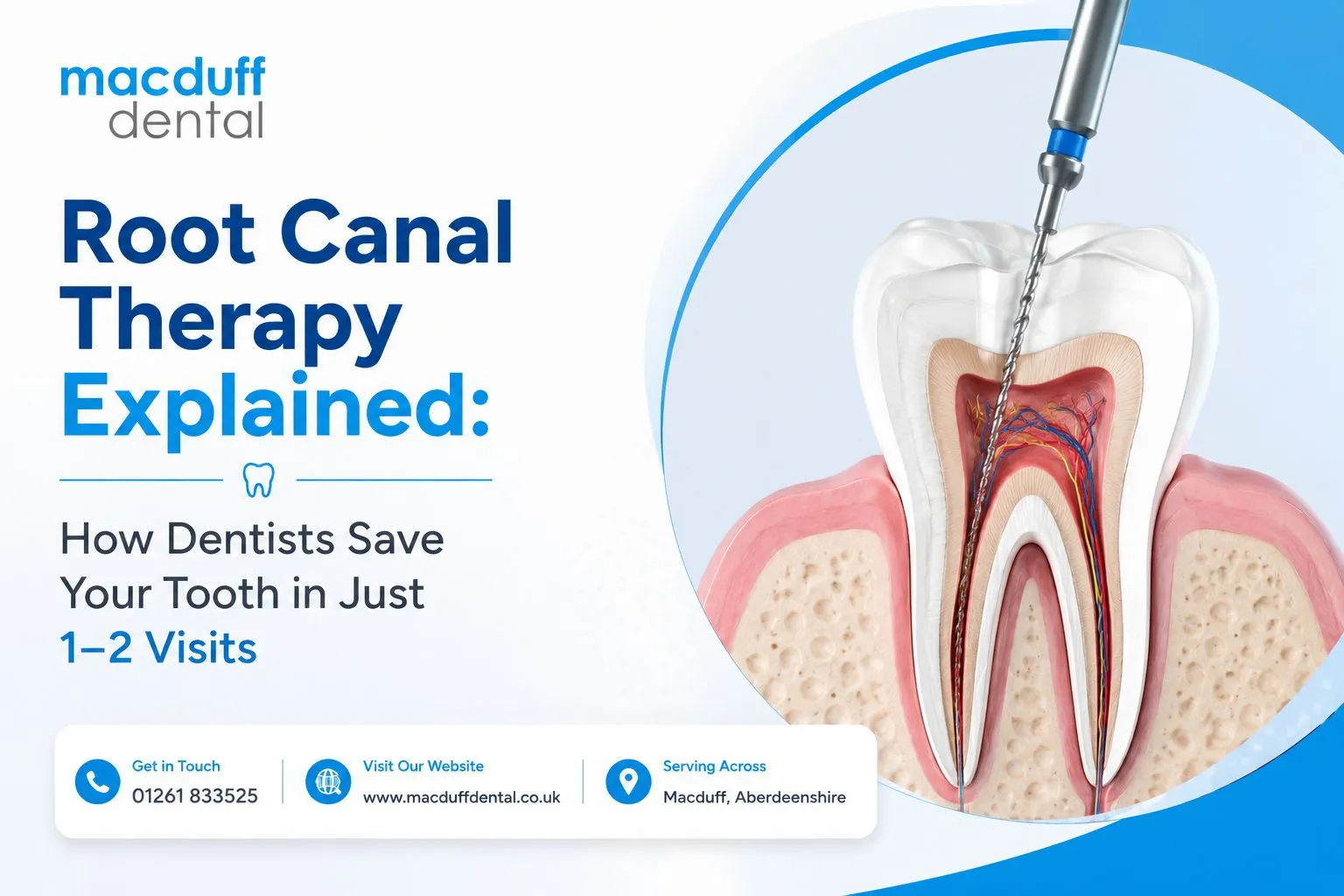

Tooth pain has a way of making people assume the worst. The moment it becomes persistent- deep, throbbing, and impossible to ignore- the mind jumps straight to extraction. But here is the thing: losing the tooth is rarely necessary. Root canal therapy is one of dentistry's most reliable and time-tested solutions, built specifically to save a natural tooth that infection has compromised. At Macduff Dental, this procedure is carried out with the kind of precision and patient-first care that tends to surprise even the most anxious patients.
The reputation root canal therapy carries is, frankly, outdated. Modern techniques have changed the picture entirely. What was once considered a lengthy, uncomfortable ordeal is now, for most patients, a straightforward experience that wraps up in one or two appointments. This blog walks through how the procedure actually works, what happens at each stage, and what restorative options can round off the treatment once the infection is gone.
What Is Root Canal Therapy and When Is It Necessary?
At its core, this is a procedure designed to remove pulp- the soft tissue sitting at the center of every tooth, housing the nerves and blood supply. When bacteria get in (through a crack, a deep cavity, or a knock to the tooth), that pulp becomes infected. And once infection sets in, it does not stay put. Without treatment, it spreads into the surrounding bone, into adjacent teeth, and eventually into serious complications that are far harder to manage.
So, what are the warning signs worth paying attention to?
- A toothache that lingers, especially when biting down or applying any pressure
- Sensitivity to heat or cold that simply does not go away on its own
- A tooth that has visibly darkened or changed color
- Swelling or puffiness in the gum around the affected root
- A small, recurring pimple-like abscess on the gum
And here is something a lot of patients do not realize- not every infected tooth announces itself with pain. Some infections build slowly and quietly, only showing up on an X-ray during a routine check-up. Which is, again, why those regular appointments matter more than most people give them credit for.
The Root Canal Procedure: A Step-by-Step Guide
Understanding root canal therapy at each stage goes a long way in easing the nerves before treatment. What happens during a root canal procedure? Here is an honest, step-by-step breakdown- no clinical jargon, just a clear picture of what to expect.
Step 1 – Examination and X-Ray
Before anything else, the dentist takes a detailed X-ray. This maps out the root canal system and shows how far the infection has progressed.
Step 2 – Local Anesthesia
The area is numbed thoroughly. The patient should feel nothing beyond mild pressure from this point forward.
Step 3 – Dental Dam Placement
A small rubber sheet is placed around the tooth. It keeps the area sterile and isolated throughout the procedure.
Step 4 – Access Opening
A small opening is made in the tooth's crown to reach the pulp chamber underneath.
Step 5 – Pulp Removal and Canal Cleaning
The infected pulp is removed entirely. The canals are then cleaned, shaped, and disinfected using precision instruments.
Step 6 – Sealing the Canals
Once clean, the canals are filled with a biocompatible material called gutta-percha and sealed shut to keep bacteria out permanently.
Step 7 – Restoration
The tooth is built back up, usually with a composite filling or a crown, and returned to full working function.
If you are wondering, How many visits does a root canal take? The answer might surprise you. In most cases, just one visit is necessary. Occasionally, two- particularly when the infection is extensive and an interim dressing is needed between sessions. But the window is short either way, and recovery tends to follow quickly.
White Dental Fillings: Completing the Repair After Treatment
Once the canals are sealed, the tooth still needs to be structurally restored. That is where white dental fillings come in. Composite resin restorations have largely replaced older amalgam options for good reason- they are shade-matched to the natural tooth, making them effectively invisible once placed, and they bond directly to the tooth structure rather than simply filling space.
For teeth at the back of the mouth- the molars that take the brunt of chewing pressure- a dental crown is sometimes recommended on top of the filling. It adds a protective shell around the restored tooth and significantly extends its lifespan. The approach depends on how much of the original tooth structure remains, and a good dentist will walk through the options clearly before any decision is made.
Professional Teeth Whitening: Enhancing Your Smile After Treatment
Endodontic treatment addresses the clinical problem. But many patients, once the pain is gone and the tooth is restored, turn their attention to how their smile looks overall. That is a completely valid next step. For anyone in that position, professional teeth whitening offers a clinically controlled way to brighten the full smile in a predictable, safe manner.
Over-the-counter whitening kits vary wildly in quality and results. A professionally administered treatment, by contrast, is calibrated to the patient's individual tooth shade and aesthetic goals- which means the outcome is consistent and the process is closely supervised.
Many patients often ask, "Is root canal treatment painful?" Well, with proper anesthesia in place, the honest answer is: not really. Most patients report that the discomfort during treatment is far milder than what the infection itself was putting them through. That perspective shift tends to change the whole experience.
Dental Care at Macduff Dental: Built Around the Patient
The team at Macduff Dental offers a thorough range of dental care services in Macduff- from routine prevention and hygiene through to complex restorative work and cosmetic treatments. Root canal procedures here are performed by experienced dental professionals who take the time to explain every step and ensure patients feel genuinely supported, not just processed.
Here is what the experience typically looks like from start to finish-
- A detailed initial consultation, with a clear explanation of all clinical findings
- Open, honest conversation about every treatment option available
- Careful, unhurried clinical work from the first appointment to the last
- Specific aftercare guidance- not a generic sheet, but tailored advice
- Ongoing access to restorative and cosmetic treatments as needed
If you're wondering, "Can a dentist save an infected tooth without extracting it?" In most cases, absolutely. Extraction is the last resort- not the default. Endodontic treatment exists precisely to avoid that outcome, and it succeeds the vast majority of the time.
Dental anxiety is not a weakness- it is one of the most common things dentists encounter. But the right practice makes a real difference. A team that treats the person alongside the tooth tends to produce far better outcomes on both fronts.
Final Words
Root canal therapy is not something to approach with dread. It is a precise, well-established procedure that removes infection, restores function, and saves a natural tooth- often without even needing a second visit. Every stage of the process is built around comfort and long-term results, not just getting through the appointment.
If you are confused about how long recovery takes after a root canal? For most patients, a day or two. Mild residual sensitivity is normal and fades quickly. Normal activity resumes fast.
A treated tooth, looked after properly, can last the rest of a patient's life. That makes this one of the better long-term investments available in modern dentistry- not a temporary measure, but a permanent fix.
Anyone dealing with persistent tooth pain, unexplained sensitivity, or visible swelling around a tooth should not wait it out. Book an appointment with Macduff Dental today and get a proper clinical assessment from a team that genuinely puts patient outcomes first- every single time.
Frequently Asked Questions
Q1: How long does root canal therapy take?
Most cases wrap up in one to two appointments, typically running between 60 and 90 minutes each.
Q2: Is root canal treatment painful?
With modern local anesthesia, the procedure involves very little discomfort- most patients are genuinely surprised by how manageable it is.
Q3: How long does recovery take after root canal treatment?
The majority of patients feel back to normal within a day or two, with any mild sensitivity fading shortly after.
Q4: Can a tooth that has had root canal treatment be whitened?
It depends on the nature of the discoloration. A dental professional can assess the tooth and recommend the most appropriate whitening approach.
Q5: What happens if an infected tooth is left untreated?
The infection spreads- into surrounding bone, adjacent teeth, and potentially beyond. Early treatment is always the better outcome.


























Sign in to leave a comment.