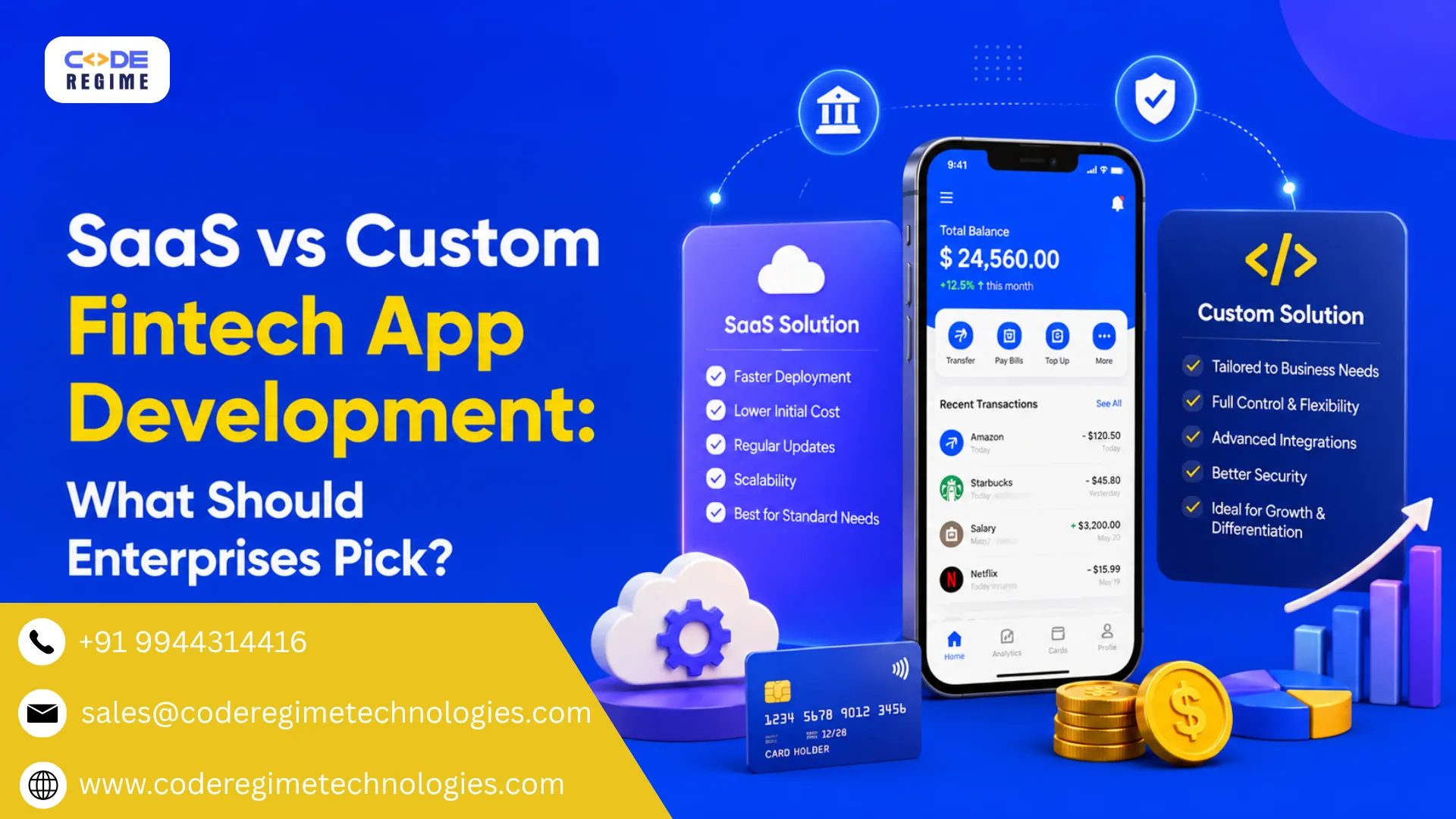

I've sat across the table with enough enterprise decision-makers, startup founders, and fintech app product leads to know that one question comes up every single time a new financial product is on the horizon:
"Should we go with a SaaS platform or build something custom?"
It sounds straightforward. It isn't.
The wrong answer can cost you millions in rework, regulatory penalties, or missed market windows. And the frustrating truth is — both options have crushed companies that chose them for the wrong reasons.
So let me walk you through exactly how I think about this decision, what the data tells us, and where enterprises are actually winning in 2025.
Why the Fintech App Development Decision Is More Complex Than It Appears
The fintech market generated $371.6 billion globally in 2024 and is projected to exceed $1 trillion by 2032, growing at a 16.1% CAGR. The stakes in getting your technology foundation right have never been higher.
Here's the core tension: SaaS platforms offer speed and predictability. Fintech app development done from scratch offers control and differentiation. But in financial services, you can't afford to sacrifice compliance and security on the altar of speed — and you can't afford to sacrifice speed when competitors are shipping every quarter.
This is the precise challenge that makes fintech app development fundamentally different from building a generic software product. Every architecture decision carries regulatory weight. Every UX shortcut carries fraud risk. Every infrastructure compromise carries audit exposure.
SaaS Fintech Solutions — The Case For and Against
The Argument For SaaS
For early-stage startups and businesses testing a new vertical, SaaS fintech platforms — think Stripe, Plaid, Mambu, or Thought Machine — offer undeniable advantages:
- Faster time-to-market: Launch a payment product in weeks, not months
- Lower upfront investment: Subscription models preserve capital for growth
- Built-in compliance modules: PCI DSS, KYC, and AML frameworks often come pre-configured
- Predictable operational costs: Engineering overhead is shifted to the vendor
For a founder validating a concept or a mid-size enterprise testing a new revenue stream, this approach makes complete strategic sense.
Where SaaS Breaks Down for Enterprises
The moment scale, differentiation, or deep regulatory customization becomes a priority — SaaS starts showing its cracks.
I've seen this pattern repeatedly. An enterprise scales past a certain transaction volume and suddenly faces:
- Vendor lock-in with pricing that escalates 300–500% as usage grows
- Limited customization that forces product compromises on core UX flows
- Shared infrastructure that creates latency and uptime dependencies outside your control
- Data residency conflicts with regulators who require on-premise or single-tenant cloud deployments
- Compliance gaps when local regulatory frameworks — RBI, FCA, SEC — require configurations the SaaS vendor hasn't built
The fundamental issue: a SaaS fintech app is architected to serve thousands of clients simultaneously. Your regulatory environment, your customer segments, and your competitive positioning are unique. Those two realities are in perpetual conflict.
Custom Fintech Application Development — The Strategic Advantage
This is where the conversation gets genuinely interesting for growth-stage enterprises and established financial institutions.
Fintech application development built specifically for your business model is not a cost — it's infrastructure. The same way a bank doesn't rent its core banking system from a SaaS provider and hope the vendor's roadmap aligns with their product vision.
What Custom Development Actually Unlocks
1) Full Regulatory Control
When you work with a credible fintech app development company, compliance architecture is baked into the foundation — not configured through a vendor's settings panel. PCI DSS Level 1, ISO 27001, SOC 2 Type II, GDPR, RBI, FCA — all of it gets implemented at the infrastructure level before a single line of business logic is written.
2) Competitive Differentiation Through Technology
Your fintech app becomes your moat. Proprietary fraud detection models trained on your transaction data. Credit scoring algorithms built for your specific borrower segment. UX flows designed for your customer demographics. None of that exists in a SaaS template.
3) Scalability Without Cost Cliffs
Cloud-native microservices architecture means you scale individual components — payment processing, fraud detection, reporting — independently. No SaaS pricing tier jump when you hit 10 million transactions. No architectural rewrite when you expand to three new markets.
4) Full IP Ownership
This point is consistently underestimated. With a purpose-built fintech application, the codebase, the models, the infrastructure configurations — all of it is yours. That intellectual property directly influences your valuation for fundraising conversations and M&A scenarios.
The Financial and Operational Reality — A Side-by-Side Comparison
SaaS Platform
- Time to Market 4–12 weeks
- Upfront Cost Low
- Long-Term Cost Scales with revenue (expensive at scale)
- Regulatory Customization Limited
- IP Ownership None
- Competitive Differentiation Minimal
- Security Architecture Vendor-dependent
- Scalability Vendor-constrained
- Data Control Shared environment
Custom Fintech App Development
- Time to Market 3–18 months (MVP-dependent)
- Upfront Cost $30K–$1M+ depending on scope
- Long-Term Cost Controlled OpEx post-launch
- Regulatory Customization Full control
- IP Ownership 100% owned
- Competitive Differentiation Significant
- Security Architecture Purpose-built
- Scalability Elastic and owned
- Data Control Full sovereignty
The inflection point for most enterprises tends to be around $5–10M ARR or 5–10 million active users. Below that threshold, SaaS often wins on economics. Above it, custom development typically delivers superior unit economics within 18–24 months of launch.
Who Should Actually Choose Custom Fintech App Development Services?
Not every business needs to build from scratch. But if any of the following describe your situation, you're likely leaving significant value on the table by relying on a SaaS platform:
You should seriously evaluate custom development if:
- Your business model depends on proprietary underwriting, risk scoring, or fraud logic
- You operate in a regulated market with specific compliance requirements a SaaS vendor can't satisfy
- Your transaction volume makes SaaS pricing economically unsustainable at projected scale
- You're building for markets where data residency regulation requires sovereign infrastructure
- Your product differentiation depends on a user experience that off-the-shelf platforms won't support
- You're planning institutional fundraising where technology IP is a material valuation input
The startup founder testing a payment concept in a single market — SaaS makes sense, move fast.
The NBFC scaling a digital lending operation with proprietary credit models and RBI compliance obligations — custom fintech application development is the architecture that serves your actual business.
The enterprise financial institution building a neobank layer to compete with challenger banks — there is no SaaS platform that delivers the differentiation that wins that battle.
The Hidden Costs Enterprises Consistently Underestimate with SaaS
I want to spend a moment on something that rarely appears in vendor pitch decks.
When you adopt a SaaS app fintech solution, the total cost of ownership includes costs that never show up in the initial contract:
- Integration engineering: Connecting SaaS platforms to your core banking system, CRM, and data warehouse is rarely trivial. Enterprises routinely spend $200K–$500K on integration work for "plug-and-play" SaaS solutions.
- Workaround development: Every time the SaaS platform can't support a required feature, your engineering team builds a workaround. Those compound over time.
- Compliance overhead: When a regulator's requirement doesn't fit the vendor's configuration model, your compliance team carries the gap.
- Migration risk: The longer you operate on a SaaS platform, the more expensive and operationally risky the eventual migration to a purpose-built system becomes.
Financial app development companies with genuine enterprise experience will tell you this directly rather than promise a smooth SaaS journey that doesn't reflect how these projects actually unfold.
Selecting the Right Fintech App Development Companies — What Actually Matters
If you've decided custom development is the right path, vendor selection is where decisions compound quickly. Here's how I evaluate fintech app development companies:
1. Domain Depth, Not Just Technical Depth
The team should understand financial regulation the way your compliance officer understands it — not the way a generalist developer who read the PCI DSS documentation understands it.
2. Security Architecture as a First-Class Deliverable
Ask specifically how security is implemented across the SDLC. If the answer involves any version of "we add security reviews at the end," that is not a company you want building regulated financial infrastructure.
3. Compliance-First Architecture Decisions
Every architectural choice — from database design to API structure — should be made with your specific regulatory environment in mind. This isn't something you retrofit.
4. Transparency in Delivery
Real-time visibility into development progress, direct access to staging environments, and genuine two-week sprint demos of working software. Not status reports telling you things are on track.
5. Post-Launch Support with Real SLAs
A fintech application development company worth working with treats launch as the beginning of the relationship, not the conclusion. SLA-backed incident response, proactive monitoring, and reserved development capacity for ongoing feature work — these aren't optional.
Frequently Asked Questions
How long does custom fintech app development take compared to deploying a SaaS solution?
A SaaS deployment runs 4–12 weeks for basic configuration; a custom fintech MVP typically takes 3–5 months, with full-featured platforms requiring 8–18 months depending on complexity and regulatory scope.
Is custom fintech app development only viable for large enterprises?
Not at all. Growth-stage startups and mid-market financial businesses building differentiated products — particularly in lending, wealth management, or regulated payments — benefit significantly from custom development when their business model depends on proprietary logic or deep regulatory customization.
How do I evaluate whether a fintech app development company has genuine compliance expertise?
Ask them to walk you through how they handled PCI DSS or RBI compliance on a previous project — specifically how architecture decisions were made to satisfy regulatory requirements. Generic answers about "security best practices" indicate surface-level familiarity. Detailed, confident answers about specific regulatory implementation indicate genuine domain depth.
What is the realistic cost of custom fintech application development?
A focused MVP typically runs $30,000–$80,000. Full-featured platforms with AI, compliance workflows, and multi-platform support run $150,000–$350,000. Enterprise-grade systems, particularly in banking, lending, or crypto exchange infrastructure, can exceed $1 million. Accurate scoping requires a discovery engagement before any reliable estimate is possible.
Can I start with a SaaS solution and migrate to custom later?
Yes, and many enterprises follow this path — but plan the migration early rather than late. The longer you operate on a SaaS platform, the more complex and expensive the migration becomes. Build your roadmap with the eventual migration in mind from the beginning.
Conclusion
The SaaS vs. custom debate in fintech isn't ideological — it's a capital allocation and risk management decision. The right answer depends entirely on where you are in your growth trajectory, what your regulatory environment demands, and how much your competitive position depends on proprietary technology.
What I know with confidence: enterprises that build defensible financial technology on purpose-built infrastructure consistently outperform those that remain permanently dependent on third-party SaaS platforms. The unit economics improve. The compliance posture strengthens. The IP compounds in value.
If you're at the stage where this decision matters, Code Regime Technologies is the partner worth speaking with. They specialize in enterprise-grade fintech app development services — covering mobile banking, digital wallets, payment gateways, lending platforms, and crypto exchanges — with compliance architecture, bank-grade security, and scalable infrastructure built into every engagement from day one.
They've delivered for banks, NBFCs, investment platforms, and fintech startups across global markets, and they treat post-launch as a sustained partnership rather than a project handover.
You can explore their fintech capabilities and book a free discovery consultation.



























Sign in to leave a comment.