

Walk into most sales galleries and you know within thirty seconds whether the developer has invested in the experience or just the address. Rows of laminated boards. A looping video nobody watches past the first minute. A single sample flat that only shows one of your eight possible layouts. For a project charging premium pricing, that gap between the product and the pitch is impossible to ignore.
Sales ready properties software exists to close exactly that gap — turning a sales gallery from a waiting room with brochures into a working, multi-room environment built around how buyers actually decide.
The Problem With Most Sales Galleries Today
A gallery's job is to sell certainty, and most physical spaces are built to do the opposite. A few recurring issues show up across almost every underperforming gallery:
- Static boards can't answer a specific buyer's question. A printed layout shows one configuration. It can't show the buyer's actual unit, floor, or view.
- One sample flat can't represent a whole project. Most launches sell six to ten configurations off a single physical show flat, if one exists at all.
- International and remote buyers are structurally excluded. A gallery built purely for in-person visits has no answer for an NRI buyer or an out-of-town investor who can't fly in for a walkthrough.
- Grand launch events need more than a stage and a screen. A room full of channel partners and stakeholders expects a presentation that matches the scale of the project being introduced.
Every one of these gaps translates directly into lost momentum — either buyers who leave without full clarity, or entire segments of your audience who never get a proper walkthrough at all.
What Interactive Sales Office Tools Actually Change
The fix isn't a bigger screen in the lobby. It's rethinking the gallery as a set of purpose-built rooms and channels, each solving a specific part of the buyer's decision:
- Dedicated meeting rooms equipped for one-on-one, high-fidelity walkthroughs, rather than a single shared display everyone competes for.
- A central LED presence in the waiting area that holds attention and reinforces project highlights before a buyer even sits down.
- Launch-event-grade content for the moments that matter most — the grand unveiling in front of hundreds of stakeholders.
- A remote, web-accessible version of the same walkthrough tool, so a buyer in Dubai or London gets the same clarity as one standing in your gallery.
Good interactive sales office tools treat these as one connected system, not four separate purchases.
How a Multi-Room Gallery System Gets Built
Designing and deploying this kind of gallery follows a distinct sequence from a single-screen installation:
- Space audit and layout planning — mapping how many meeting rooms, waiting areas, and event spaces the gallery needs to support.
- Hardware specification per room — matching display size, processing power, and control interface to each room's function.
- Content architecture — building the digital twin and walkthrough content once, then deploying it consistently across every room and device.
- Remote access build-out — configuring a browser-based version so the same experience travels beyond the physical gallery.
- Event-mode content production — separate, higher-impact content prepared specifically for launch events, distinct from day-to-day sales walkthroughs.
The goal throughout is consistency: a buyer who sees the project on a Tuesday afternoon in a private room should get the same quality of information as one who saw it at the launch event in front of a packed room.
Which Projects Need a Multi-Room Gallery Approach
This level of gallery investment makes the most sense for:
- Premium developments with a genuine grand launch moment — the kind of project that pulls in hundreds of channel partners and stakeholders on day one.
- Projects with a significant international or NRI buyer base, who need remote access without sacrificing walkthrough quality.
- High-footfall galleries running multiple concurrent buyer conversations, where a single shared screen creates a bottleneck.
- Developers positioning a location advantage — connectivity, skyline views, proximity to business districts — that's easier to feel than to describe.
The Buyer Journey Through the Gallery
A well-designed multi-room gallery guides different buyers through different, appropriate paths:
For an in-person buyer:
- Arrival, where the LED display in the waiting area sets context and builds anticipation.
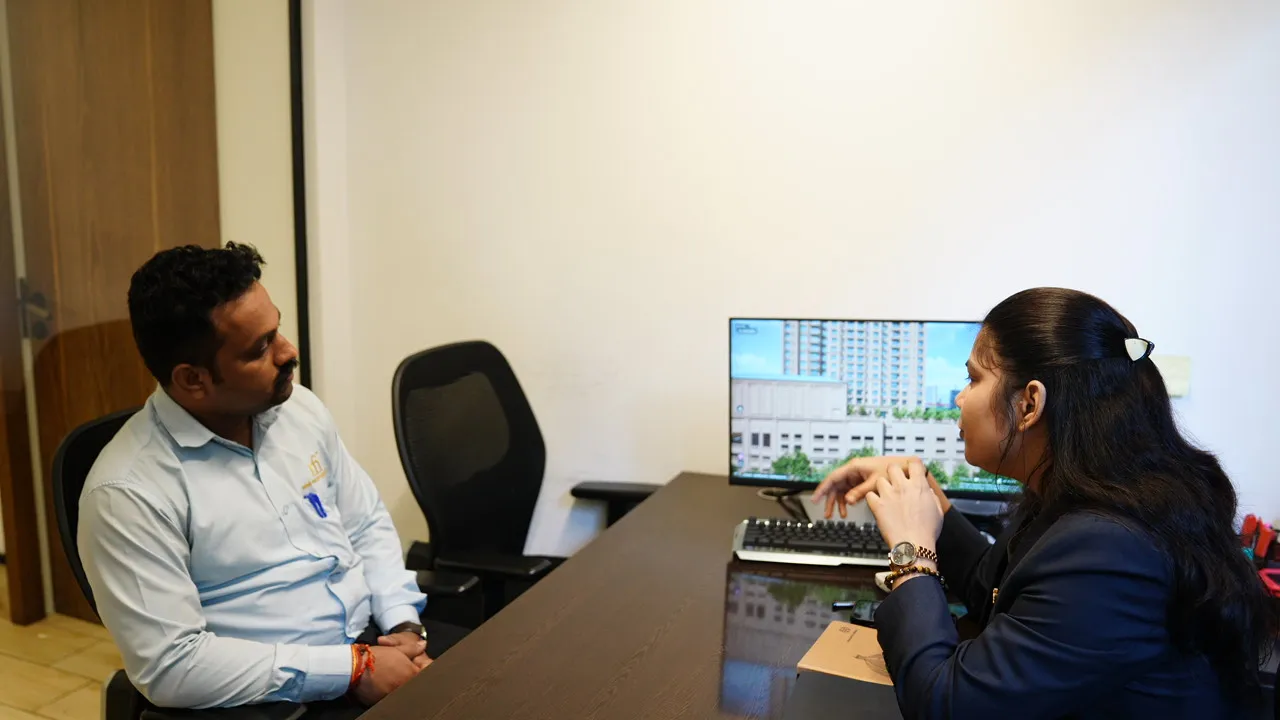
- A dedicated meeting room walkthrough, using a large touchscreen controlled by the sales executive via iPad.
- Deep exploration of specific interests — sea views, amenity access, floor comparisons — at the buyer's pace.
- A guided conversation, with the executive adjusting the presentation live based on what the buyer asks.
For a remote or international buyer:
- A scheduled video call using the same walkthrough platform's web version.
- A live, guided tour conducted by a sales executive, mirroring the in-person experience.
- The same layout, view, and amenity data — just delivered through a browser instead of a gallery room.
Neither path should feel like a lesser version of the other.
What Changes for the Sales Team
Running multiple rooms simultaneously requires more sales-floor discipline, not less. Executives need to manage several buyer conversations at once, each potentially at a different stage of the journey — some exploring, some negotiating, some remote. A shared, consistent digital twin across every room and device is what makes this manageable: no executive is working from an inferior version of the pitch, and no buyer feels like an afterthought.
A Real Example: L&T The Gateway, Sewri
L&T The Gateway, a premium high-rise development in Sewri, Mumbai, is a strong working example of a gallery built around exactly this multi-channel approach. L&T Realty needed to showcase the project's prime location, sea views, and exceptional connectivity between Mumbai's north and south, while also serving international clients who couldn't visit in person, and staging a grand launch event for over 200 channel partners and stakeholders.
The solution was built across four coordinated components:
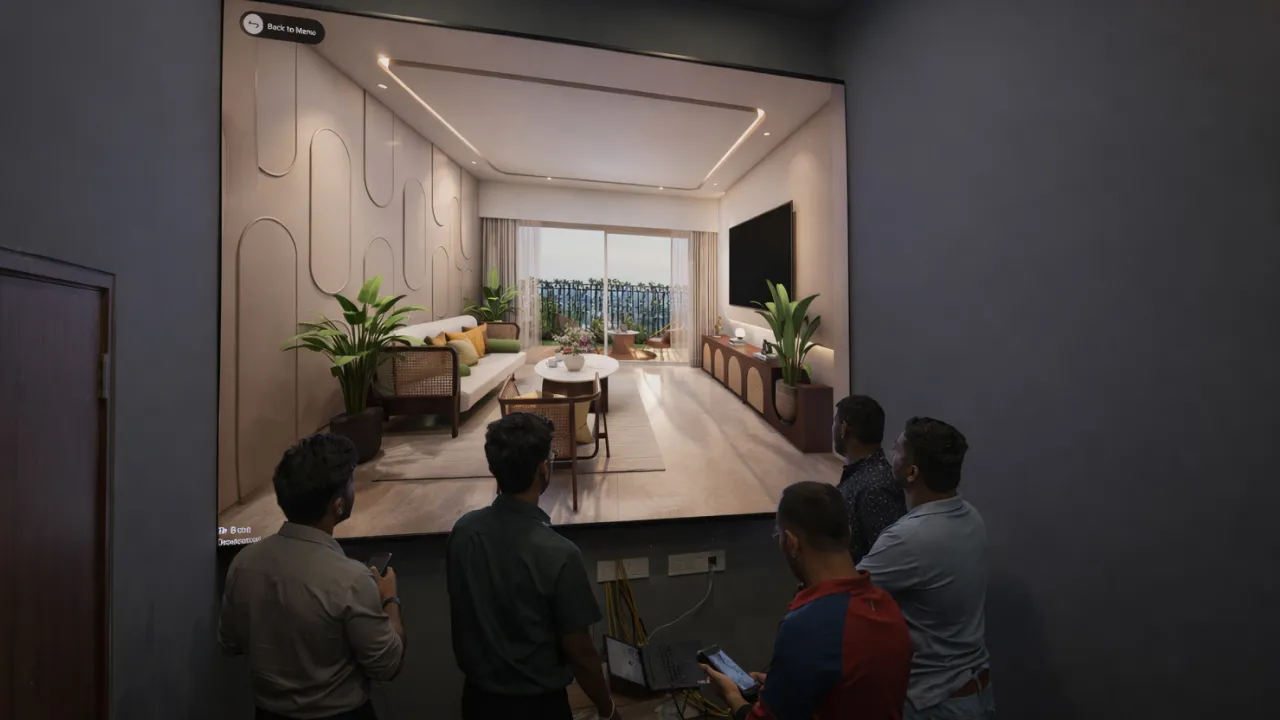
- Immersive software installed in five dedicated sales meeting rooms, each equipped with a 55-inch touchscreen TV connected to high-performance PCs capable of real-time 4K rendering, controlled by sales executives through an 11-inch iPad Pro.
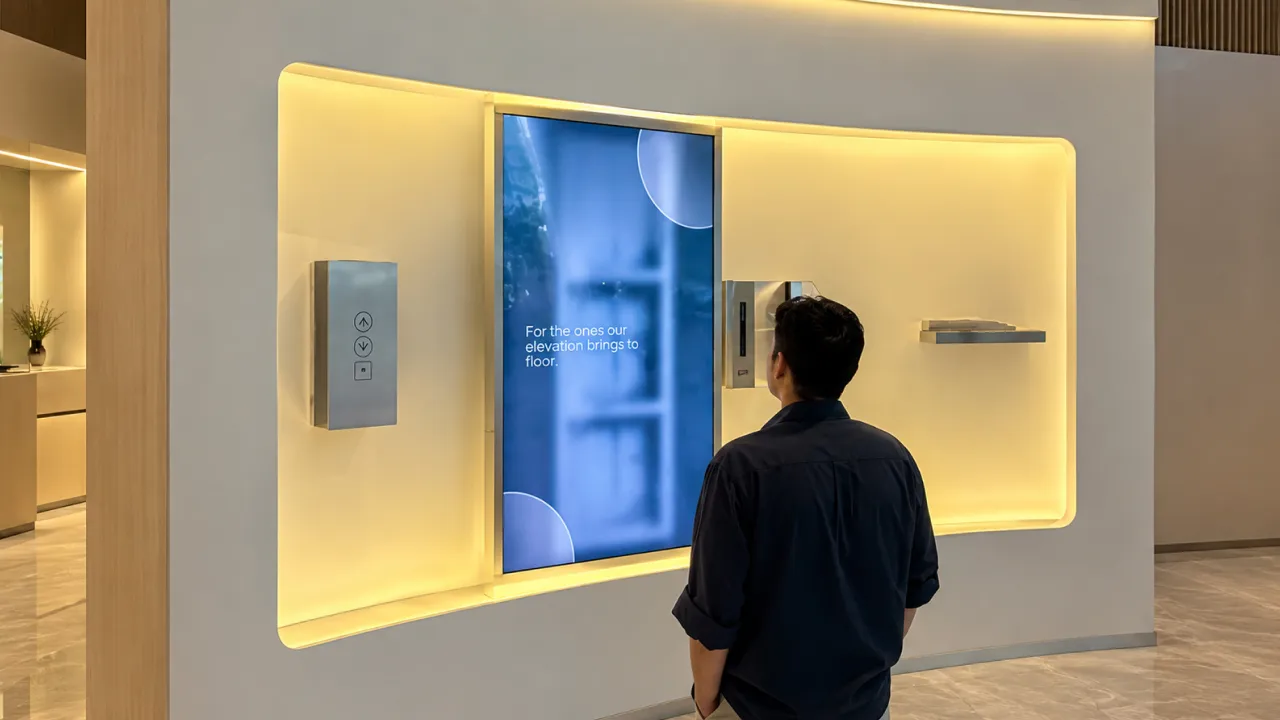
- LED screen integration in the waiting area, showcasing project highlights and maintaining visitor interest, also controllable via iPad.
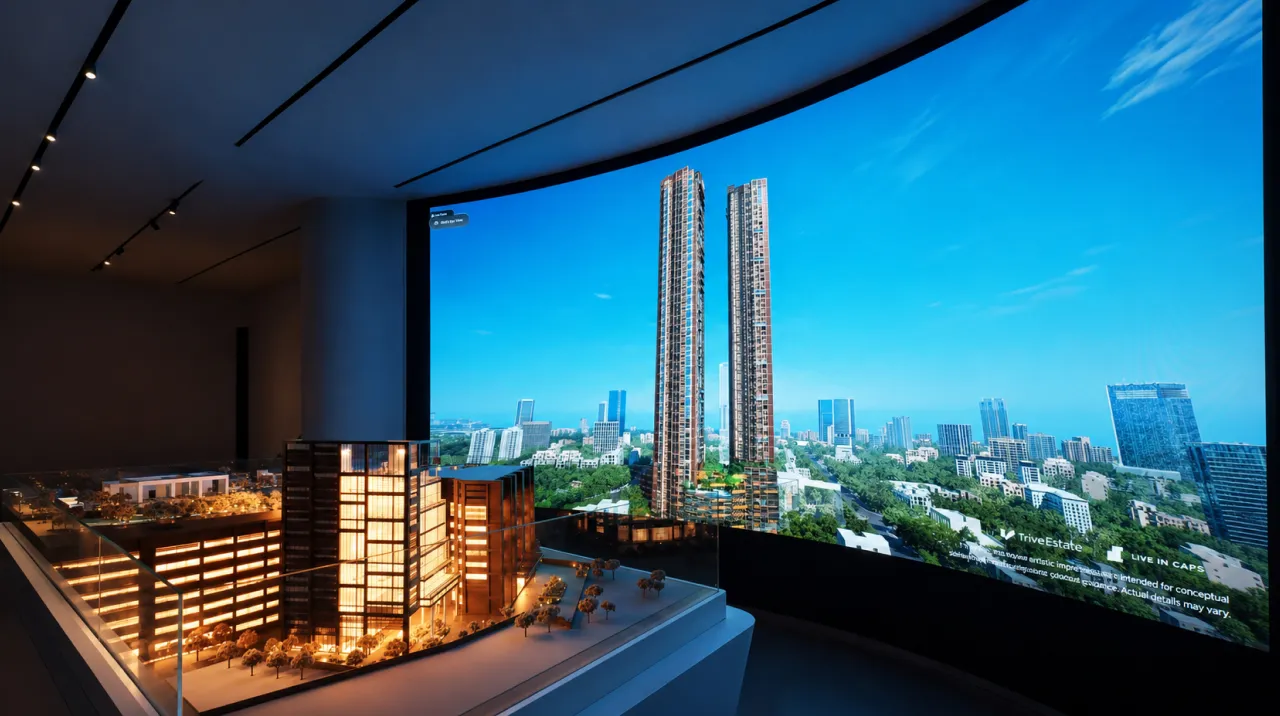
- A dedicated location AV piece, combining storytelling with a visual focus on connectivity — the Mumbai Trans Harbour Link, the Orange tunnel, the Navi Mumbai airport — to make the location advantage tangible rather than descriptive.
- A web version of the platform, V-Retail, enabling sales reps to conduct live guided video sessions for international and remote clients, extending the reach of in-person selling.
For the project's grand launch at the Jio World Convention Centre, the team also curated hybrid 3D anamorphic content with stereoscopic sound, built specifically for the scale of an event with 200-plus attendees.
The Technology Behind the Gallery
Running this kind of environment reliably, across five rooms and a remote channel, depends on a specific technical foundation:
- High-performance, real-time 4K rendering PCs in every room, ensuring consistent visual quality regardless of which space a buyer is in.
- iPad-based control interfaces, giving sales executives intuitive, flexible navigation during live client conversations.
- LED wall integration, extending the same content into shared waiting areas.
- A browser-accessible web version, so the walkthrough isn't confined to physical hardware.
- Event-grade anamorphic and stereoscopic content production for large-scale launch moments.
This same underlying real-time engine and multi-device deployment approach powers digital twin platforms like Spaci, adapted here specifically for a multi-room, hybrid-channel gallery.
Verified Results
The impact at L&T The Gateway showed up across both the sales process and the launch itself:
- The interactive sales tool moved the entire sales process beyond traditional scale models and brochures, delivering a fully digital, engaging experience for every buyer.
- The 3D anamorphic launch content generated strong early sales momentum, driven by increased excitement and visibility among launch attendees.
- Sales conversion rates saw a significant uplift in the months immediately following deployment, as buyers were able to make faster, better-informed decisions.
Where This Approach Has Real Limits
A multi-room gallery is a genuine investment, and it's worth being clear-eyed about the constraints:
- It needs real physical space. Five dedicated meeting rooms aren't feasible for every gallery footprint — smaller developments may need a scaled-down version.
- Remote sessions still depend on a skilled sales executive. The web version extends reach, but it doesn't replace the need for a rep who can read the conversation and guide it well.
- Event-grade content is a separate production effort. Day-to-day sales content and launch-event content aren't interchangeable, and both need dedicated planning.
- Consistency requires discipline. Without a shared content architecture across rooms, different executives can end up presenting slightly different versions of the same project.
Frequently Asked Questions
How many meeting rooms does a gallery actually need? It depends on footfall and ticket size, but the goal is enough rooms that buyers aren't waiting or sharing a single shared display during peak visit times.
Can remote buyers get the same experience as an in-person visit? Yes, when the web version runs on the same underlying digital twin — the difference is the delivery channel, not the content quality.
Is this only relevant for grand, large-scale launches? No — the multi-room and remote-access approach applies to any premium gallery with meaningful footfall, though the event-grade content layer is specifically useful for large launch moments.
How is iPad control different from a fixed touchscreen setup? iPad control lets the sales executive guide the walkthrough from anywhere in the room, adjusting the pace and focus to match the buyer's questions in real time, rather than being tied to a fixed panel.
Ready to Rebuild Your Sales Gallery Around How Buyers Actually Decide?
If your gallery is still built around static boards and a single sample flat, it's working against the product you're trying to sell. V-Estate designs multi-room, hybrid-channel sales galleries — physical and remote — the way it did for L&T Realty at The Gateway.
Book a demo with V-Estate to explore what an interactive gallery could look like for your next launch.

























Sign in to leave a comment.