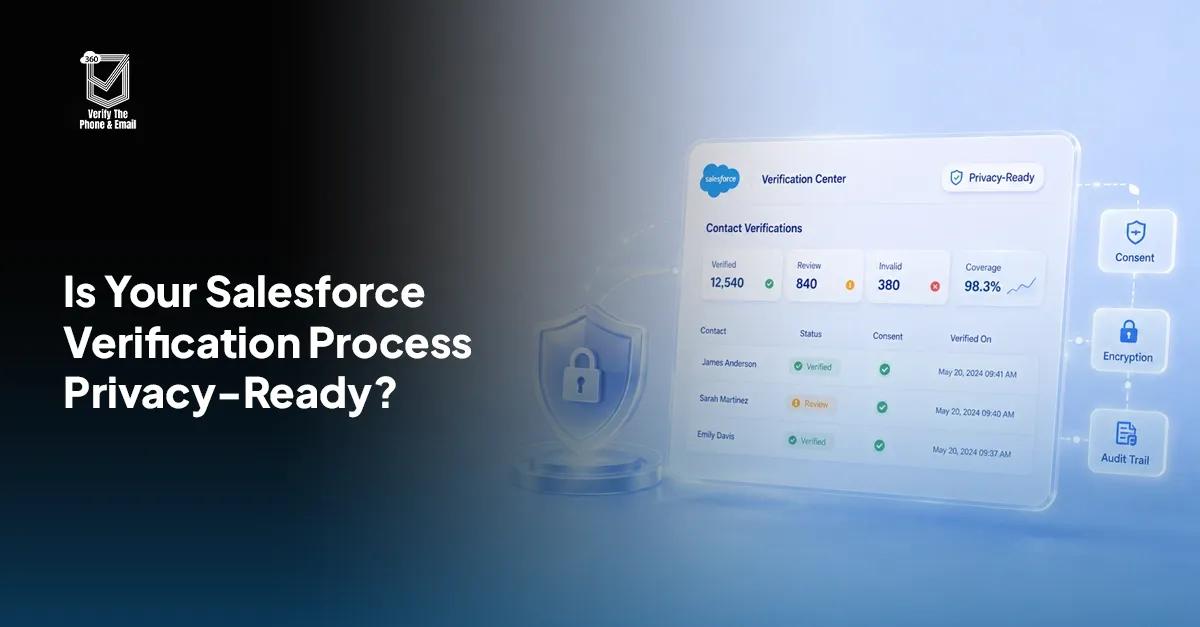

Email and phone verification looks like a data-quality task. From a privacy perspective, it is also data processing. A verification tool may inspect, transmit, classify, store, or log identifiers tied to real people, making the verification layer part of your compliance surface. The question is not only, “Does this email or phone number work?” It is also, “What happens to the data while we check?”
GDPR Checklist for Email/Phone Verification
Under GDPR, personal data includes information relating to an identified or identifiable person. Personal email addresses qualify, and business email addresses or business telephone numbers can also be personal data when they identify an individual.
1. Identify Exactly What Personal Data Is Verified
2. Define a Specific Purpose
3. Confirm the Lawful Basis
4. Apply Data Minimization
5. Understand Controller and Processor Responsibilities
6. Check Where Data Travels
7. Review International Transfers
8. Set Retention and Security Rules
9. Keep Verification Separate From Marketing Permission
HIPAA Considerations for Healthcare Data Verification
HIPAA does not make every email address or phone number PHI in every context. The key question is whether the data is protected health information handled by a covered entity or business associate, and whether the verification workflow creates, receives, maintains, or transmits that PHI.
1. Determine Whether the Workflow Touches PHI or ePHI
Map the Salesforce objects and fields involved. Contact data linked to patient, member, treatment, billing, or other protected health information may bring the verification workflow into your HIPAA risk analysis.
2. Determine Whether the Vendor Is a Business Associate
HHS states that a vendor can be a business associate when it creates, receives, maintains, or transmits PHI on behalf of a covered entity. If that definition applies, a Business Associate Agreement, or BAA, may be required.
3. Do Not Rely on a “HIPAA Compliant” Label
Ask what the vendor actually does with ePHI, what safeguards apply, whether a BAA is available when required, and which subcontractors can access the data. Compliance depends on the full arrangement, not a marketing phrase.
4. Follow the Minimum Necessary Principle Where Applicable
Limit PHI used or disclosed for verification to what is reasonably necessary for the intended purpose. A contact check usually should not require an entire patient record.
5. Include Verification in Your Security Risk Analysis
HHS treats risk analysis as foundational to Security Rule compliance. Evaluate where ePHI is created, received, maintained, or transmitted, then document threats, vulnerabilities, and safeguards.
What “Zero Data Exposure” Actually Means
“Zero data exposure” is not a defined GDPR certification, HIPAA certification, or universal legal standard. It should be treated as an architecture claim that needs a precise explanation of what information leaves the primary system, who can receive it, where it is stored, and whether additional copies are created.
Read full article here https://360degreecloud.com/product/vtm-vtp/blog/salesforce-email-verification-compliance-checklist/


























Sign in to leave a comment.