Customers today expect fast, convenient, and personalized communication. Most people prefer messaging over emails or phone calls, and WhatsApp has become one of the most popular communication platforms worldwide.
However, many businesses struggle to manage customer conversations across different channels. Sales teams lose leads, support teams miss messages, and customer data remains scattered across multiple systems.
This is where salesforce integration with WhatsApp becomes a game-changer.
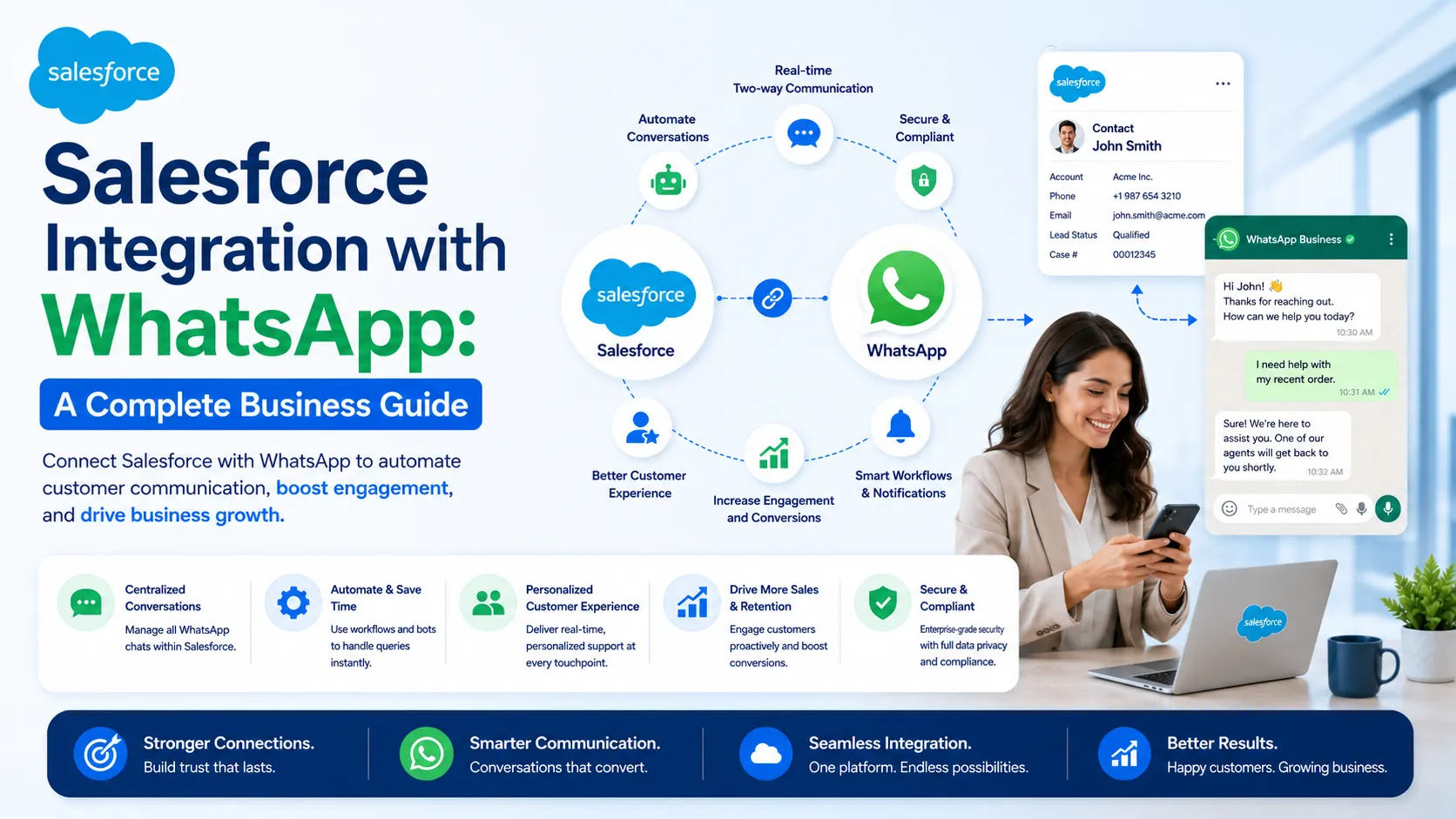
By connecting WhatsApp with Salesforce, businesses can manage customer interactions from one place, automate responses, track conversations, and provide better customer experiences. Whether you are in sales, customer support, or marketing, this integration can help you work smarter and build stronger customer relationships.
In this guide, we will explore how Salesforce and WhatsApp work together, their benefits, real-world use cases, and why businesses are choosing this powerful integration.
What Is Salesforce Integration with WhatsApp?
Salesforce integration with WhatsApp connects the world's leading CRM platform with WhatsApp Business messaging capabilities.
This integration allows businesses to:
- Send and receive WhatsApp messages directly from Salesforce
- Track customer conversations
- Automate notifications and reminders
- Manage leads more efficiently
- Improve customer support
- Store communication history in one place
Instead of switching between multiple platforms, your team can manage everything within Salesforce.
Why Businesses Need WhatsApp and Salesforce Integration
The Growing Demand for Instant Communication
Customers want quick responses. Waiting hours or days for an email response can lead to frustration and lost opportunities.
WhatsApp provides:
- Instant communication
- High message open rates
- Easy customer engagement
- Global accessibility
When combined with Salesforce, businesses gain a complete view of every customer interaction.
Common Business Challenges
Many organizations face problems such as:
- Missed customer inquiries
- Delayed responses
- Poor lead management
- Inconsistent customer communication
- Lack of conversation tracking
Salesforce integration solves these challenges by creating a centralized communication system.
Key Benefits of Salesforce Integration with WhatsApp
Improved Customer Experience
Customers appreciate fast and personalized communication.
With Salesforce integration, your team can:
- View customer history instantly
- Respond quickly
- Deliver personalized support
- Maintain consistent communication
This creates a better customer experience and improves satisfaction.
Faster Lead Conversion
Sales teams can connect with prospects through WhatsApp, where customers are already active.
Benefits include:
- Faster follow-ups
- Better engagement
- Improved response rates
- Higher conversion opportunities
A quick WhatsApp message often receives attention faster than an email.
Automated Communication
Automation helps businesses save time and reduce manual work.
Examples include:
- Appointment reminders
- Order confirmations
- Delivery updates
- Payment notifications
- Follow-up messages
Salesforce workflows can automatically trigger WhatsApp messages based on customer actions.
Centralized Customer Data
Every conversation becomes part of the customer record inside Salesforce.
This allows teams to:
- Access communication history
- Track customer journeys
- Improve collaboration
- Make better business decisions
ncreased Team Productivity
Employees spend less time switching between systems.
Benefits include:
- Faster workflows
- Reduced manual tasks
- Better team collaboration
- Improved efficiency
How Salesforce Integration with WhatsApp Works
Step 1: Connect WhatsApp Business API
The integration begins by connecting the WhatsApp Business API with Salesforce.
This creates a secure communication bridge between both platforms.
Step 2: Sync Customer Data
Customer information is synchronized automatically.
This ensures:
- Accurate records
- Updated contact information
- Better communication tracking
Step 3: Enable Messaging Automation
Businesses can configure automated workflows such as:
- Welcome messages
- Lead nurturing campaigns
- Service notifications
- Customer support responses
Step 4: Monitor and Analyze Performance
Salesforce reporting tools help businesses measure:
- Response rates
- Customer engagement
- Conversion performance
- Support effectiveness
Real-Life Use Cases of Salesforce WhatsApp Integration
Retail Businesses
Retail companies can send:
- Order confirmations
- Shipping updates
- Product recommendations
- Customer support messages
Example:
A customer places an online order. Salesforce automatically triggers a WhatsApp confirmation message and later sends delivery updates.
Healthcare Providers
Healthcare organizations can use WhatsApp for:
- Appointment reminders
- Follow-up communications
- Patient notifications
This helps reduce missed appointments and improve patient engagement.
Real Estate Companies
Real estate agents can:
- Share property listings
- Schedule site visits
- Respond to inquiries quickly
This speeds up communication and improves lead conversion.
Financial Services
Banks and financial institutions can send:
- Transaction alerts
- Account updates
- Customer support messages
All communications remain securely tracked within Salesforce.
Salesforce Integration with WhatsApp vs Traditional Communication
| Feature | WhatsApp + Salesforce | Traditional Email |
|---|
| Response Speed | Fast | Moderate |
| Open Rate | Very High | Lower |
| Customer Engagement | High | Moderate |
| Automation | Advanced | Basic |
| Real-Time Communication | Yes | Limited |
| Mobile Accessibility | Excellent | Good |
Businesses looking for faster customer engagement often find WhatsApp significantly more effective than traditional channels.
Expert Tips for Successful Implementation
Define Clear Business Goals
Before integration, identify your objectives.
Examples:
- Improve customer support
- Increase lead conversion
- Automate communication
- Enhance customer engagement
Create Personalized Messaging
Customers respond better to personalized communication.
Use customer data from Salesforce to send relevant messages.
Follow WhatsApp Compliance Rules
Always:
- Obtain customer consent
- Respect privacy regulations
- Avoid spam messaging
This protects your brand reputation.
Monitor Performance Regularly
Track important metrics such as:
- Response times
- Customer satisfaction
- Lead conversion rates
- Campaign effectiveness
Continuous optimization delivers better results.
Why Choose Zordial Technologies?
At Zordial Technologies, we help businesses unlock the full potential of Salesforce and WhatsApp integration.
Our Expertise
- Certified Salesforce professionals
- Customized integration solutions
- Industry-specific implementation strategies
- Automation and workflow optimization
- Ongoing technical support
What Makes Us Different?
- Deep Salesforce expertise
- Customer-focused approach
- Scalable solutions
- Secure implementation practices
- Proven project delivery experience
We understand that every business has unique requirements. Our team designs solutions tailored to your goals, processes, and customer expectations.
Whether you need customer support automation, lead management improvements, or complete communication transformation, Zordial Technologies can help you achieve measurable results.
Ready to Transform Customer Communication?
Your customers are already using WhatsApp every day.
The question is: Is your business ready to meet them there?
With Salesforce integration, you can streamline communication, automate workflows, improve customer experiences, and drive business growth.
Partner with Zordial Technologies to build a powerful Salesforce WhatsApp integration that delivers real business value.
Contact Us Today
Get in touch with our Salesforce experts and discover how WhatsApp integration can help your business improve engagement, increase efficiency, and boost conversions.
Conclusion
Customer expectations continue to evolve, and businesses must adapt to stay competitive. Salesforce integration with WhatsApp provides a powerful way to improve communication, automate processes, and build stronger customer relationships.
By combining the capabilities of Salesforce CRM with the convenience of WhatsApp messaging, businesses can deliver faster responses, increase customer satisfaction, and achieve better results.
If you're ready to modernize customer engagement and streamline operations, contact Zordial Technologies today and start your Salesforce WhatsApp integration journey.
Frequently Asked Questions (FAQs)
1. What is Salesforce integration with WhatsApp?
Salesforce integration with WhatsApp connects Salesforce CRM with WhatsApp Business, allowing businesses to manage customer conversations, automate messaging, and track interactions from one platform.
2. How does WhatsApp integration improve Salesforce CRM performance?
It improves customer engagement, centralizes communication, automates workflows, and provides a complete view of customer interactions.
3. Can businesses automate WhatsApp messages through Salesforce?
Yes. Businesses can automate appointment reminders, notifications, confirmations, follow-ups, and customer support communications.
4. Is Salesforce WhatsApp integration suitable for small businesses?
Absolutely. Small businesses can improve customer communication, increase efficiency, and manage leads more effectively through the integration.
5. Is WhatsApp Business API required for Salesforce integration?
Yes. Most professional Salesforce WhatsApp integrations use the WhatsApp Business API to enable secure and scalable communication.
6. Can Salesforce track WhatsApp conversations?
Yes. Customer conversations can be stored and managed directly within Salesforce records for better visibility and reporting.
7. Why should I choose Zordial Technologies for Salesforce WhatsApp integration?
Zordial Technologies offers Salesforce expertise, customized implementation, automation solutions, and dedicated support to ensure successful integration and business growth.




























Sign in to leave a comment.