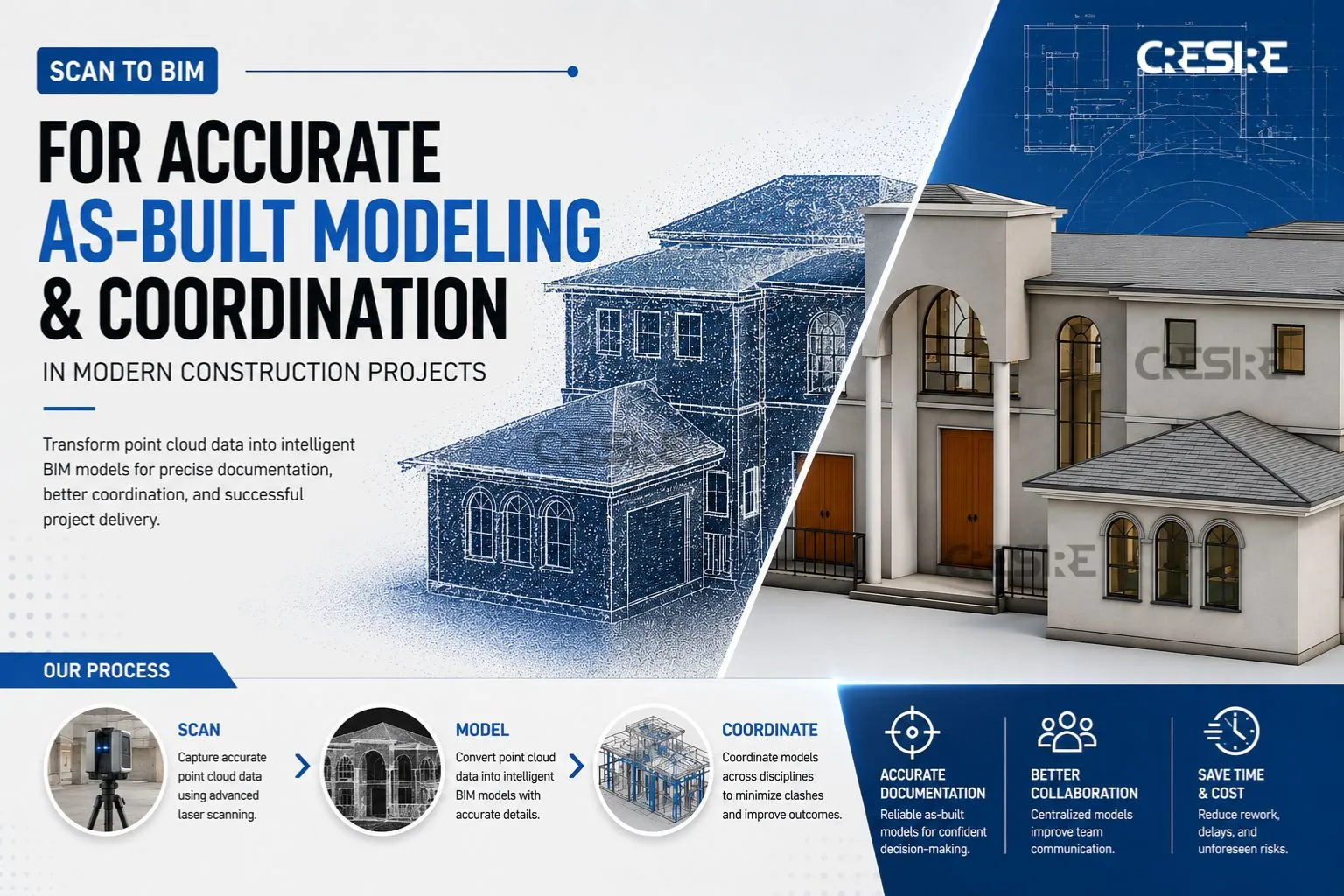

The current construction process places more demands on team productivity and coordination in dealing with intricate buildings, as well as reduces the room for costly mistakes. However, one major problem persists through all stages of the construction process for the Architecture, Engineering, and Construction (AEC) industry—existing conditions inaccuracies.
Old, unreliable drawings, undocumented building alterations, measurement inconsistencies, and inaccurate building data cause issues with coordination in the design and construction phase. Such mistakes are common for contractors, architects, mechanical, electrical, and plumbing engineers (MEP), and facility managers.
This is exactly why Scan to BIM is not just another buzzword in technology anymore. It is becoming a powerful tool to obtain accurate building data to facilitate coordination and accelerate decision-making.
Using laser scanning technology and transforming point cloud data into BIM models enables project teams to collaborate using the real-life building and not the information from outdated drawings.
Why Existing Building Data Is Still a Major Problem in Construction
The first obstacle that most renovation and retrofits face at the very onset is lack of trust in the current documents.
With old buildings, the problem is that documentation becomes obsolete, or there are no documents in the first place. Spaces get reconfigured; MEPs get moved around; structure gets changed; and field conditions change as well.
If you base your work on wrong documents, the results will show during construction:
- Mechanical systems conflict with structural components
- Ceiling clearances become inaccurate
- Prefabricated components fail to fit on-site
- Teams spend time resolving unexpected clashes
- RFIs and change orders increase significantly
These issues don’t only impact budgets—they also reduce productivity and create communication gaps between stakeholders.
AEC firms today are under pressure to avoid these risks before construction begins. This is where Scan to BIM workflows provide measurable value.
From Laser Scans to Intelligent BIM Coordination
Laser scanning gathers extremely precise spatial data from structures that exist on site. There are millions of data points gathered that make up point clouds which accurately depict the real world.
However, the actual point cloud data alone is not easily usable by the project team when it comes to coordination and planning for design and construction. The benefit of point cloud data is when it gets turned into BIM models.
Point Cloud to BIM converts scanned point clouds into intelligent 3D models in programs like Revit. These models will include the architecture, structure, and MEP components according to the actual on-site conditions.
This process allows teams to:
- Model existing conditions accurately
- Validate field dimensions early
- Improve multidisciplinary coordination
- Reduce construction uncertainty
- Support clash detection workflows
- Streamline prefabrication processes
Instead of reacting to issues during construction, teams can identify and resolve them during design stages.
Why Accurate As-Built Models Matter More Than Ever
As construction projects become more complex, the margin for error continues to shrink.
Modern projects increasingly depend on prefabrication, modular construction, fast-track delivery schedules, and multi-trade coordination. These workflows require precise dimensional accuracy because even small discrepancies in field conditions can disrupt fabrication and installation.
This is especially important in:
- Hospitals and healthcare facilities
- Industrial plants and manufacturing units
- Airports and transportation infrastructure
- Commercial retrofits
- Data centers
- Educational campuses
- Heritage restoration projects
For these projects, accurate as-built BIM models are no longer optional—they are critical operational assets.
Point Cloud to BIM helps ensure that every discipline works from the same verified building data. This improves coordination efficiency and reduces the likelihood of expensive site conflicts later in the project lifecycle.
The Coordination Challenges Teams Face Without Scan to BIM
One of the most common causes of project delays is poor coordination between trades.
Architectural, structural, HVAC, plumbing, electrical, and fire protection systems often compete for limited space within complex building environments. When teams work from inaccurate drawings or disconnected data sources, coordination issues become inevitable.
Without reliable as-built information:
- Designers make assumptions about existing conditions
- Contractors encounter unforeseen conflicts during installation
- Coordination meetings become reactive instead of proactive
- Project schedules become harder to maintain
Scan to BIM helps eliminate these coordination gaps by creating a centralized BIM environment based on actual site data.
With accurate models available early in the workflow, project teams can:
- Perform clash detection with confidence
- Improve installation sequencing
- Coordinate prefabricated systems more effectively
- Minimize field modifications
- Accelerate approvals and project reviews
This leads to smoother collaboration between architects, engineers, contractors, and owners.
Reducing Rework Through Data-Driven Construction
Rework remains one of the construction industry’s most expensive productivity issues.
In situations where teams detect inaccuracies after commencement of the construction process, such issues lead to alterations that will affect labor, timing, and project efficiency.
Most of these problems come about because of inaccurate information collected at the very onset of the project.
The use of scanning to BIM processes can help minimize rework because of their accuracy of representation.
This allows teams to:
- Verify dimensions earlier
- Identify conflicts before installation
- Improve fabrication accuracy
- Reduce unnecessary site visits
- Improve communication between stakeholders
For contractors and project managers, this means fewer surprises in the field and better control over project outcomes.
Supporting Smarter Renovation and Retrofit Projects
Unlike building new structures, renovations tend to be much more complicated since there are a lot of unknowns within the buildings.
The older the buildings are, the higher chances that undocumented changes will occur over time.
By using Point Cloud to BIM, renovations can become easier by gaining a better understanding of the existing building spaces.
This is particularly valuable for:
- MEP upgrades
- Facility expansions
- Building repurposing projects
- Industrial retrofits
- Sustainability improvement initiatives
Accurate BIM models improve planning accuracy and help teams reduce risks during phased construction activities where operations must continue during renovation work.
Why Owners and Facility Managers Are Investing in Digital Building Data
Scan to BIM is not limited to its use in the construction industry only.
Facility managers understand the need for keeping digital documentation of the building that is accurate.
As-built BIM models developed using laser scanning information can assist with:
- Facility management systems
- Asset tracking
- Maintenance planning
- Space utilization analysis
- Future renovation workflows
- Digital twin initiatives
Rather than depending on archaic paper-based systems, the owners can benefit from data-driven information regarding their buildings.
The use of building data for facilities management is emerging as one of the important priorities in commercial, industrial, healthcare, and infrastructure sectors.
The Growing Role of Scan to BIM in Digital Construction
Construction is becoming a sector in which workflow becomes digitized and dependent on accurate information for each stage of delivery processes.
Whether reality capture, BIM coordination, digital twins, and predictive maintenance, it all comes down to accurate data.
One of the processes critical for development in this sphere is Scan to BIM.
Such a process is vital for the creation of models reflecting the reality to facilitate construction throughout the building's life cycle.
To compete in the current climate, AEC companies should cooperate better, minimize risks associated with construction, and complete projects faster.
Therefore, creating as-built models becomes vital to keep up in the contemporary environment.

























Sign in to leave a comment.