

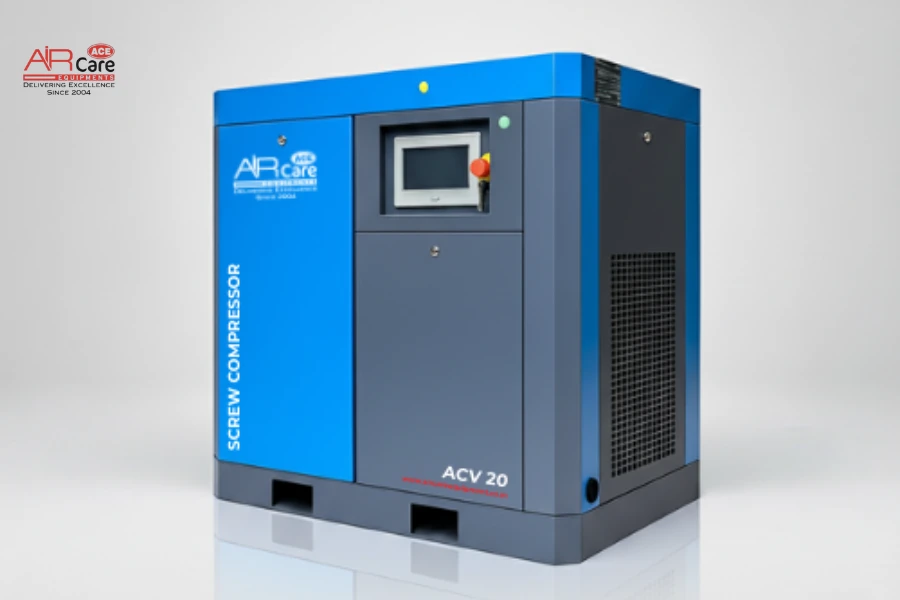
A Screw Type Air Compressor is a rotary compressor designed to provide a continuous supply of compressed air for industrial and commercial applications. Unlike a reciprocating compressor that uses pistons, a screw compressor uses rotating screw elements to compress air. Because of its continuous operation and consistent airflow, it is widely used in manufacturing, automotive, engineering, pharmaceutical, packaging, and other industries.
Understanding the working principle and applications of this compressor can help businesses select the right compressed-air solution for their specific requirements.
What Is a Screw Type Air Compressor?
A Screw Type Air Compressor uses two interlocking helical rotors to compress atmospheric air. As the rotors rotate, air is drawn into the compression chamber and trapped between the rotor profiles. The volume of the trapped air gradually decreases as it moves through the rotors, increasing its pressure before it is discharged from the compressor.
Screw compressors are commonly available in oil-injected and oil-free configurations. The appropriate type depends on the required air quality, pressure, airflow, and industrial application.
Working Principle of a Screw Type Air Compressor
The working process of a screw compressor can be explained through four basic stages.
1. Air Intake
Atmospheric air enters the compressor through an intake valve and air filter. The filter helps prevent dust and other particles from entering the compression system.
2. Air Compression
The filtered air enters the space between the rotating screw elements. As the rotors turn, the air becomes trapped and is gradually compressed as the available volume decreases.
This continuous rotary movement allows the compressor to produce compressed air without the repeated intake and discharge strokes associated with a Piston Air Compressor.
3. Cooling and Separation
In oil-injected screw compressors, oil is introduced into the compression chamber. It helps lubricate moving components, reduce heat, and improve sealing between the rotors.
After compression, the oil is separated from the compressed air using a separation system. The separated oil can then be returned to the compressor circuit.
Oil-free screw compressors use a different compression arrangement designed to prevent oil from entering the compression chamber.
4. Compressed Air Discharge
After compression and treatment, the compressed air leaves the compressor and enters the downstream air system. Depending on the application, additional equipment such as air receivers, filters, and dryers may be installed before the air reaches production equipment.
Main Types of Screw Compressors
Oil-Injected Screw Compressor
Oil-injected compressors use oil during compression for lubrication, cooling, and sealing. They are commonly used in general industrial applications where the compressed-air quality requirements allow the use of an oil-injected system.
Oil-Free Screw Compressor
Oil-free air compressors are designed to produce compressed air without oil entering the compression chamber. They can be considered for applications where highly controlled air purity is important.
Industries with sensitive production processes may require oil-free technology depending on their specific standards and air-quality requirements.
Screw Compressor vs Piston Air Compressor
Both screw and piston compressors are used for producing compressed air, but their operating principles are different.
A Piston Air Compressor uses reciprocating pistons that move inside cylinders to compress air. A screw compressor uses continuous rotary motion between screw elements.
Screw compressors are generally well suited to applications requiring continuous airflow and extended operating periods. Piston compressors can be appropriate for intermittent operation, smaller applications, or situations where a different pressure and capacity combination is required.
The right choice depends on airflow, pressure, duty cycle, operating hours, and application requirements.
Applications of Screw Type Air Compressors
Screw compressors are widely used across industrial and commercial sectors.
Manufacturing
Manufacturing facilities use compressed air for pneumatic tools, automation systems, machinery, cleaning, and production processes. A continuous supply can support efficient operation of automated equipment.
Automotive Industry
Automotive manufacturing and workshops use compressed air for pneumatic tools, assembly equipment, painting, cleaning, and other processes.
Packaging
Packaging machines often require compressed air to operate cylinders, actuators, valves, and automated systems. Screw compressors can provide the continuous airflow required by production lines.
Pharmaceutical Industry
Pharmaceutical facilities can require carefully controlled compressed-air quality for certain processes. Depending on the application, oil-free screw compressor technology may be considered.
Food Processing
Compressed air can be used for automation, packaging, conveying, and other production operations. Air quality requirements should be evaluated carefully before selecting the compressor.
Textile Industry
Textile machinery can use compressed air for automation, cleaning, pneumatic controls, and other production functions.
High-Pressure Applications
High Pressure Air Compressors are designed for applications that require higher-than-standard compressed-air pressures.
A screw compressor can be suitable for certain high-pressure applications, but the exact compressor specification must match the required working pressure and airflow.
When selecting equipment for high-pressure use, consider:
- Required pressure
- Airflow
- Operating hours
- Cooling requirements
- Air quality
- Safety requirements
- Maintenance requirements
The compressor should always be selected according to the manufacturer's rated operating range.
Medical Air Applications
A Medical Air Compressor is used to supply compressed air for healthcare-related applications. Medical compressed air has specific quality and reliability requirements that can differ significantly from general industrial applications.
Healthcare facilities may require specialised compressor systems, filtration, drying, monitoring, and backup arrangements depending on their application and applicable standards.
A standard industrial compressor should not be assumed to be suitable for medical air without confirming the required specifications and standards.
How to Select a Screw Type Air Compressor
Before purchasing a compressor, businesses should evaluate several factors:
- Required airflow
- Working pressure
- Operating hours
- Duty cycle
- Air-quality requirements
- Installation environment
- Energy efficiency
- Maintenance requirements
- Future production needs
Correct sizing is particularly important. An undersized compressor may struggle to meet demand, while an unnecessarily oversized system can increase energy and installation costs.
Why Choose Air Care Equipment?
Choosing a suitable compressor requires an understanding of the application's pressure, airflow, air-quality, and operating requirements. Air Care Equipment provides industrial compressed-air solutions for different applications and production environments.
By evaluating the complete compressed-air requirement before purchasing equipment, businesses can select a solution that supports reliable performance and efficient operation.
Conclusion
A Screw Type Air Compressor works by using rotating screw elements to continuously compress air. Its smooth rotary operation and ability to provide consistent airflow make it suitable for many industrial applications.
From manufacturing and automotive operations to packaging, textiles, pharmaceuticals, and specialised applications, screw compressors can support a wide range of compressed-air requirements. However, the correct model should always be selected according to airflow, pressure, air quality, operating conditions, and duty cycle.
Understanding the working principle and application requirements is the first step toward selecting the right compressor for reliable and efficient compressed-air production.























Sign in to leave a comment.