

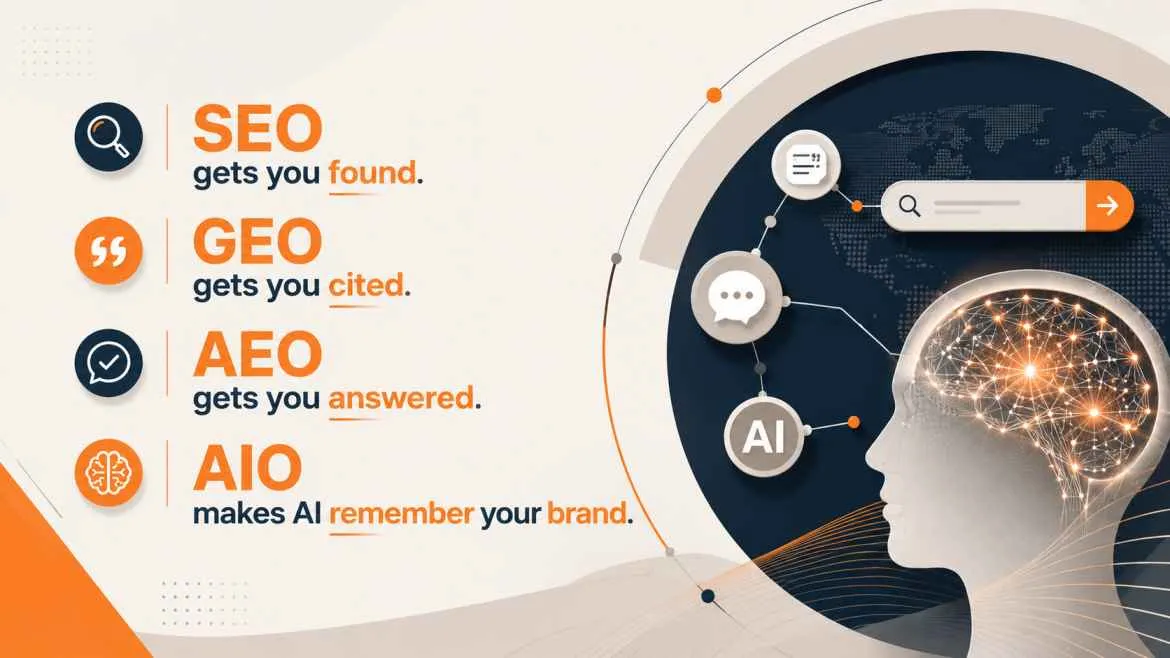
While ranking on Google is still important, it’s only one part of modern search.
Now brands compete for exposure across search engines, AI platforms, response engines and voice interfaces. Each environment uses various retrieval methods and ranking signals, and hence a single optimization strategy cannot cover all discovery channels.
This is where SEO, GEO, AEO, and AIO come into play. Each is a different part of search exposure, from classic rankings to AI citations to direct answers.
This guide is a breakdown of the differences between the four tactics, where each fits, and how they work in concert to keep your business visible across today’s search environment.
What Is SEO, GEO, AEO, and AIO?
Each solves a separate problem of visibility. Together they help your brand appear in Google search, AI tools and answer-first search experiences.
What is SEO?
Search Engine Optimization (SEO) helps your website rank higher on search engines such as Google and Bing. The idea is simple: help visitors find your pages more easily when they search for topics connected to your business. This includes everything from technical performance and keyword analysis to useful content, internal linkages, backlinks, and a good user experience.
For example, if a user searches for “best CRM software for small businesses,” good SEO will give your page a better chance of appearing in Google’s organic results.
What is GEO?
Generative Engine Optimization (GEO) helps AI systems grasp your information so well that they can use it in their answers. GEO is not only about ranking, but it’s about building authority around your themes, producing complete and trustworthy material, and providing AI systems with enough context to reference your brand with confidence.
For example, if a user asks ChatGPT, “Which CRM platforms are good for growing SaaS companies?” ChatGPT will respond with something like this: The stronger the GEO, the more likely your brand will be featured in the answer.
What is AEO?
Answer Engine Optimization (AEO) helps your content appear where users want a quick answer, not a list of links. That is, Google’s AI Overviews, highlighted snippets, voice assistants, and similar answer-first experiences.
For example, someone searching “What is customer lifetime value?” AEO makes your definition the first thing people see in the answer.
What is AIO?
AI Optimization (AIO) boosts the signals AI systems utilize to learn about your brand. It relies on consistent messaging, trustworthy authorship, trusted mentions, topical authority, and well-organized material, so AI models have more confidence in what they know about your organization.
Your organization produces expert articles and is featured by recognized industry websites, is active on LinkedIn and says the same thing on every channel. Over time, those signals add up, and your credibility increases, so AI systems are more likely to identify your expertise when generating replies.
Also Read: Entity SEO: The Future of Ranking in AI Search
How SEO, GEO, AEO, and AIO Compare
These four strategies support the same goal: helping people find your business. The difference lies in where your content appears, how platforms process it, and what success looks like.
| Factor | SEO | GEO | AEO | AIO |
| Primary Goal | Rank in search engines | Get cited by AI | Become the direct answer | Build AI-recognized authority |
| Target Platform | Google, Bing | ChatGPT, Gemini, Perplexity, Claude | AI Overviews, Featured Snippets, Voice Search | AI ecosystems across the web |
| Optimization Focus | Keywords, technical SEO, backlinks | Entity authority, semantic relevance, citations | Question-answer format, structured data | Brand authority, entity signals, expert content |
| Success Metric | Rankings, traffic, CTR | AI citations, prompt coverage | Answer placements, featured snippets | Brand recognition, AI visibility, branded demand |
When Should You Use Each Strategy?
Every business needs all four tactics, but which one takes precedence depending on your goals, audience, and stage of growth.
When SEO needs to be your focus
If organic search is driving a big percentage of your traffic or lead creation, SEO should get the most focus. It also provides the basis for all other optimization strategies as AI systems still depend on high-quality online content.
When GEO has the largest impact
Use GEO when your audience uses AI tools for research, product discovery, and vendor evaluation. The ones who gain the most from greater AI awareness are usually B2B corporations, SaaS brands, consultants, agencies and tech firms.
When is AEO the right choice
AEO is great for firms that answer common consumer queries. Health care providers, financial enterprises, legal practices, education platforms and local service businesses will get more awareness by offering precise and structured replies.
When AIO is critical
When brand authority matters in purchasing decisions, AIO should be on your strategy list. Companies that invest in thought leadership, executive branding, digital PR, unique research, and expert content build higher trust signals for both users and AI systems.
Must Read: LLM SEO Content Template for Startups
How to Build a Search Strategy That Covers All Four
SEO, GEO, AEO, and AIO are not independent tactics. They are ideally suited to each other. Each one boosts a different area of your online visibility, but they all rely on the same fundamentals, which are good content, true knowledge, and a brand people trust.
- Technical SEO and Strong Content
Your website should be fast, remain crawlable, and have a logical structure. If search engines and AI systems can’t access or understand your content, it will be more difficult to rank, regardless of how good the information is.
Pro Tip: Before you invest effort in AI-focused optimization, check your Core Web Vitals, internal linking, and index coverage.
- Make Your Content Easy to Extract Answers From
People don't follow links anymore. A lot of search engines show you the answers right there on the results page. Help them with question-focused headlines, concise definitions, comparison tables, FAQs, and a clear content flow.
Pro Tip: Below each H2, answer the primary question in 1–2 words. Then explain it more.
- Build Clear Domain Knowledge
AI systems work to understand what your brand is all about. That’s easier with consistent terminology, reliable authors, structured data, and mentions from trusted sources. The clearer your competence, the greater your authority.
Pro Tip: Stay within a defined specialty. On linked issues, publication builds more authority than covering one subject in full.
- Topics Over Keywords
Today, publishing one page for each keyword hardly works any more. Instead, create a cluster of connected articles that all focus on a central theme. Answer typical questions, cover multiple views, and link those pages internally.
Pro Tip: Consider your core topic as a pillar. Support it with guidelines, case studies, comparisons, FAQs, and industry insights.
- Share content that is somewhat interesting
AI platforms tend to cite content that adds value, rather than replicating what is already online. Your content becomes more useful and more likely to be cited through original research, novel frameworks, client tales, expert opinion, and first-hand experience.
Pro Tip: Add original facts, actionable insights or real-world examples that you don’t find in every other post.
- Stay Consistent with Your Brand Message Everywhere
Your website, LinkedIn profile, author profiles, guest articles, podcasts, newsletters and media mentions should all be telling the same message. A clear message helps search engines and AI systems comprehend what you’re about.
Pro Tip: Make sure your positioning, service descriptions and key messaging are consistent across all platforms your business appears on.
The Future of Search Isn't One Strategy
Search is not traveling in one direction. Traditional search, AI search, answer engines and conversational AI all impact the same consumer journey today. A potential client may find your website on Google, compare solutions on ChatGPT, verify your credibility on LinkedIn and then come back via a branded search before reaching out to you.
That's why SEO, GEO, AEO, and AIO need to work together. SEO helps people discover your content. AEO answers their inquiries. GEO can boost your chances of getting AI citations. AIO adds authority signals to all three. Together they build a search strategy tailored to how people search today.
Businesses that blend these disciplines, instead of viewing them as distinct efforts, will create more visibility throughout the entire consumer journey.
How Brand Pro Max Builds Future-Ready Search Strategies
Today, search is more than Google. Your brand needs visibility on search engines, AI platforms, and answer engines.
Brand Pro Max is a combination of SEO, GEO, AEO, and AIO. We build technical SEO foundations, develop topical authority, optimize content for AI retrieval, and increase entity recognition across the web.
The result? More visibility, more opportunities to be cited by AI and a search strategy that delivers qualified visitors, branded demand and business success.
Ready to future-proof your search? Get a free strategy call with Brand Pro Max to boost visibility across Google and AI search.



























Sign in to leave a comment.