
When marketing leaders sit down to allocate budget, one question comes up again and again: Should we invest more in SEO or double down on SEM? Both channels can deliver measurable returns, but they operate differently, scale differently, and influence revenue in unique ways. The real key isn’t choosing one over the other—it’s understanding how each contributes to ROI and aligning your strategy with your business goals.
Let’s break this down in a practical, no-jargon way so you can confidently decide where your next marketing dollar should go.
Understanding SEO and SEM in Simple Terms
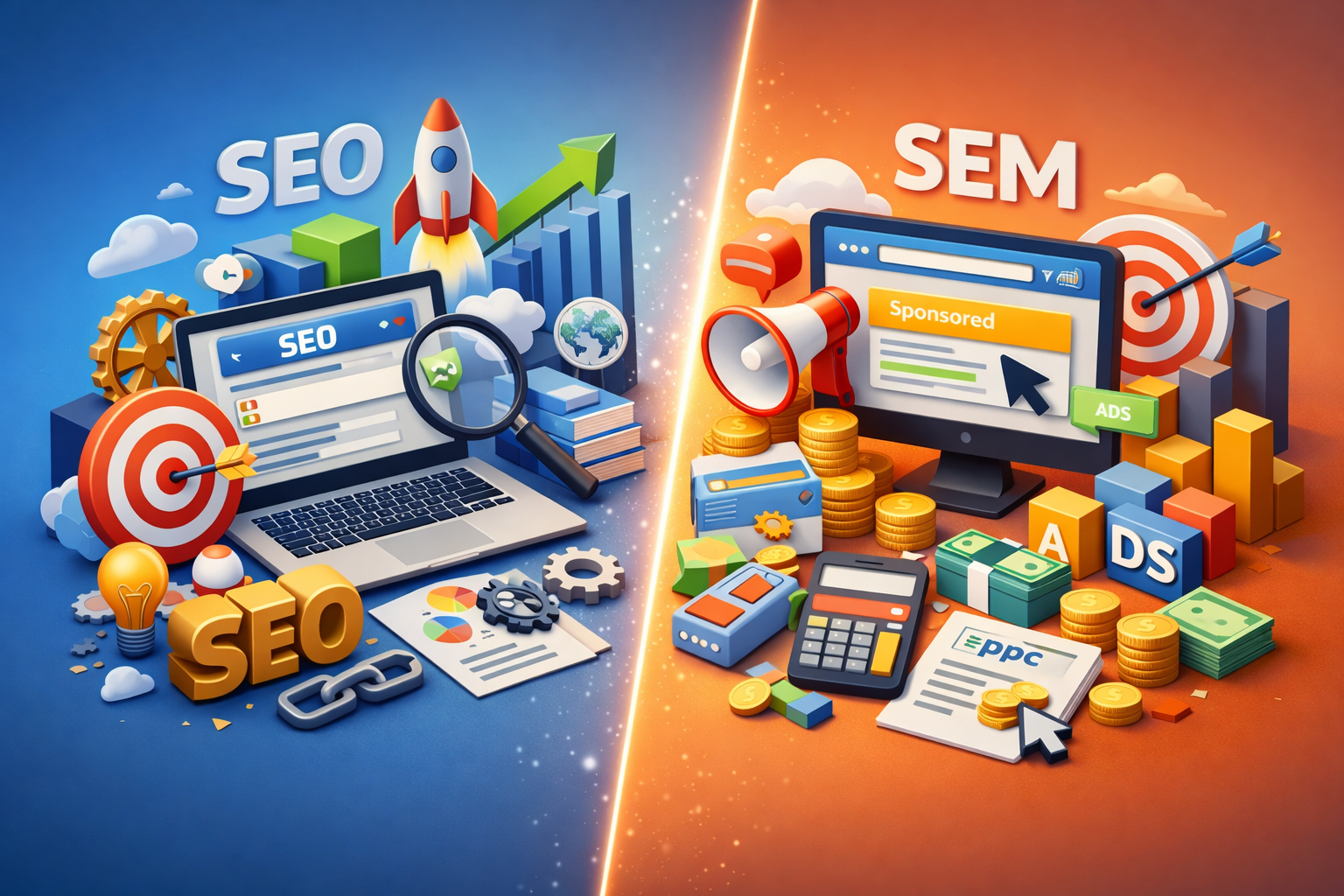
Search Engine Optimization (SEO) focuses on improving your website so it ranks higher in organic search results. You’re not paying for clicks. Instead, you invest in content creation, technical improvements, user experience, and authority building to earn visibility naturally.
Search Engine Marketing (SEM) refers to paid search advertising. You bid on keywords, pay for each click, and appear in sponsored search results. SEM allows you to get in front of potential customers almost instantly.
While both channels aim to increase visibility and conversions, they differ in speed, cost structure, and long-term sustainability.
How ROI Works in SEO vs. SEM
Return on investment is typically measured as:
ROI = (Revenue – Cost) ÷ Cost
The challenge with comparing SEO and SEM is that their cost patterns are very different.
- SEO usually requires upfront investment and ongoing maintenance.
- SEM involves continuous spend tied directly to traffic volume.
Because of this, ROI timelines can look very different between the two.
When SEM Delivers Strong ROI
SEM can generate results quickly, making it ideal for businesses that need immediate traction. If your website converts well and you have a clear understanding of your audience, paid search can drive consistent leads and revenue.
SEM tends to perform best when:
- You need fast visibility
- Your offer is clear and competitive
- Your landing pages are optimized for conversion
- You can accurately track performance metrics
For example, if you’re launching a new product or targeting high-intent keywords like “buy,” “pricing,” or “near me,” SEM allows you to reach ready-to-purchase customers without waiting for organic rankings to develop.
The main limitation is cost. As competition increases, cost-per-click rises. If your margins are thin or your conversion rates are low, SEM profitability can shrink quickly.
When SEO Provides Better Long-Term ROI
SEO is a longer-term strategy, but it often delivers more sustainable returns. Once your pages rank well, you can continue attracting traffic without paying for every click. Over time, this can reduce your average customer acquisition cost.
SEO tends to produce strong ROI when:
- Your business benefits from educational content
- You can build authority within your niche
- You consistently publish high-quality resources
- Your website provides strong user experience
While SEO may take months to gain traction, it creates compounding benefits. One well-optimized article can generate traffic for years, especially when supported by internal linking and regular updates.
Comparing SEO and SEM Through a Practical Example
Imagine your business sells a service with a strong profit margin. If you run SEM campaigns and pay for clicks, your profitability depends on how efficiently you convert visitors into customers.
On the other hand, if SEO efforts help your content rank organically, you may see traffic grow without ongoing per-click costs. Although SEO requires ongoing investment in content and optimization, the long-term cost per lead often decreases as your authority strengthens.
The difference ultimately comes down to speed versus sustainability:
- SEM produces faster results but requires ongoing spend.
- SEO builds value gradually but offers long-term stability.
Key Factors That Influence ROI
Several variables impact how well SEO or SEM performs for your business:
1. Industry Competition
Highly competitive industries often see higher ad costs, which can make SEM more expensive. SEO may also be challenging but can offer better returns over time if you establish expertise.
2. Sales Cycle Length
Businesses with longer decision-making processes benefit more from SEO content that educates and nurtures prospects. SEM is particularly effective for short purchase cycles.
3. Budget Flexibility
If your budget allows for sustained paid advertising, SEM can drive consistent growth. If budget stability is a concern, investing in SEO may provide better long-term efficiency.
4. Tracking and Analytics
Both channels depend on strong tracking systems. Without accurate measurement, it’s difficult to optimize campaigns or understand true ROI.
Why Combining SEO and SEM Often Delivers the Best Results
The most effective digital marketing strategies rarely rely on just one channel. SEO and SEM can complement each other in powerful ways.
SEM provides quick insights into keyword performance, helping marketers understand what resonates with audiences. These insights can then inform SEO content strategies.
Meanwhile, SEO builds credibility and authority, making paid campaigns more effective by reinforcing brand trust.
Using both channels together allows businesses to:
- Capture immediate demand through paid ads
- Build long-term visibility through organic search
- Test messaging quickly
- Reduce reliance on any single source of traffic
Final Thoughts: Which Channel Drives Better ROI?
There isn’t a universal answer because ROI depends on your business model, goals, and execution quality.
If your priority is immediate results and you have strong conversion systems in place, SEM can deliver faster returns. If your focus is sustainable growth and long-term efficiency, SEO often provides greater value over time.
The smartest approach is to view SEO and SEM not as competitors, but as partners. When aligned strategically, they create a balanced digital marketing engine that drives both short-term wins and lasting success.
By understanding your audience, tracking performance carefully, and investing consistently, you can turn both SEO and SEM into powerful drivers of measurable ROI.

























Sign in to leave a comment.