In the fast-paced and competitive world of digital marketing, search engine optimization (SEO) acts as one of the most critical levers for generating traffic and visibility online. Businesses, bloggers, and agencies all strive for a prominent position on search engine results pages (SERPs). One of the factors that often gets debated is keyword density—the frequency with which specific keywords appear within a piece of content. While keywords are essential to help search engines understand the subject matter of a page, overloading content with them—a practice known as keyword stuffing—has the opposite effect.
This is where tools like the SERPninja Keyword Density Checker step in to strike the right balance. They provide clarity on whether your content is optimized or over-optimized so that you can achieve a perfect middle ground: readability for users and relevance for search engines.
In this comprehensive article, we will cover the following:
- The significance of keyword density in SEO
- The real risks of keyword stuffing
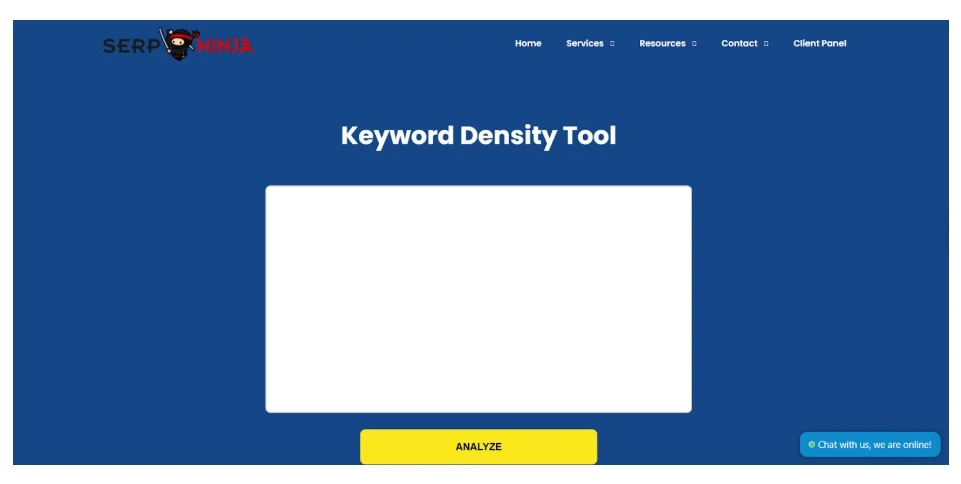
- An overview of the SERPninja Keyword Density Checker
- Key features and benefits of using this tool
- Practical steps to avoid keyword stuffing
- How to integrate keyword density analysis into your broader SEO strategy
- Future-proofing content with semantic SEO and natural language
Word by word, let’s dig into how you can transform your keyword strategy with tools like SERPninja’s checker.
Understanding Keyword Density
Keyword density refers to the percentage of times a target keyword appears in a piece of content relative to the total word count. For example, if a 1,000-word article uses the keyword “email marketing” ten times, the keyword density is 1%.
The simple formula is:
Keyword Density (%) = (Number of keyword occurrences / Total word count) × 100
In the early 2000s, when search algorithms were less advanced, keyword density was often manipulated to boost rankings—you could insert a keyword as many times as possible and secure higher visibility. However, modern algorithms by Google, Bing, and other search platforms rely on far more sophisticated semantic analysis, user intent, and contextual quality measures. Today, obsessing over keyword density alone can backfire.
The Dangers of Keyword Stuffing
Keyword stuffing means placing a keyword excessively in the text to trick search engines into thinking a page is highly relevant to a search query. This practice may include:
- Repeating a keyword unnaturally in multiple sentences
- Forcing keywords into meta tags, footers, or hidden text
- Overuse in headings or subheadings
The consequences of keyword stuffing include:
- Poor User Experience: Content becomes difficult to read. Readers may bounce quickly if they sense your article exists purely for manipulation rather than information.
- Search Engine Penalties: Google’s algorithms, particularly its Panda and Hummingbird updates, target keyword stuffing and devalue pages that rely on it.
- Reduced Conversion Rates: Even if traffic comes in, poorly written content rarely converts because users don’t find real value.
- Brand Reputational Damage: A site that publishes obvious keyword-stuffed content appears untrustworthy or spammy.
The solution is balance. It’s about integrating keywords naturally and ensuring that user intent drives the content strategy more than keyword repetition.
Enter the SERPninja Keyword Density Checker
The SERPninja Keyword Density Checker was designed to provide marketers, SEO professionals, and writers with insights into how keywords are distributed across their content. Rather than guess whether you are overusing or underusing keywords, this tool computes density percentages and reports in a clean, actionable manner.
What the tool does:
- Scans content: It analyzes your content, counting how many times each keyword occurs.
- Calculates density: It translates this into a percentage relative to the entire word count.
- Identifies problem areas: High-density keywords are flagged so you can revise them.
- Suggests balance: It provides guidance on ideal keyword appearances without overstuffing.
By turning subjective judgments into measurable data, the SERPninja Keyword Density Checker helps you maintain SEO-friendly, user-focused content.
Features of the SERPninja Keyword Density Checker
Accurate Keyword Frequency Analysis
The tool detects single keywords, two-word phrases, and longer keyword clusters. This is crucial in the modern SEO environment where long-tail and phrase-based targeting are equally important.
Customizable Reports
Marketers can adjust reports to focus only on specific keyword sets or analyze all present keywords to spot unexpected ones showing up.
Integration with Content Strategy
Results are easy to export for collaboration with writers, editors, or agency partners. This prevents multiple entries of the same keyword across different sections.
Easy-to-Use Interface
Designed for both technical SEOs and content creators, the interface is clean and intuitive, avoiding unnecessary complexity.
Readability Safeguards
Beyond density, SERPninja encourages proper on-page SEO by reminding users to prioritize context and user intent over keyword stuffing.
How to Use SERPninja to Avoid Keyword Stuffing
Using the keyword density checker effectively requires more than pasting content and reading a score. Here’s a strategic process to maximize its benefits:
1. Start with Audience-Centric Content
Before worrying about density, create content that genuinely serves your audience. Answer questions, solve problems, and enrich the reader’s understanding. Keyword density then becomes a check, not the main purpose.
2. Run the Content Through the Checker
Paste your draft into the tool and allow it to analyze. You’ll see a list of top keywords and phrases along with their respective percentages.
3. Identify Overuse Patterns
Spot percentages that seem unnaturally high (e.g., a keyword appearing 5-8% of the time in a 1,000-word article). This indicates the risk of keyword stuffing.
4. Revise for Natural Flow
Replace some repetitions with synonyms, pronouns, or semantically related terms. Instead of forcing the exact phrase repeatedly, use variations that sound natural to the reader.
5. Balance Primary and Secondary Keywords
SERPninja allows you to observe how secondary keywords are under- or overused. By balancing them, you create diversified signals of relevance for search engines.
6. Re-run Analysis
After adjustments, run the text through the tool again. This iterative process ensures you have reduced stuffing without losing keyword focus.
Ideal Keyword Density: Is There a Magic Number?
Many SEO experts suggest keeping keyword density between 1-2% for primary keywords. However, the truth is that no universal "magic number" guarantees ranking. What matters more is natural flow and semantic context. Google’s algorithms evaluate surrounding text, synonyms, and user intent, rather than focusing solely on density percentages.
For instance, if your keyword is “healthy diet plan”, repeating it five times in 1,000 words might be enough, but enriching the context with related terms like nutrition, balanced meals, weight management, or dietary habits improves ranking potential.
The Role of LSI and Semantic SEO
Modern SEO has shifted from pure keyword targeting to understanding latent semantic indexing (LSI) and semantic SEO. Engines map related terms and build topic understanding rather than relying on one keyword.
This means that instead of just aiming for density, you should diversify language. This is where keyword density tools, like SERPninja, provide guidance—they help you avoid overstuffing and ensure you have variety in the way content is expressed.
Practical Strategies to Avoid Keyword Stuffing
Use Synonyms and Variations
Instead of repeating “best running shoes,” try “top sneakers for athletes” or “high-performance footwear.”
Answer Questions
Include long-tail keyword variations by writing FAQs. These improve natural usage of phrases while enhancing the value of your content.
Focus on Readability
Write as if you are explaining a concept to a friend. If a sentence sounds robotic due to keyword repetition, rewrite it.
Optimize Headers and Subheaders
Place keywords selectively in H2 or H3 headings instead of repeating them relentlessly in the body.
Leverage Multimedia Elements
Add keywords subtly in alt text for images, captions, and video descriptions. But avoid stuffing them into every file.
Benefits of Using SERPninja Keyword Density Checker
- Improved Content Quality: Balanced content flows smoothly and resonates with both search engines and human readers.
- Higher Rankings Over Time: Avoids penalties by aligning content with SEO best practices.
- Saves Time for Editors and SEO Managers: Provides instant clarity on keyword distribution without manual counting.
- Consistency Across Teams: Agencies and businesses with multiple writers can ensure content teams use a common standard.
- Support for Long-Term SEO Health: Rather than gaming the system, SERPninja promotes sustainable optimization strategies.
Incorporating Keyword Density into a Broader SEO Strategy
Keyword density is just one part of on-page SEO. To achieve holistic results:
- Keyword Research: Use SERPninja’s density insights alongside research tools to target what your audience is searching for.
- Content Depth: Ensure your article addresses related subtopics, not just the main keyword.
- User Intent Alignment: Write for informational, navigational, or transactional intent depending on the keyword.
- Technical SEO Harmony: Optimize page load speed, metadata, and schema to supplement keyword efforts.
- Link Building and Authority: Combine balanced content with backlinks to improve authority signals.
Future of Keyword Density and Content Optimization
As AI-powered search (like Google’s Search Generative Experience and other large language models) becomes more prevalent, keyword density, while still relevant, will be less of a ranking factor. Search will focus more on:
- Topic coverage rather than density
- User engagement signals (click-through, dwell time, bounce rate)
- Expertise, Authoritativeness, and Trustworthiness (E-A-T)
Still, keyword density checkers like SERPninja remain an essential calibrator—helping avoid glaring overuse while freeing creators to focus on depth and intent.
Final Thoughts
Keyword density is not about hitting a rigid percentage—it’s about ensuring balance, natural usage, and harmony with modern SEO principles. Tools like the SERPninja Keyword Density Checker empower writers, SEOs, and marketers by preventing keyword stuffing and creating content that resonates with both readers and algorithms.
Instead of fearing penalties or guessing the “right number,” content creators can rely on automated analysis to highlight overuse and guide revisions. Coupled with semantic SEO and a strong content strategy, avoiding keyword stuffing becomes second nature.
With the help of such tools, businesses and bloggers can spend less time counting keywords and more time producing valuable, high-quality, and conversion-driven content. In today’s competitive environment, that is what truly sets top-ranking sites apart.























Sign in to leave a comment.