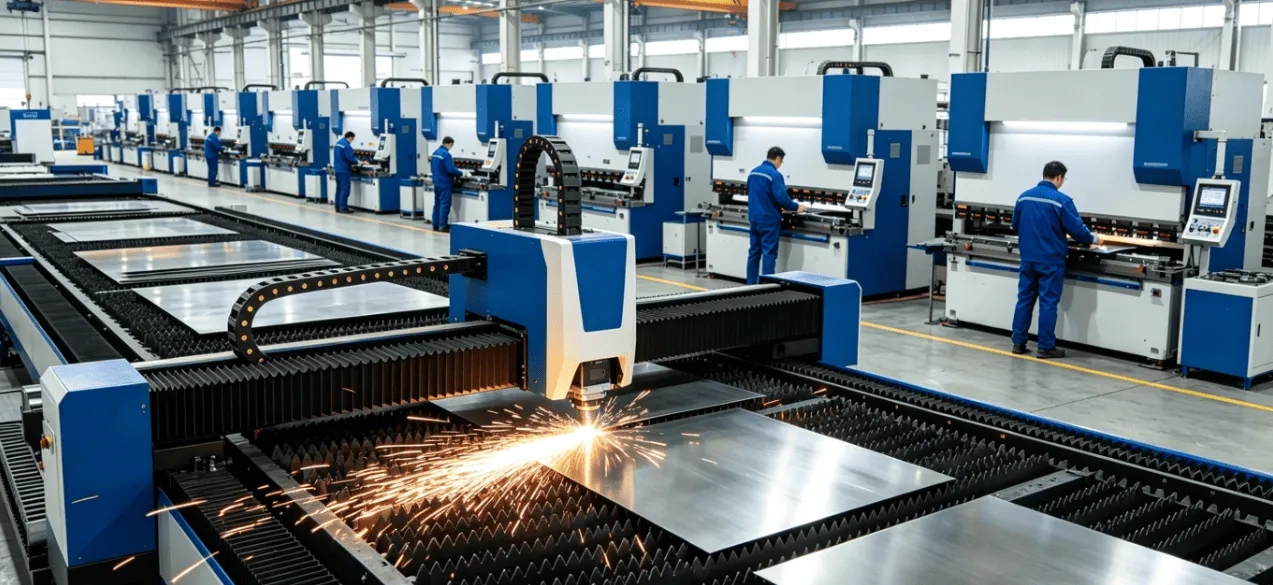

Sourcing precision sheet metal components requires a delicate balance between tool-up speed, geometric accuracy, and localized supply chain logistics. Industrial manufacturing data from 2026 demonstrates that implementing advanced nesting algorithms coupled with automated fiber laser cutting can optimize material utilization by up to 15% and slash production lead times in half. This comprehensive breakdown evaluates the critical mechanical tolerances, material verification standards, and design-for-manufacturability principles required to successfully navigate overseas manufacturing. This roadmap ensures your custom enclosures and brackets meet global engineering expectations without unexpected overhead costs.
1. Fiber Laser Cutting Dynamics and Edge Quality
Modern fabrication lines rely heavily on high-powered fiber lasers (typically 4kW to 12kW) to cut through carbon steel, stainless steel, and aluminum sheets.
The primary technical challenge during laser cutting is minimizing the heat-affected zone (HAZ), which can alter the mechanical properties of the metal edges and complicate subsequent bending or welding processes. High-tier facilities utilize nitrogen assist gases rather than oxygen when cutting stainless steel to prevent oxidation and ensure a clean, burr-free edge that is instantly ready for finishing. If you are sourcing complex geometries, partnering with an established provider ensures that micro-joints and nesting paths are optimized to eliminate component deformation. You can analyze how these advanced cutting parameters are integrated into full-scale production by visiting Baosheng Industry.
2. Press Brake Precision and Springback Compensation
Bending is where flat sheets transform into three-dimensional structural components, and it demands precise control over the material's elastic recovery, commonly known as springback.
Every metal alloy exhibits a unique springback factor based on its tensile strength and thickness. For instance, bending 5052 aluminum requires different over-bending angles than structural carbon steel to achieve a true 90-degree angle. Premium manufacturers utilize CNC press brakes equipped with real-time laser angle-measuring systems that automatically adjust the stroke depth during the bend cycle. When establishing your quality requirements for sheet metal fabrication in China, specifying linear and angular tolerances (such as ISO 2768-m) ensures the final parts align perfectly during final enclosure assembly.
3. Progressive Die Stamping vs. Flexible Laser-Punch Cells
Choosing between hard tooling and flexible CNC fabrication is the primary financial pivot point in sheet metal procurement.
Progressive die stamping requires a significant upfront investment in hard tooling but delivers incredibly low per-part costs and high repeatability for production runs exceeding 10,000 units. For low-to-medium volumes or prototyping, flexible turret punch presses and laser combination machines eliminate tooling costs entirely and allow for rapid design iterations. A common sourcing pitfall is choosing hard tooling too early in the product lifecycle; a qualified manufacturer will guide you through this transition, helping you utilize flexible prototyping methods until your design is fully frozen and validated.
4. Material Traceability and Mill Certification Standards
The structural integrity of a sheet metal part is entirely dependent on the quality of the raw sheet.
Lower-tier suppliers may substitute commercial-grade steels that suffer from inconsistent thickness variations or internal stresses, leading to unpredictable warping during laser cutting or stamping. Top-tier Chinese fabricators maintain strict material traceability protocols, providing mill test certificates (MTCs) that verify the chemical composition and mechanical properties of every batch of steel, aluminum, or brass. In 2026, verification of sheet thickness tolerances via precise mechanical checks is mandatory, as even a 0.1mm variance in a 2mm sheet can cause significant deviations in bending forces and final part dimensions.
5. Integrated Surface Finishing and Corrosion Protection
A complete sheet metal solution must extend beyond cutting and bending to encompass professional surface finishing.
Depending on the environment where the part will operate, finishes can range from standard powder coating and wet painting to specialized zinc plating, anodizing, or e-coating (electrophoretic deposition). Managing the finish under the same roof as the fabrication prevents the raw, unprotected metal from developing surface rust during transit between sub-contractors. Furthermore, experienced fabricators will adjust their blanking and bending dimensions to account for the exact coating thickness, ensuring that critical slide fits, threaded holes, and hinge mechanisms function flawlessly after the final protective layer is applied.
Conclusion
Successfully sourcing sheet metal components involves evaluating a manufacturer's technological infrastructure and quality control framework. By focusing on fiber laser edge quality, automated springback compensation, and verified material traceability, you protect your supply chain from costly assembly defects. Aligning your engineering specifications with a fabricator capable of executing both flexible prototyping and high-volume automated production is the most effective approach to achieving market-ready precision at an optimized cost structure.



























Sign in to leave a comment.