
Good tennis movement can make a noticeable difference in every part of your game. You can have a powerful serve and reliable groundstrokes, but if you cannot reach the ball in balance, your technique becomes harder to execute. Efficient movement helps you arrive at the right position, prepare your racket earlier, and recover quickly for the next shot.
The good news is that you do not need complicated equipment or hours of conditioning to improve your movement. A few focused tennis movement drills can help players develop quicker reactions, better balance, and more efficient court positioning. Whether you are a beginner learning the basics or an experienced player looking to sharpen your movement, these drills are easy to add to regular practice.
1. Split-Step and Hold Drill
The split step is one of the most important movements in tennis. It prepares your body to react in different directions as your opponent hits the ball.
Start near the center of the baseline with your feet approximately shoulder-width apart. Lightly bounce on the balls of your feet and perform a small split step. As your feet land, stay balanced with your knees slightly bent. Hold the position for a moment before returning to your normal stance.
Once the movement feels comfortable, have a partner point left, right, forward, or backward immediately after your split step. React in the indicated direction, then return to the starting position.
Focus on staying light rather than jumping high. The goal is to create a quick, athletic position that allows you to push toward the ball without losing balance.
2. Lateral Shuffle Drill
The lateral shuffle is a simple way to develop side-to-side movement, which is essential when covering the baseline.
Begin on one side of the court and shuffle sideways toward the other side. Keep your hips low, chest upright, and feet moving quickly. Try not to cross your feet while performing the basic version of the drill.
After reaching the opposite side, shuffle back to your starting point. Complete several repetitions while maintaining good posture.
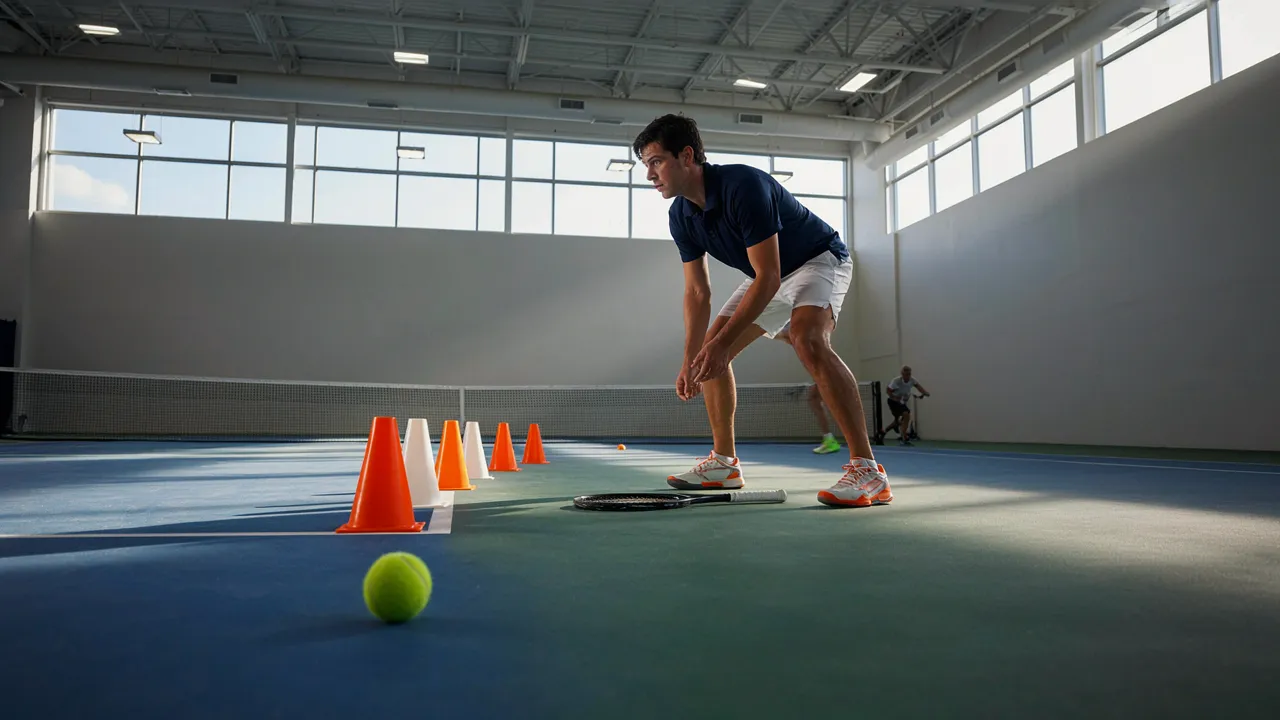
To make the drill more tennis-specific, place two cones several feet apart. Shuffle between them for 20–30 seconds, rest briefly, and repeat.
This is one of the most practical footwork exercises for tennis because it teaches players to stay balanced while moving laterally and changing direction.
3. Forward-and-Back Movement Drill
Tennis players do more than move from side to side. Balls can also pull you forward toward the service line or push you backward toward the baseline.
Place a cone near the baseline and another closer to the service line. Start at the baseline cone. Move forward using small, controlled steps toward the second cone. Touch or pass the cone, then quickly move backward to the starting point.
When moving backward, avoid turning completely around unless the drill specifically requires it. Tennis players often need to maintain awareness of the court and prepare for the next shot.
Keep the movements controlled at first. Speed should increase only after you can maintain balance and proper body position.
4. Four-Corner Reaction Drill
This drill combines movement, reaction, and recovery.
Set four cones around the court to represent different movement directions: forward, backward, left, and right. Begin in the middle. A coach or practice partner calls out one direction, and you move quickly toward that cone before returning to the center.
For an added challenge, have your partner call directions randomly rather than following a predictable pattern.
The key is to recover to the middle after every movement. In a real match, reaching one ball is only part of the job. You also need to prepare for what comes next.
These tennis footwork drills can help develop the reaction habits needed to transition efficiently between shots.
5. Crossover Recovery Drill
The crossover step becomes useful when you need to cover more distance quickly. Unlike a basic shuffle, the crossover allows you to travel farther while maintaining momentum.
Start near the center of the baseline. Move toward one side using crossover steps, then transition into smaller adjustment steps as you approach your target position. Once you reach the desired point, change direction and recover toward the center.
Start slowly so you can learn the movement pattern. Keep your eyes forward and avoid allowing your upper body to lean excessively.
This drill is especially useful for players who frequently find themselves reaching for wide balls. Better movement can help you arrive earlier and create a more balanced position for the shot.
6. Shadow Footwork With Recovery
You do not always need a ball or hitting partner to practice tennis movement. Shadow footwork allows you to rehearse common court patterns without actually hitting a shot.
Start at the center of the baseline. Imagine your opponent hits a ball to your forehand side. Move toward the imaginary ball, establish your hitting position, and then recover to the center. Repeat the pattern on the backhand side.
Next, add forward movement for a short ball. Move in, establish your position, then recover backward.
Perform each sequence slowly at first. Once the pattern becomes natural, increase the speed while keeping your movements controlled.
Shadow training is valuable because it allows you to focus entirely on positioning, foot placement, recovery, and balance.
Build Better Movement Through Consistency
Improving tennis movement is not about performing the fastest drill possible. Quality matters more than speed. If your feet become tangled, your posture breaks down, or you lose balance, slow the drill down and rebuild the movement pattern.
Try spending 10–15 minutes on footwork before a practice session. You could begin with split steps, continue with lateral shuffles, add forward-and-back movement, and finish with reaction or shadow drills.
As your movement improves, you may notice that you reach more balls comfortably and have more time to prepare your strokes. Good footwork can also help you recover between shots instead of being forced to stop and restart after every movement.
Most importantly, make your footwork practice consistent. A few focused sessions each week can be more useful than one demanding workout followed by several weeks without practice.
Strong tennis starts with getting into the right position. By adding these simple tennis movement drills, footwork exercises for tennis, and tennis footwork drills to your routine, you can build better balance, quicker reactions, and more efficient court coverage—one step at a time.























Sign in to leave a comment.