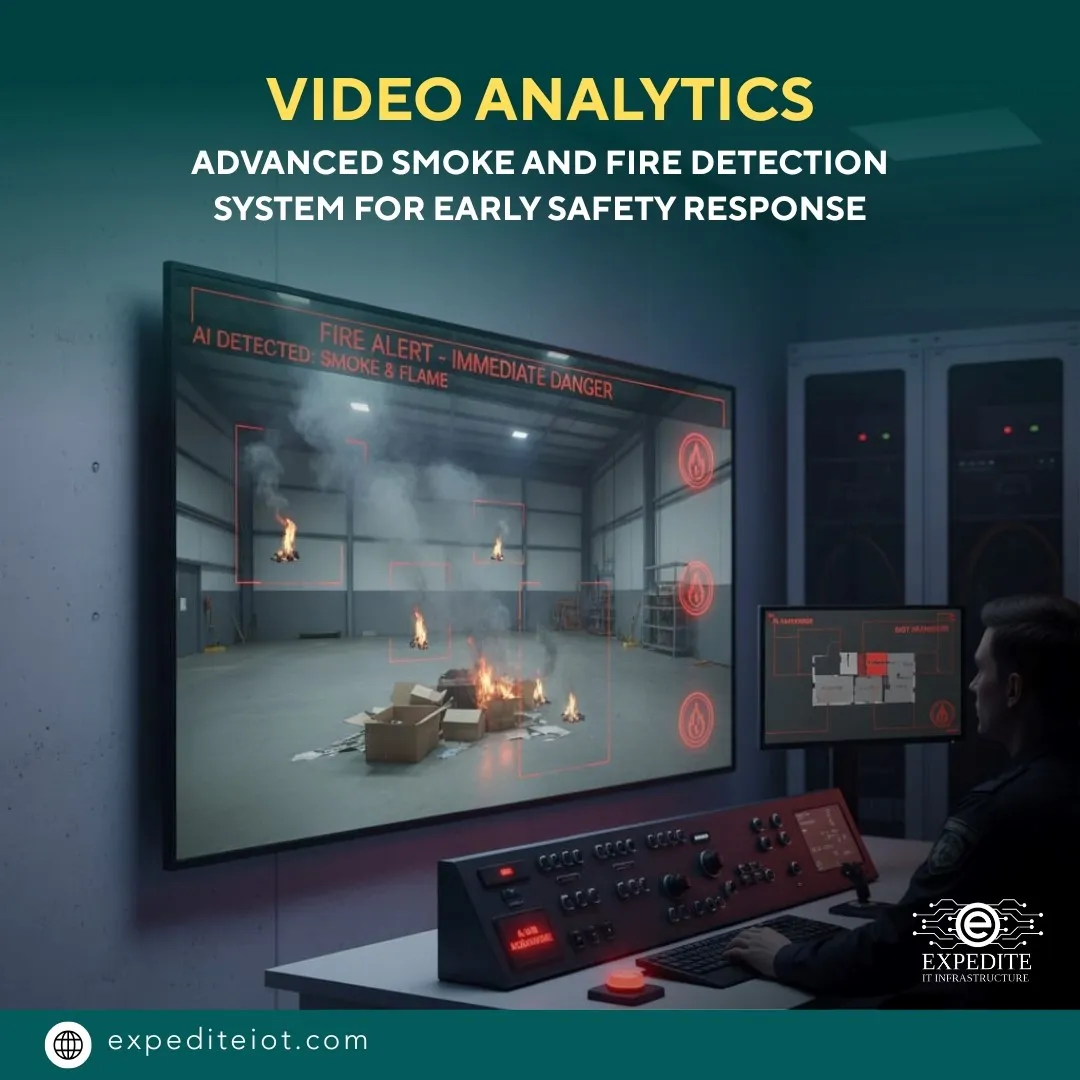

Video Analytics is fundamentally transforming the way fire and smoke hazards are detected, assessed, and responded to in Oman's most critical built environments. As conventional fire detection systems reach the limits of their technological capability, plagued by delayed alerts, high false alarm rates, and limited situational awareness, Video Analytics-powered fire and smoke detection platforms are emerging as the definitive next step for enterprises, government facilities, industrial complexes, and smart city infrastructure across the Sultanate.
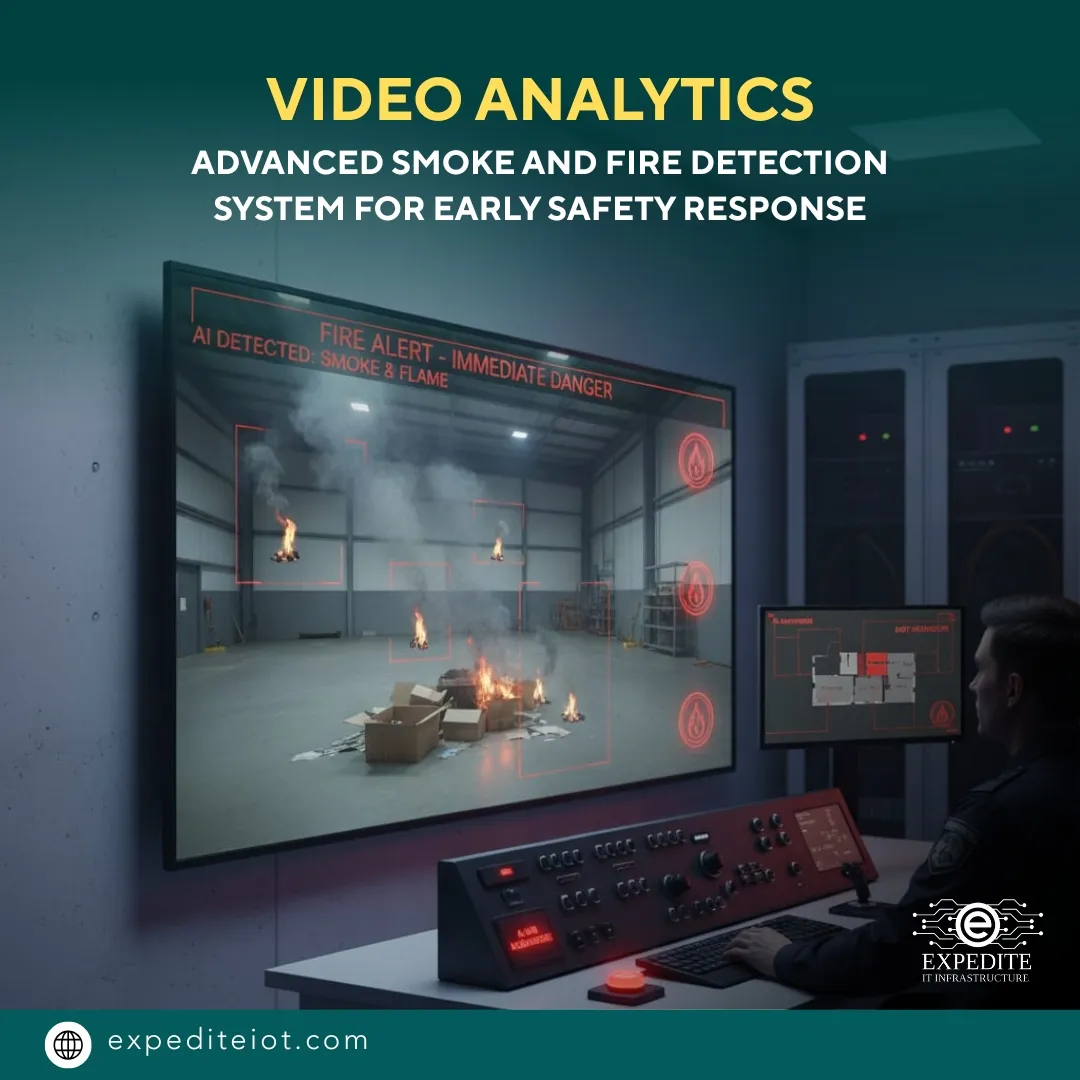
Unlike traditional point detectors that rely solely on heat or particulate thresholds, intelligent video-based fire detection continuously analyzes live camera feeds using deep-learning algorithms to identify the visual signatures of flame, smoke plumes, and pre-ignition thermal anomalies, delivering Real-Time Hazard Detection with sub-second response times that can mean the difference between a contained incident and a catastrophic loss of life or infrastructure.
The Limitations of Conventional Fire Detection in Oman's Built Environment
Oman's diverse built environment, spanning glass-facade commercial towers in Muscat's Al Khuwair district, petrochemical processing facilities in Sohar Industrial Port, logistics warehouses in the Salalah Free Zone, and heritage hospitality developments across the Hajar Mountains, presents fire detection challenges that conventional systems were never engineered to address.
Traditional ionization and photoelectric smoke detectors operate on simple threshold principles: when particulate density or temperature exceeds a preset level, an alarm trigger. This approach suffers from several fundamental limitations in Oman's operational environments:
- High False Alarm Frequency: Dust, steam, cooking fumes, and exhaust from industrial processes routinely trigger conventional detectors, desensitizing building occupants and security teams to alarm signals, a phenomenon known as alarm fatigue
- Detection Lag: Point detectors only alarm when hazardous conditions physically reach the sensor, by which time a fire may have already progressed beyond the incipient stage
- Limited Coverage in Large Spaces: High-bay warehouses, open-plan industrial halls, and atrium structures present detection gaps that conventional ceiling-mounted detectors cannot adequately cover
- Zero Situational Awareness: A conventional detector triggers a binary alarm signal, it provides no information about fire size, spread direction, proximity to occupants, or exit route viability
- Outdoor Inapplicability: External fuel storage areas, oil and gas processing zones, and open logistics yards cannot be protected by indoor-type conventional detectors
These limitations create measurable risk gaps, and Oman's Civil Defence and Ambulance Authority (CDAA) incident records consistently reflect that many of the country's most damaging fire incidents began in environments where conventional detection provided inadequate early warning.
AI-Powered Video Analytics: The Science Behind Intelligent Fire Detection
The breakthrough capability that distinguishes AI-Powered Video Analytics from both conventional fire detection and earlier generations of video motion analysis lies in its use of convolutional neural networks (CNNs) and deep learning models trained on millions of real-world fire and smoke event datasets. These models learn to recognize the precise visual characteristics of combustion, the flickering luminosity patterns of open flames, the billowing turbulence of smoke plumes, the specific color gradients of different fuel types burning, with accuracy and speed no human operator or rule-based algorithm can match.
How AI Fire Detection Works
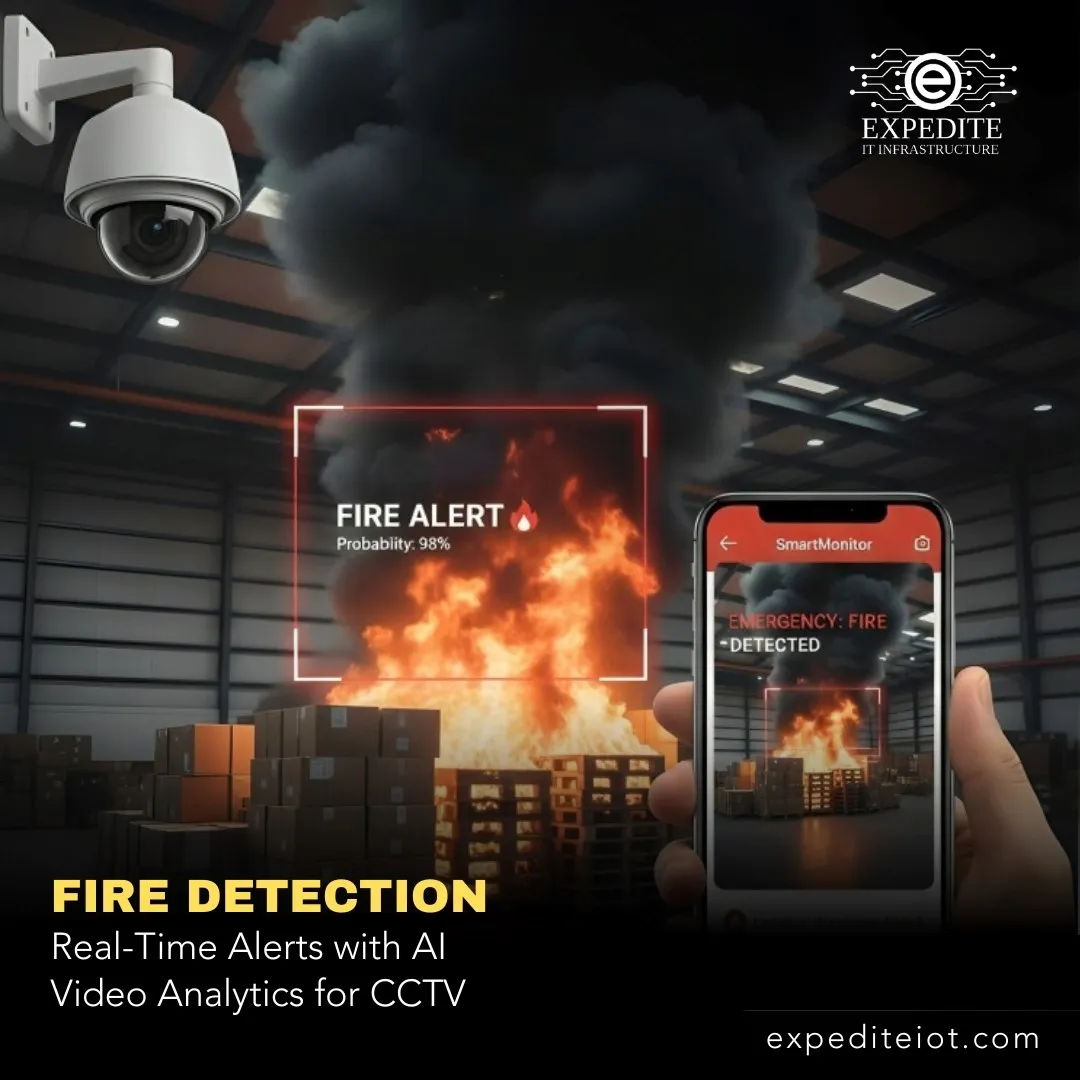
The AI-Powered Video Analytics engine processes every frame of every connected camera feed in real time. At each frame, the neural network evaluates hundreds of visual features simultaneously, pixel intensity distributions, temporal motion vectors, color channel ratios, and spatial pattern geometries, to calculate a confidence score for the presence of fire or smoke. When this confidence score exceeds the detection threshold (which is calibrated per-camera based on scene-specific risk profiles), an alert is generated and Automated Emergency Response protocols are triggered, all within a two-to-five-second detection window from first visible ignition.
Multi-Spectral and Thermal Camera Integration
Advanced deployments integrate visible-light cameras with thermal infrared cameras for multi-spectral fire detection. Thermal cameras detect anomalous heat signatures, including overheating electrical panels, smouldering insulation, and hot-work area flare-ups, that are invisible to visible-light cameras but represent critical early-stage fire precursors. This multi-spectral approach is particularly valuable in Oman's oil and gas, petrochemical, and heavy manufacturing sectors where thermal pre-ignition hazards are prevalent.
Video Analytics Software: Platform Architecture and Capabilities
The intelligence behind smart fire detection systems resides in the Video Analytics Software platform, the software layer that receives camera streams, executes AI inference, manages alert workflows, and coordinates with building management, fire suppression, and emergency communication systems. Selecting the right Video Analytics Software architecture is critical to achieving reliable, low-latency fire detection at scale.
Edge vs. Server-Side Processing
Modern Video Analytics Software platforms offer two primary processing architectures. Edge processing deploys AI inference directly on smart cameras or local edge servers, delivering sub-second detection latency and maintaining operation during WAN outages, essential for remote oil field locations and industrial facilities with unreliable connectivity. Server-side and cloud processing architectures centralize inference on high-performance GPU clusters, enabling more sophisticated multi-camera correlation, cross-site analytics, and centralized management, preferred for large urban deployments in Muscat and multi-building campus environments.
Core Platform Capabilities
- Multi-Camera Fire Event Correlation: Cross-referencing detections across adjacent cameras to confirm events, determine spread trajectories, and eliminate isolated false positives
- Zone-Based Risk Profiling: Per-camera sensitivity calibration based on the specific fire risk characteristics of each monitored area
- Alarm Verification Workflows: Automated verification sequences that confirm detections before escalating to emergency services, dramatically cutting Reduced False Alarms rates compared to conventional systems
- Video Clip Archiving: Automatic preservation of pre- and post-event video evidence for post-incident investigation and insurance documentation
- Integration APIs: Open REST and ONVIF interfaces for connection to BMS, PSIM, fire alarm panels, PA systems, and access control platforms
- Mobile Command Interface: Real-time alert notifications and live video access for security commanders and fire safety officers via iOS and Android applications
Video Analytics Solutions: Application Domains in Oman
The versatility of Video Analytics Solutions for fire and smoke detection extends across virtually every built environment category in Oman. Each sector brings distinct fire risk profiles, regulatory requirements, and operational constraints that shape the optimal detection architecture.
Oil, Gas, and Petrochemical Facilities
Oman's petroleum sector, anchored by Petroleum Development Oman (PDO), OQ (formerly Oman Oil Company), and a network of international operators, represents the most demanding environment for fire detection technology. Outdoor storage tank farms, pressurized gas processing trains, and flare stack zones require detection systems capable of identifying fast-spreading hydrocarbon fires in open-air, high-wind environments where conventional detectors are completely ineffective. Video Analytics Solutions equipped with multi-spectral cameras and specialized hydrocarbon flame recognition models provide the millisecond-speed detection that these extreme-consequence environments demand.
Logistics and Warehousing
High-bay automated storage and retrieval warehouses present extreme fire propagation risk, densely racked combustible goods, limited human visibility, and fast-spreading fire pathways through rack structures create scenarios where every second of detection delay translates to exponentially greater loss. Video analytics fire detection in warehouse environments provides wide-area coverage from elevated camera mounting positions, enabling detection of nascent smoke plumes before sprinkler activation thresholds are reached.
Hotels, Malls, and Hospitality Infrastructure
Oman's Vision 2040 tourism diversification strategy is driving rapid expansion of high-rise hotels, resort complexes, and entertainment destinations. In hospitality environments, Reduced False Alarms is as important a performance metric as detection speed, unnecessary evacuations in large public venues cause panic, injury, business disruption, and erosion of occupant trust in the fire safety system. AI-powered video fire detection dramatically reduces nuisance alarm rates compared to conventional systems by distinguishing actual smoke from steam, cooking vapors, dry ice effects, and dust, preserving the integrity and credibility of fire alarm signals.
Data Centers and Critical Infrastructure
Data centers house irreplaceable digital infrastructure whose destruction can cascade into operational, financial, and reputational catastrophe. Early-stage smoke detection,, before flames develop, is paramount in these environments. Video analytics systems detect the first wisps of electrical insulation smoke or cooling system combustion in server halls, triggering pre-action suppression system arming and data protection protocols that conventional detectors would miss until conditions are already severe.
Real-Time Hazard Detection: Speed and Accuracy as Life-Safety Imperatives
The defining performance characteristic of any fire detection system is the interval between ignition and alarm, and Real-Time Hazard Detection through video analytics compresses this interval to levels previously unachievable with conventional technology. Research consistently demonstrates that AI video fire detection systems achieve confirmed detection of open flame within three to eight seconds of visible ignition, compared to one to four minutes for ceiling-mounted point detectors in large-volume spaces.
In practical terms, this detection speed advantage translates directly to life-safety and property protection outcomes:
- Evacuation Lead Time: Earlier detection provides longer pre-flashover evacuation windows, dramatically increasing occupant survival probability in large buildings
- Suppression Effectiveness: Fire suppression systems activated at the incipient stage can extinguish fires that would overwhelm suppression resources if allowed to develop
- Emergency Service Response: Automated direct notification to Oman Civil Defence and Ambulance Authority dispatch centers reduces total response chain time
- Asset Preservation: Containing fires at the earliest stage minimizes structural damage, equipment loss, and business interruption costs
- Forensic Intelligence: Captured video evidence from the moment of ignition supports insurance claims, liability investigations, and root cause analysis
For Oman's insurance and risk management community, the documented Real-Time Hazard Detection capability of video analytics systems is increasingly recognized as a risk mitigation factor qualifying facilities for reduced property insurance premiums, providing a tangible financial return on security technology investment.
Automated Emergency Response: From Detection to Action in Seconds
Detection alone does not save lives, it is the speed and coherence of the emergency response chain that determines outcomes. Automated Emergency Response integration is what transforms video analytics fire detection from a passive monitoring capability into an active life-safety system that initiates protective actions the moment a hazard is confirmed.
Automated response sequences triggered by confirmed video analytics fire detection include:
- Fire Suppression Activation: Pre-action and deluge suppression systems armed or released based on zone-specific confirmed detection
- Public Address Announcements: Automated, zone-targeted evacuation announcements in Arabic and English triggered without requiring human intervention
- Access Control Integration: Fire doors released, escape route doors unlocked, and elevator recall sequences initiated simultaneously with alarm
- HVAC Smoke Control: Ventilation systems switched to smoke control mode, pressurizing escape routes and extracting smoke from occupied zones
- Emergency Lighting Activation: Guidance lighting systems directed toward confirmed safe evacuation routes based on fire location data
- Civil Defence Notification: Direct digital alert transmission to Oman Civil Defence and Ambulance Authority dispatch, including GPS location, fire zone identification, and live camera feed access
This end-to-end Automated Emergency Response capability is particularly critical in Oman's large-footprint facilities, industrial complexes, hospital campuses, university buildings, and shopping malls, where manual coordination of a multi-system emergency response would introduce dangerous delays.
Reduced False Alarms: Operational Integrity Through AI Precision
The operational burden of false fire alarms in Oman extends far beyond the inconvenience of unnecessary evacuations. Each false alarm triggers emergency service dispatch, disrupts business operations, erodes occupant compliance with evacuation procedures, and imposes costs on facility operators including Civil Defence call-out fees and insurance premium surcharges. Reduced False Alarms through AI-powered video fire detection represents one of the most commercially compelling arguments for technology migration from conventional to intelligent detection systems.
AI video analytics achieves dramatically Reduced False Alarms through several technical mechanisms:
- Temporal Pattern Validation: Requiring detection confidence to be maintained across multiple consecutive frames before alarming, eliminating momentary visual artifacts
- Environmental Adaptation: Scene-specific background learning that distinguishes expected environmental conditions (dust, steam, sunlight reflections) from genuine hazard signatures
- Multi-Sensor Correlation: Requiring concurrent detection across overlapping cameras or co-located detectors before escalating to alarm, effectively eliminating single-sensor false positives
- Operator Verification Integration: Configurable alarm verification workflows that present live and recorded video to operators for human confirmation before emergency service notification
- Continuous Model Updates: Cloud-connected AI models continuously updated with new fire event training data, progressively improving discrimination accuracy over time
Industry benchmarks from comparable Middle East deployments demonstrate false alarm rate reductions of 85–95% when migrating from conventional detectors to AI video fire detection, with corresponding improvements in emergency service relationships and facility operator confidence in the fire safety system.
Video Analytics Oman: National Deployment Context and Regulatory Framework
The deployment landscape for Video Analytics Oman fire and smoke detection systems is shaped by a convergence of regulatory requirements, national infrastructure investment priorities, and the specific fire risk characteristics of Oman's built environment sectors.
Oman's primary fire safety regulatory framework, administered by the Civil Defence and Ambulance Authority (CDAA), mandates fire detection and suppression systems in all commercial, industrial, and residential buildings above defined size and occupancy thresholds. While the specific technology of detection systems is not currently prescribed, CDAA increasingly recognizes video analytics systems as compliant with detection performance requirements where they can demonstrate equivalent or superior sensitivity to BS 5839 or NFPA 72-compliant conventional systems.
National investment drivers accelerating Video Analytics Oman adoption include:
- Oman Vision 2040: Smart city development, tourism infrastructure expansion, and industrial diversification, all creating large-scale new facilities requiring advanced fire protection
- NEOM-Adjacent Industrial Development: Cross-border industrial zone projects and logistics corridors requiring internationally benchmarked safety standards
- Government Facility Upgrades: Ministry infrastructure modernization programs specifying technology-forward safety and security systems
- Insurance Market Pressure: International reinsurers increasingly requiring documented advanced fire detection capabilities for large industrial risk coverage
Video Analytics Muscat: Smart Capital Fire Safety Transformation
As Oman's administrative and commercial capital, Muscat is the epicenter of Video Analytics Muscat fire detection deployments. The city's diverse built environment, from the high-rise mixed-use towers of Al Khuwair and Bausher, to the heritage souq districts of Muttrah, to the vast Oman Convention and Exhibition Centre complex, presents an equally diverse set of fire detection challenges that video analytics systems are uniquely equipped to address.
Priority deployment sectors in Muscat include the banking and financial services district (where business continuity requirements demand ultra-reliable early detection), the expanding healthcare cluster around the Royal Hospital and Sultan Qaboos University Hospital (where vulnerable occupant populations elevate life-safety stakes), and the city's portfolio of five-star hospitality properties catering to international business and leisure visitors.
Expedite IoT's Video Analytics Muscat practice maintains a locally based team of fire safety and video analytics engineers capable of delivering rapid site assessments, system design, installation, and commissioning for any building typology in the capital region.
Video Analytics Salalah: Industrial Port and Tourism Sector Protection
Salalah's dual identity as Oman's primary southern industrial port and a world-class monsoon tourism destination creates a unique fire detection environment that Video Analytics Salalah deployments must address across dramatically different risk profiles and operational settings.
In the Salalah Port and Free Zone, home to petrochemical storage, container logistics, food processing, and light manufacturing operations, fire detection requirements are dominated by large outdoor and semi-open industrial spaces, high-value asset concentrations, and the continuous movement of vehicles and personnel that renders conventional detection approaches unworkable. Video analytics systems mounted on masts or building perimeters provide continuous wide-area flame and smoke monitoring across these complex industrial geometries.
In Salalah's hospitality and tourism infrastructure, which expands significantly during the Khareef season attracting hundreds of thousands of domestic and international visitors, the priorities shift to occupant life-safety, rapid evacuation coordination, and the operational resilience that Reduced False Alarms enables in high-occupancy public venues. Our Video Analytics Salalah solutions are calibrated to perform reliably in the city's humid monsoon climate, with hardware selected for IP66 weatherproof operation and optical performance in the high-humidity, low-visibility conditions of the Khareef season.
Why Trust Expedite IoT for Video Analytics Fire Detection in Oman
Choosing a technology partner for life-safety systems demands rigorous evaluation of credentials, regional experience, and the depth of technical expertise behind every deployment. Expedite IoT's video analytics solutions practice is built on demonstrated competence across four dimensions of professional excellence:
- Experience: Proven track record of video analytics and integrated fire safety deployments across Oman, Saudi Arabia, and Qatar, including oil and gas, hospitality, healthcare, logistics, and government facility sectors
- Expertise: Engineering team holding certifications in video analytics platforms (Milestone, Genetec, Avigilon), fire alarm systems (EN 54, BS 5839, NFPA 72), and integration frameworks including ONVIF and BACnet
- Authoritativeness: Recognized integration partner for leading AI video analytics and fire detection platform vendors, with documented reference deployments available for client review
- Trustworthiness: Transparent project delivery methodology, defined post-installation performance SLAs, 24/7 managed monitoring service options, and long-term maintenance contracts ensuring system performance over multi-year operational lifecycles
Every Expedite IoT fire detection engagement begins with a documented fire risk assessment and detection gap analysis, providing clients with evidence-based justification for technology selection and a clear baseline against which post-deployment performance improvements are measured.
Conclusion
The convergence of artificial intelligence, deep learning, and advanced camera technology has created a new paradigm in fire safety, one where Video Analytics-powered detection systems deliver capabilities that conventional fire detection simply cannot match. From the Real-Time Hazard Detection that compresses detection-to-alarm intervals from minutes to seconds, to the Automated Emergency Response chains that activate protective systems without human intervention, to the dramatic Reduced False Alarms that restore operational credibility to fire safety programs, AI-Powered Video Analytics is establishing a new standard for fire protection across Oman's built environment.
Whether your requirement is for intelligent fire detection in a Muscat commercial tower, a Salalah industrial facility, or any other built environment across Oman, Expedite IoT brings the regional expertise, certified engineering capability, and technology partnerships required to design, deploy, and sustain world-class Video Analytics Solutions that protect lives, assets, and business continuity. Contact our team today to schedule a complimentary fire risk assessment and video analytics feasibility review for your facility.
FAQs
1. How does Video Analytics fire detection differ from conventional smoke detectors?
While conventional smoke detectors respond only when airborne particulates or heat physically reach the sensor, often taking one to four minutes in large spaces, Video Analytics fire detection analyzes live camera feeds using AI neural networks to identify the visual characteristics of flame and smoke in three to eight seconds from first visible ignition. This delivers dramatically earlier warning, genuine situational awareness (showing operators exactly where and how fast a fire is developing), and significantly Reduced False Alarms compared to point detectors, which are routinely triggered by dust, steam, and cooking vapours in real-world environments.
2. Can AI-Powered Video Analytics fire detection systems work outdoors in Oman's climate?
Yes. AI-Powered Video Analytics fire detection is particularly well-suited to outdoor applications that are impossible to address with conventional detectors. IP66/IP67-rated cameras qualified for Oman's extreme heat (operational to +60°C), dust, and, in Salalah, high-humidity monsoon conditions are available from leading manufacturers. AI models are trained to account for outdoor visual conditions including sunlight glare, wind-driven vegetation movement, and vehicle exhaust, maintaining accurate Real-Time Hazard Detection performance in complex outdoor environments.
3. What Video Analytics Software platforms does Expedite IoT deploy in Oman?
Expedite IoT takes a vendor-neutral approach to Video Analytics Software selection, recommending the platform that best matches each client's site characteristics, integration requirements, and budget parameters. Platforms we deploy include Milestone XProtect with integrated fire analytics, Genetec Security Center with AI video analytics modules, Bosch AVIOTEC dedicated video fire detection, and Hikvision DeepinMind fire detection series, all offering open integration APIs for connection to fire alarm panels, BMS, and emergency systems.
4. How do Video Analytics Solutions integrate with existing fire alarm systems in Oman?
Modern Video Analytics Solutions for fire detection are designed to complement, not replace, existing fire alarm infrastructure. Integration is achieved through relay output interfaces (connecting video detection confirmations directly to conventional fire alarm panel input zones), OPC/BACnet interfaces for BMS integration, and REST API connections for PSIM and security management platforms. This approach allows organizations to enhance their existing fire alarm infrastructure with AI video detection capabilities without requiring complete system replacement, protecting legacy investments while delivering next-generation performance.
5. How can Expedite IoT help implement Video Analytics fire detection across Muscat and Salalah facilities?
As an experienced video analytics system provider operating across Oman, Expedite IoT delivers end-to-end project management for Video Analytics Muscat and Video Analytics Salalah deployments, from initial fire risk assessment and system design through to installation, commissioning, staff training, and ongoing managed service options. Our locally based engineering teams in both cities ensure rapid response times for both deployment projects and post-commissioning support needs. Contact us to arrange a site assessment at your facility.
Video Analytics Software, Video Analytics Solutions, Video Analytics Services, Video Analytics, Video Analytics Oman, Video Analytics Incident Detection, Video Analytics Threat Detection
































Sign in to leave a comment.