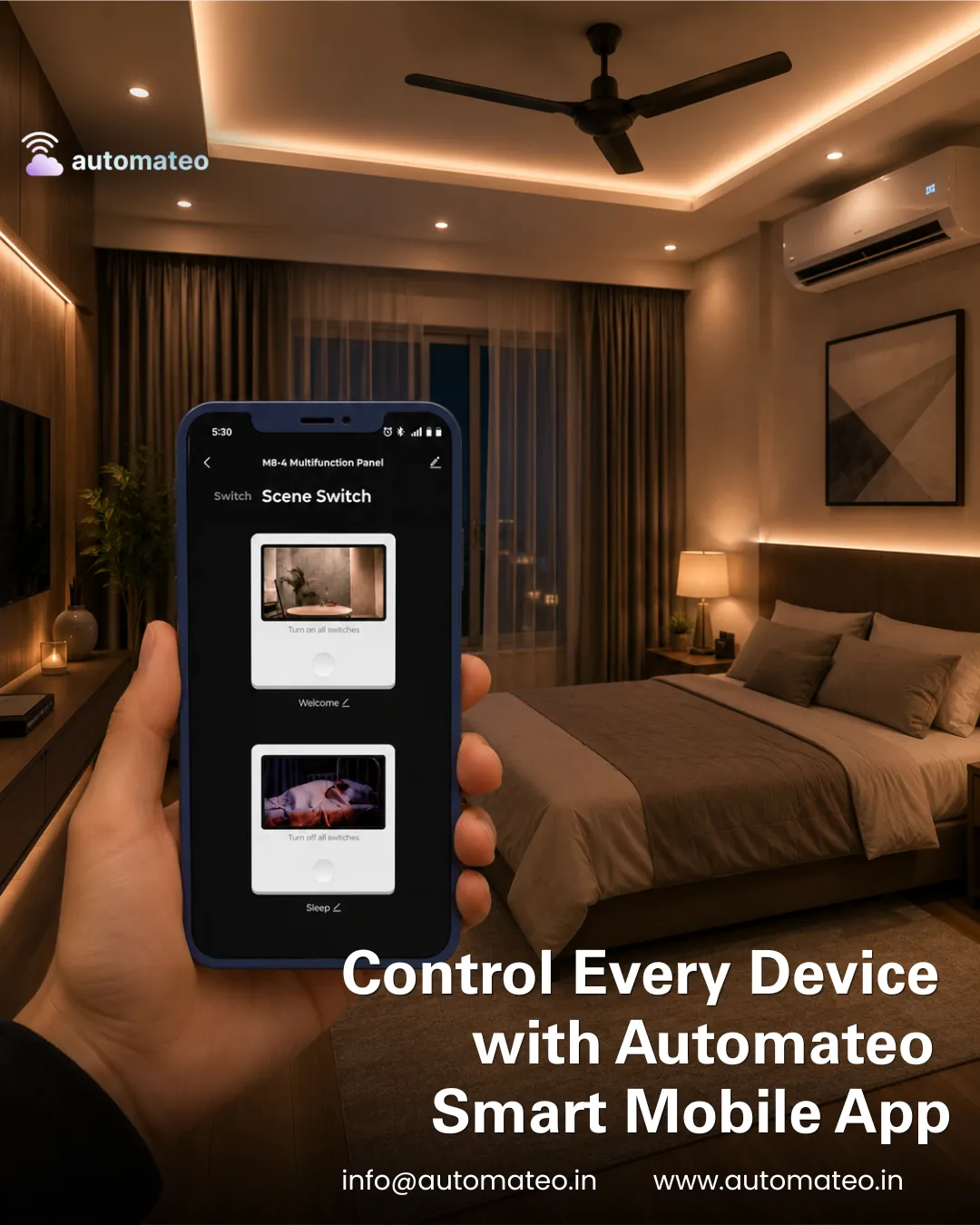

Walk into a newly handed-over flat in Mohali or a renovated kothi in one of Chandigarh's older sectors, and one thing has quietly changed the switchboards. The old rows of plastic toggles are giving way to glass touch panels, and the people behind those walls are running their fans, lights, AC and curtains from a phone in their pocket.
This has been building for a few years, and it has finally reached the point where smart home automation solutions in Chandigarh are not a Sector 5 bungalow thing anymore. They're going into 3BHK flats in Zirakpur, duplexes in Panchkula, and independent houses in Kharar where the owner simply got tired of walking down a corridor at midnight to switch off a light.
At Automateo we work across the Tricity, and the questions people ask us are refreshingly practical. Will it work when the internet drops? Do I have to break walls? Who comes if something stops working two years later? Good questions. Let's go through what we actually install, and what changes in the house once it's in.
Where it starts: lighting and fans
This is the part everyone uses every single day, and it's usually where the whole thing begins.
Your lights and fans move onto a touch panel, the app, or your voice. You can dim them, group them, and set them to run on a schedule. The thing people notice first isn't the fancy stuff though it's being able to switch off a light in a room you are not standing in. Kids leave the study light on, the balcony light burns all night, the store room light gets forgotten for a week. On a normal switchboard you find out when the bill arrives. Here you glance at the panel and it's done.
Fan speed is the same story. No walking to the regulator, no getting up at 3 AM when the temperature drops.
Air conditioning, which in this city matters more than anything
Chandigarh summers do not need an introduction. From late April onwards the AC is the single biggest line on your electricity bill, and it's also the appliance people manage the worst running it at 18°C all night, leaving it on in an empty room, coming home to a bedroom that takes forty minutes to cool.
Automateo systems handle AC through IR or direct integration, depending on the unit. You set temperature and mode from the app or panel, schedule it to shift a couple of degrees warmer after 2 AM, and switch it on from the car so the room is already comfortable when you walk in. The scheduling alone is where most families see their bill actually move.
Curtains, and why people underestimate them
Motorised curtains sound like the most indulgent item on the list until you live with them.
Bedroom curtains that open at 7 AM on their own change how you wake up. Living room curtains that close in the afternoon keep a west-facing room from turning into an oven anyone in Panchkula with big western windows knows exactly what that means. And for a house that's empty during the day, curtains that open and close on a schedule make it look occupied, which is a small security benefit nobody plans for but everybody appreciates.
Security: the part families ask about first
For a lot of our customers this is the actual reason they called.
We install smart door locks, video door phones, cameras and motion sensors, all tied into the same system. The video door phone means you see who rang the bell whether you're in the kitchen or in Sector 17 or in another country. Smart locks mean no more hiding a spare key under a pot for the maid or a relative you give access and take it back from your phone. Motion sensors send you an alert if something moves in the house at 2 PM on a Tuesday when nobody should be home.
The value here isn't gadgetry. It's that you stop wondering. Parents living alone, a house locked up during a Manali trip, a delivery guy at the gate you just look and you know.
Scenes: one button instead of eleven switches
Scene control is the feature people dismiss in the demo and then use constantly.
A "Good Night" button turns off every light downstairs, sets the bedroom AC, closes the curtains and arms the sensors. "Movie" drops the living room lights to twenty percent and shuts the curtains. "Away" kills everything and switches the system to alert mode. "Good Morning" opens the bedroom curtains and turns the geyser on.
None of this is complicated technology. It's just the twelve small actions you were doing manually every day, collapsed into one tap.
App control, and the offline question
The app lets you run the house from anywhere office, in-laws' place, holiday. Forgot whether you switched off the iron? Check. Want the water heater on before you reach home? Done.
But here's the part that matters more, and the thing to ask any provider of smart home automation solutions in Chandigarh what happens when the internet goes down? A well-built system keeps running on local control. Panels still work, switches still work, schedules still run. Only remote access pauses until the connection is back. If a system goes dead the moment your router restarts, it's a badly designed system, and heavy monsoon weeks in the Tricity will expose it fast.
So what actually changes in the house
People expect the tech to be the exciting part. It isn't. What changes is smaller and more everyday than that.
You stop getting up. That's genuinely the first thing families mention you settle into bed, realise the drawing room light is on, and handle it without moving. Multiply that by four or five times a day.
The bills come down, but not by magic. They come down because scheduling and dimming quietly remove the waste you were never going to catch manually. Lights that used to burn all afternoon don't. The AC doesn't run at full tilt in an empty bedroom.
The house gets easier for everyone else too. This one is worth saying plainly: a system only works if your mother, your kids and the house help can all use it. Physical switches must keep working as physical switches. Automation should sit on top of normal life, not replace it and force everyone to learn an app.
Mornings and nights get shorter. The round of the house before sleeping, the scramble of opening curtains and switching things on before work those routines collapse into a button.
And when you eventually sell or rent, a properly automated home is a genuine differentiator in the Tricity market. Buyers walking through two similar flats in Mohali will remember the one with the touch panels.
Retrofit or new construction — both work
The biggest myth we deal with is that automation means breaking walls.
If the house is already built and lived in, retrofit modules go behind your existing switchboards. Wiring stays, switch plates change, and your normal switches keep working normally. Most 2–3 BHK retrofits are finished in a day or two.
If the house is still under construction, that's the better window. A slightly different wiring plan at the electrical stage costs very little extra and opens up curtain motors, cleaner panel placement, and centralised control. We're regularly on sites in Mohali's newer sectors and Aerocity at exactly this stage, and it saves the owner money later.
Do it in stages if you want
Nobody has to automate a whole house on day one, and we often suggest against it.
Start with the master bedroom and the living room. Live with it a month. You'll find out quickly which features you reach for daily and which ones you stopped touching after the first week. Then extend with that knowledge instead of guessing. It spreads the cost, and you don't end up paying to automate a guest room that gets used four times a year.
Why Tricity families work with Automateo
Automateo is built for this region. We know the local builders, the wiring practices, the load patterns, and the difference between servicing a house in Kharar and a flat in Zirakpur. The same team handles consultation, wiring guidance during construction, installation, configuration and support afterwards you're not passed between three companies.
Support is the thing to weigh most carefully. If a panel stops responding eighteen months from now, you want a team that drives over, not an email address in another state. That's the most common complaint we hear from people asking us to replace someone else's installation.
If you're considering smart home automation solutions in Chandigarh for a house you're building or one you already live in, the useful next step isn't a brochure. It's a site visit — someone looking at your switchboards, your load and your rooms, and telling you honestly what's worth doing and what isn't.




















Sign in to leave a comment.