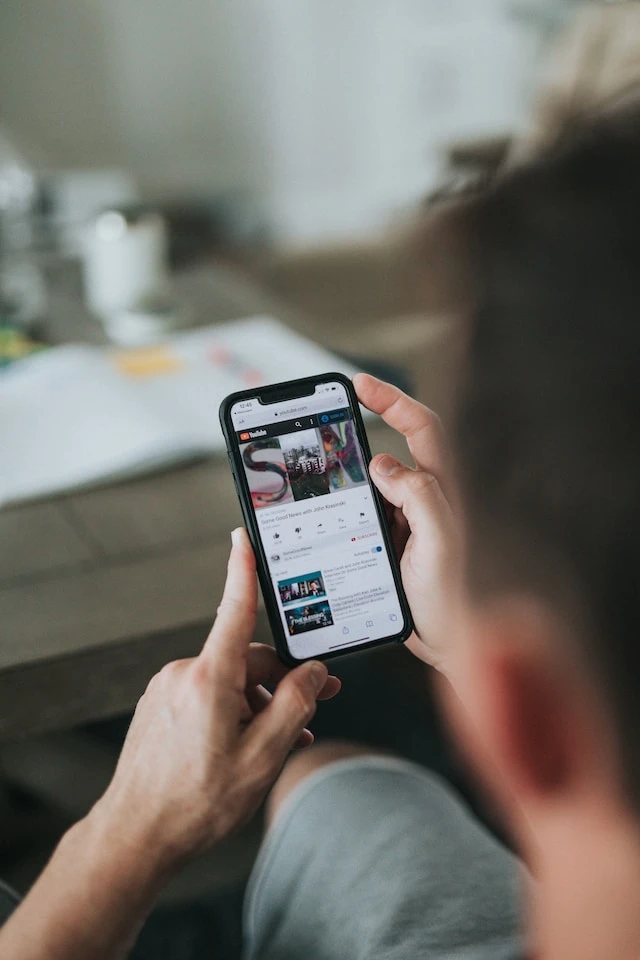

By adopting practices like creating a responsive layout and organizing your design, you can improve the mobile user experience and rank higher in search engines.
As people increasingly use their mobile phones to browse the internet, businesses need to think about creating mobile-friendly websites to reach customers.
A mobile-friendly website is one of the ways to improve your position in search engines. According to a Stat counter report, one reason mobile-friendly websites are so important is that around 60% of internet traffic comes from mobile phone devices.
Being mobile-friendly means that your website will display different versions depending on the devices your visitors are using. Mobile devices have smaller screens than desktop computers, so a mobile-friendly website can be scaled to provide users with a better viewing experience.
With desktop browsing, you not only get a bigger screen, but you also get other programs and features that mobile devices may not have, such as: Adobe Flash and pop-up screens. Mobile-friendly sites have mobile-specific features like direct calling and browsing, and load in a timely manner.
Here are some best practices for making your site mobile-friendly.
DEVELOP A RESPONSIVE LAYOUT
The responsive layout allows you to resize the page to fit the user's device. It can be scaled to different screen sizes, show relevant content and change the appearance as required, For example, switch from a two-column layout on desktop to a one-column layout on mobile. If it's a responsive design, it shouldn't affect the loading time as it adjusts to the screen size. When creating or updating your website, you can choose a mobile-friendly theme.
A responsive website can also improve your search engine optimization as Google ranks mobile-friendly websites higher in search results. Google's algorithms use mobile versions of page views instead of desktop views to rank websites.
Ecommerce website builders like Wix and Squarespace have customizable, mobile-friendly themes. WordPress can also customize a website.
If you already have a website that doesn't render well on mobile, try adding the viewport Meta tag. Adding this tag will resize your website correctly to the screen sizes of different devices.
OPTIMIZE PAGE SPEED
Speed makes a great first impression on your audience. According to a Portent survey, a website that loads in one second has a three times higher conversion rate than a website that loads in five seconds.
To check your website's load time, visit BrowserStack SpeedLab. Enter your website URL and select "Get Free Report". This tool checks your website speed and can show your score for both desktop and mobile browsing. The test must be taken twice: once on mobile devices and once on computers.
One way to increase website speed is to embed videos on a third-party site and then embed them on your site. This way, your site doesn't feel the weight of these videos, which can affect speed.
COMPRESS IMAGES
When adding images to your website, remember to compress your images to reduce file size and speed up downloads. When you compress images, the amount of data that needs to be loaded to display them is reduced, which increases website speed. You can compress images using free tools to reduce file size without quality loss. You should also use appropriate image formats which offer smaller file sizes than JPEGs and PNGs of similar quality. Using these formats can help increase website speed.
Another option is lazy loading, which loads images only when needed. These images float below the page tab - that's what the user can see without scrolling down. When the user scrolls down, the images are loaded.
USE HTML5 INSTEAD OF ADOBE FLASH
Adobe Flash is popular for animation; however, it is not supported by mobile devices. Avoid using Flash on your websites and use HTML5 instead.
HTML5 lets you do a lot online without using browser plug-ins. You can embed videos, music and create animations using HTML5 supported by mobile devices.
AVOID POP-UPS
Pop-ups work fine on desktop versions of websites, but not on mobile devices.
Pop-ups are difficult to see on smaller screens and may not activate at certain times, such as when a user exits the site or accesses the Contact Us section. Also, closing pop-ups on a mobile screen can be tricky as the X in the corner may not be visible.
CHANGE THE SIZE AND POSITION OF THE BUTTON
If a button is too small or in the wrong place on a mobile page, it can be difficult to use. Most mobile users use their thumbs to navigate, so the buttons should be big enough for you to press with your thumb.
Users should also be able to press any button on your site with their thumb while scrolling; the buttons should be at the bottom of the page.
USE A LARGE, LEGIBLE FONT
The recommended font size of at least 14 pixels for desktop computers may not be large enough to be readable on a smaller screen. The best way to check if it's readable is to test it on a mobile device.
Do not try new fonts such as script fonts, on a mobile device, as they may be less legible. Try formatting multiple lines of text in bold and consistent with the font style.
Use black text instead of different colors. This helps users recognize when the background is a different color or when they are experiencing reflections such as glare from the sun when viewing their device outdoors.
ORGANIZING LINKS
Think about the difficulty of clicking a link accurately with your thumb and not with the mouse. Organize the links to make it easier for users to click the links they want.
It is also better to limit the number of links to avoid a sea of blue and limit the number of redirects that take users to another site for a better mobile experience. If you have a link that directs visitors to another site, let them know they are leaving your site, eg: "Click here to visit XYZ's new website."
ORGANIZE YOUR WEB DESIGN
Don't overload your website by adding multiple calls-to-action on a single page. When users are too busy, navigating a smaller screen can be difficult and confusing. Only use essential features that users would actively search for e.g. a contact form.
Keep the design simple so navigation is easy to understand. Use spaces so users can see everything at a glance and organize content. Also, remove any outdated content so it doesn't take up unnecessary space or confuse users.
Avoid long lists of options and functions in menus. While the menu with all the available navigation options looks simple, it takes up a lot of screen space, especially on small screens. Try the hamburger menu instead, a button that opens a longer menu. This saves space and reduces clutter.
TEST YOUR WEBSITE REGULARLY ON MOBILE DEVICES
To ensure that your website is mobile-friendly, there are many ways to test it. First, test websites for usability on mobile devices. Be sure to test on Android and iOS devices.
The page can also be launched with the free Google Mobile Friendly trial. You can test each side.
Remember to test frequently, especially after every website update.


























Sign in to leave a comment.