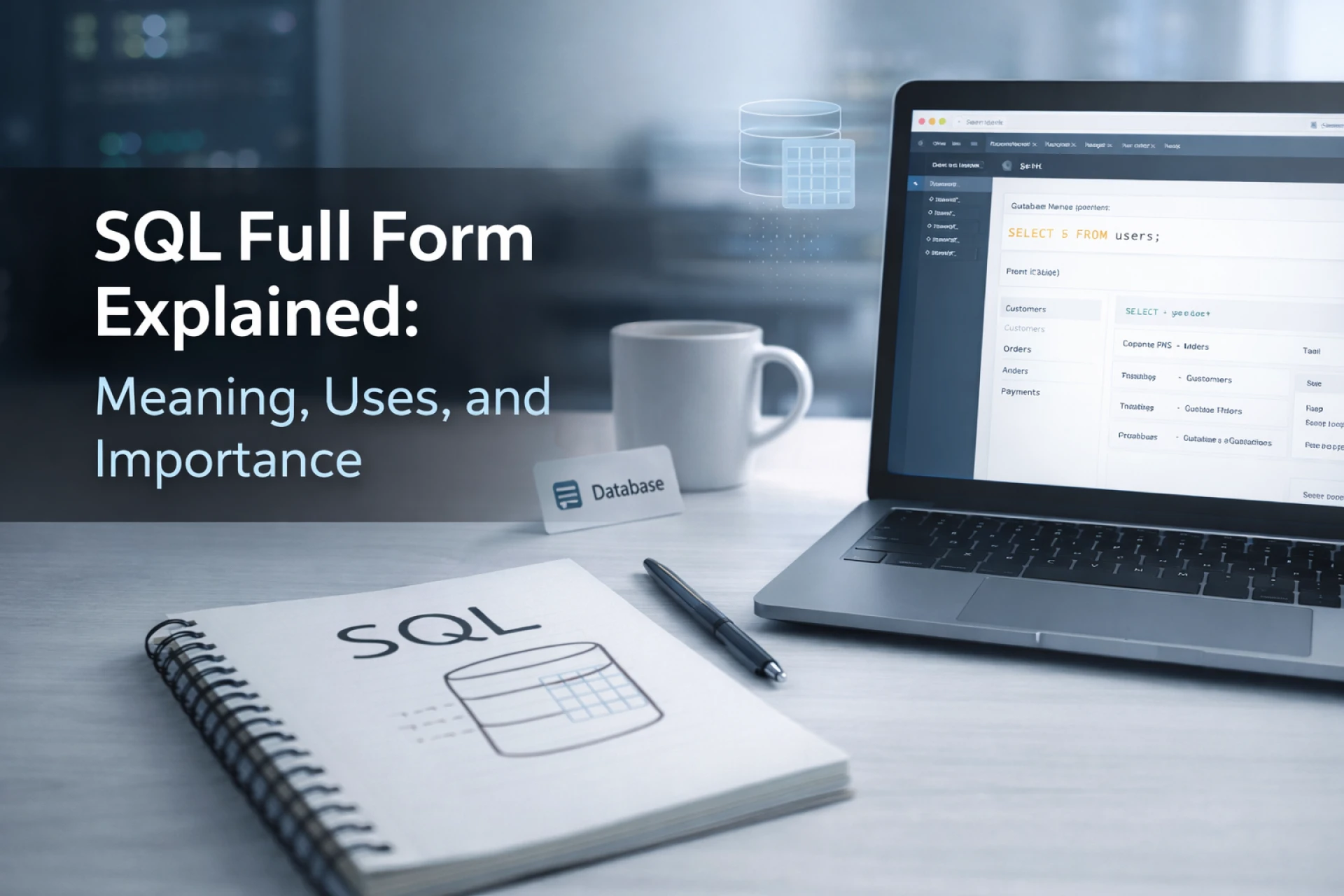

Structured Query Language, or SQL, is the standard language used to work with relational databases. Simply put, SQL allows users to store, retrieve, update as well as manage data efficiently, using straightforward commands that are both powerful and easy to understand. Because of its user-friendly syntax, SQL has become the go-to language for data management across industries from finance to healthcare, e-commerce to government systems.
Unlike traditional programming languages, SQL is declarative, which means it tells the computer what you want done rather than how to do it. This is different from imperative or procedural languages such as Java or COBOL, which require step-by-step instructions. For example, in Java, you have to provide detailed steps for the program to follow to get to the customer you want; whereas in SQL, all you would need to find, sort, or filter data; whereas in SQL, all you need is to simply declare your intent like selecting all customers from a certain city and the database figures out the best way to execute it. This makes SQL faster to write as well as easier to learn, though mastering advanced queries and optimization still requires skill. (You may have seen similar “declare what you want” tools in tech diagnostics too, like chrome.//net-internals, where you view system info instead of writing step-by-step code.)
Since its creation in the 1970s, SQL has become the backbone of relational database systems. It was purpose-built to work with relational databases, and those databases are optimized for SQL. This mutual design makes SQL extremely efficient for managing structured data. Hence, businesses can rely on SQL not just to store data, but also to analyze it, maintain it, and secure it.
SQL is also popular among data analysts, data scientists and software developers and is not only used by database administrators. The reason is that SQL excels at tasks such as data processing, access control, data integration, and big data analytics. In data science, e.g. SQL is used to create and manage large datasets needed for analysis. Machine learning and AI applications also depend on SQL because they require clean, well-structured data to train models. It would be very difficult to work with large datasets effectively without SQL.
Another reason SQL remains so important is that it complies with ACID properties: atomicity, consistency, isolation, and durability. These regulations ensure that transactions are reliable and that sensitive or critical data is protected. Because of this, SQL is often used in banking, healthcare, and e-commerce systems, where data accuracy and integrity are absolutely essential. Businesses are therefore able to make informed decisions because they are certain that their data-driven decision-making is sound.
Advantages of Using SQL
SQL has stood the test of time because it offers a range of advantages that few other languages can match.
- Easy Data Manipulation: SQL commands like SELECT, INSERT, UPDATE, DELETE, GROUP BY, and ORDER BY make it simple for users, no matter what experience level, to manage and query databases. Although advanced analytics can involve complicated queries, they can still handle powerful operations even when the user is not a great programmer.
- Rapid Query Processing: SQL databases often use indexing and query optimization techniques. This improves the speed of data retrieval and this is very essential in applications that require real time responses or where there is a lot of data.
- Robust Data Security: SQL supports user authentication, role-based access, permissions, and encryption. This makes sure that confidential information remains secure, which is essential for businesses with private customer information or regulated data.
- Commonality and Compatibility: SQL follows ANSI and ISO standards, which imply that skills and queries are largely transferable across different systems, including cloud databases and big data platforms. Therefore, when one learns SQL it opens doors to multiple tools and environments.
- Scalability: SQL can manage both small databases for a startup as well as massive enterprise-level datasets. The design enables organizations to expand their data systems without significant performance concerns, although optimization becomes more important as datasets scale.
- Open Source Support: Many SQL databases are open source, such as MySQL and PostgreSQL. These communities continuously contribute to improvements, troubleshooting, and innovations and thus make SQL relevant decades after its creation.
How SQL Queries Work
Relational databases organize information in tables with rows and columns, and relationships between tables are established using keys. For example, a retail database can consist of multiple tables, such as for customers, orders, products, and payments. Each of these tables is linked through keys such as a unique customer ID.
SQL allows users to write queries to manipulate this data. Once a query is executed, it passes through several stages inside the database system:
- Parsing: First, the database checks your SQL statement for correctness. The parser analyzes the syntax which makes sure you are authorized to run the command, and converts your query into a format the database engine can understand.
- Query Optimization: The relational engine or query optimizer evaluates many different ways to run your query; then selects the fastest and most efficient plan, converting it into bytecode for the database to execute. This allows for optimal use of both memory and processing power which is critical for executing Large Datasets.
- Execution and Storage: Finally, the storage engine executes the query and handles the physical data storage. It retrieves, modifies, or inserts data as needed to make sure relationships between tables are respected. This includes enforcing one-to-many or many-to-many connections, primary and foreign keys as well as data integrity rules. The results are then returned to the user or application.
SQL in Today’s World
The relevance of SQL in the modern era cannot be overstated. Cloud computing, AI, machine learning as well as big data all depend on robust data management. SQL integrates seamlessly with languages like Python and Java, allowing it to power analytics pipelines, dashboards, and AI workflows. Therefore, Enterprises can use SQL not only for storage but also as a foundation for insights and automation, ensuring that decisions are made quickly, accurately, and supported by high-quality data.
Although new tools and languages emerge every year, SQL remains a cornerstone of data management because it combines simplicity, power, and reliability. It doesn't matter whether you are a beginner learning to query data, a data analyst running reports, or a data scientist feeding machine learning models, SQL provides the tools needed to handle, secure as well as analyze data efficiently.
In conclusion, SQL is not just any ordinary programming language; it is a specialized, declarative language built for relational databases, which makes it incredibly efficient, versatile, and essential. Once you understand how to use SQL, you will be able to manipulate large datasets, integrate with modern AI systems, ensure secure and reliable transactions, and make informed decisions all while leveraging a language that has stood the test of time.




























Sign in to leave a comment.