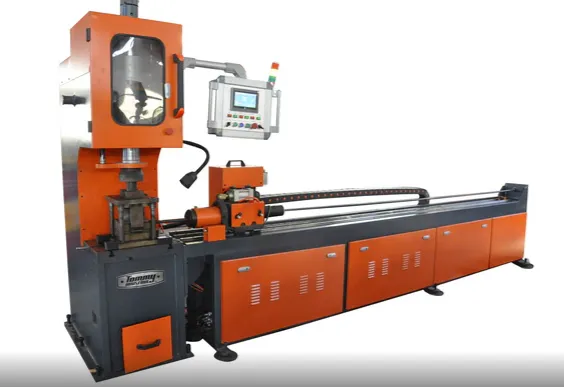

Buying new fabrication equipment is never a casual decision - especially when stainless steel is involved.
Stainless steel is strong, corrosion-resistant, and widely used across industries like automotive, furniture, construction, fitness equipment, and industrial frameworks. But anyone who works with it knows one thing: it’s tough. And that toughness demands the right machine.
If you’re exploring stainless steel tube punching machines for your workshop or manufacturing unit, you need more than just a brochure comparison. You need clarity on what truly matters.
Here’s a practical, easy-to-understand guide to help you compare the right features before making your investment.
1. Machine Frame and Structural Strength
The first thing to evaluate is the machine’s build quality.
Punching stainless steel requires significant force. If the frame is weak or poorly engineered, vibration becomes a problem. Vibration leads to inaccurate holes, increased tool wear, and inconsistent results.
High-quality stainless steel tube punching machines are designed with rigid, reinforced frames that absorb pressure and maintain alignment. A strong structure ensures:
- Better punching accuracy
- Reduced maintenance
- Longer machine life
- Consistent performance under heavy loads
Don’t underestimate this factor. A solid body is the foundation of reliable output.
2. Punching Capacity and Material Compatibility
Not all machines are built for the same thickness or tube diameter range.
Before choosing among stainless steel tube punching machines, define your production needs clearly:
- Maximum tube thickness
- Tube diameter range
- Type of holes required
- Production volume
If a machine lacks sufficient tonnage, you may experience incomplete shearing, rough edges, or burr formation. A machine with appropriate punching capacity ensures clean, smooth holes even in thicker stainless steel sections.
Always match the machine’s strength to your most demanding job - not just your current average workload.
3. Precision and Control System
Precision is what separates professional fabrication from average output.
Look for stainless steel tube punching machines equipped with advanced control systems such as CNC or servo-based mechanisms. These systems offer:
- Accurate hole positioning
- High repeatability
- Reduced operator dependency
- Programmable job settings
When working on bulk production, repeatability becomes critical. The machine should be able to produce identical holes across hundreds or thousands of pieces without deviation.
Precision reduces rework. Reduced rework improves profitability.
4. Tooling Quality and Compatibility
Even the most powerful machine depends on its tooling.
When comparing stainless steel punches, check:
- Type of punch and die system used
- Ease of tool change
- Tool alignment accuracy
- Availability of customized dies
Stainless steel puts heavy stress on tooling. Proper die clearance and hardened tools extend life and maintain hole quality.
Machines that allow quick and easy tool changes reduce downtime and improve workflow efficiency.
A well-designed tooling system protects both quality and productivity.
5. Automation Features
In modern fabrication, automation is no longer optional - it’s a competitive advantage.
Many advanced stainless steel tube punching machines now offer features such as:
- Automatic tube feeding
- Programmable hole patterns
- Multi-station punching
- Integrated punching and cutting functions
Automation increases speed while maintaining consistency. It reduces manual errors and improves safety in the workshop.
If you’re aiming for higher production capacity or scaling your business, automation should be a serious consideration.
6. Production Speed and Cycle Efficiency
Speed matters - but stability matters more.
When comparing machines, look at:
- Punching cycle time
- Setup time
- Changeover flexibility
- Continuous operation capability
A machine that performs smoothly during extended operation is more valuable than one that simply advertises high speed.
The best stainless steel tube punching machines balance efficiency with precision, ensuring you get both productivity and quality without compromise.
7. Ease of Maintenance
Maintenance directly affects long-term costs.
Before making a purchase, ask:
- How accessible are the components?
- Are spare parts readily available?
- Is technical support responsive?
- What is the warranty coverage?
Stainless steel applications can accelerate wear and tear if machines are not engineered properly. A machine designed for easy maintenance reduces downtime and prevents unexpected disruptions.
Choosing equipment that is simple to service saves money over time.
8. Safety Features
Fabrication environments demand strict safety standards.
Look for stainless steel tube punching machines that include:
- Emergency stop systems
- Protective guarding
- Overload protection
- Clear control interfaces
A safe machine protects operators and reduces the risk of workplace accidents. It also improves operator confidence and overall efficiency.
Safety should never be an afterthought.
9. Customization and Flexibility
Every production line is different.
You may need custom hole patterns, different tube shapes, or integration with other equipment. Flexible stainless steel tube punching machines that allow configuration adjustments can adapt as your production needs evolve.
Scalable machines help future-proof your investment.
Instead of buying again in a few years, you expand your capabilities within the same system.
10. Long-Term Value Over Initial Cost
It’s tempting to focus only on price. But the real question is: what is the total cost of ownership?
A lower-priced machine may result in:
- Higher maintenance expenses
- Increased scrap rates
- More frequent downtime
- Faster tooling replacement
High-quality stainless steel tube punching machines may require a slightly higher initial investment, but they deliver consistent performance, lower operational stress, and better long-term returns.
In manufacturing, reliability always wins over short-term savings.
Final Thoughts
Choosing the right stainless steel tube punching machine is about making a smart, informed decision - not just comparing price tags.
Focus on structural strength, punching capacity, precision systems, tooling compatibility, automation features, and long-term durability. When these elements align with your production needs, you gain more than a machine - you gain operational confidence.
Stainless steel fabrication demands accuracy and stability. The right stainless steel tube punching machines provide both, helping your business maintain high standards, improve efficiency, and compete confidently in the market.
Take your time. Compare carefully. Invest wisely.
Because the right decision today shapes the performance of your production line tomorrow.

























Sign in to leave a comment.